CET-DELHI-POLYTECHNIC SERIES Physics
Motion In A Straight Line
3 previous year questions.
Volume: 3 Ques
Yield: Medium
High-Yield Trend
3
2018 Chapter Questions 3 MCQs
01
PYQ 2018
medium
physics ID: cet-delh
A particle is moving on a circular path of radius r. Its displacement after one revolution :
1
2
3
4
Official Solution
Correct Option: (3)
Concept: It's important to differentiate between distance and displacement.
Distance is the total length of the path traveled by an object. It is a scalar quantity.
Displacement is the shortest straight-line distance between the initial and final positions of an object. It is a vector quantity (meaning it has both magnitude and direction). Step 1: Visualize the motion A particle is moving on a circular path of radius . It completes one revolution. This means the particle starts at a certain point on the circle and, after moving along the circumference, returns to the exact same starting point. Step 2: Determine the initial and final positions Let the starting point of the particle on the circular path be point A. After one complete revolution, the particle comes back to point A. So, Initial Position = Point A Final Position = Point A Step 3: Calculate the displacement Displacement is defined as the change in position, or the shortest straight-line distance between the initial and final positions. Since the initial position and the final position are the same (Point A), the straight-line distance between them is zero. Displacement = Final Position - Initial Position If both are the same point, the vector difference is the zero vector, and its magnitude is 0. Therefore, the displacement of the particle after one complete revolution is 0 (zero). Step 4: Consider the distance traveled (for clarity, though not asked) The distance traveled in one revolution is the circumference of the circular path. Circumference of a circle with radius is given by . So, the distance traveled would be . This corresponds to option (1), but the question asks for displacement. Option (2) is half the circumference (distance for half a revolution). Option (4) is the diameter (displacement if the particle moved from one end of a diameter to the other, i.e., half a revolution). The question specifically asks for {displacement}.
Distance is the total length of the path traveled by an object. It is a scalar quantity.
Displacement is the shortest straight-line distance between the initial and final positions of an object. It is a vector quantity (meaning it has both magnitude and direction). Step 1: Visualize the motion A particle is moving on a circular path of radius . It completes one revolution. This means the particle starts at a certain point on the circle and, after moving along the circumference, returns to the exact same starting point. Step 2: Determine the initial and final positions Let the starting point of the particle on the circular path be point A. After one complete revolution, the particle comes back to point A. So, Initial Position = Point A Final Position = Point A Step 3: Calculate the displacement Displacement is defined as the change in position, or the shortest straight-line distance between the initial and final positions. Since the initial position and the final position are the same (Point A), the straight-line distance between them is zero. Displacement = Final Position - Initial Position If both are the same point, the vector difference is the zero vector, and its magnitude is 0. Therefore, the displacement of the particle after one complete revolution is 0 (zero). Step 4: Consider the distance traveled (for clarity, though not asked) The distance traveled in one revolution is the circumference of the circular path. Circumference of a circle with radius is given by . So, the distance traveled would be . This corresponds to option (1), but the question asks for displacement. Option (2) is half the circumference (distance for half a revolution). Option (4) is the diameter (displacement if the particle moved from one end of a diameter to the other, i.e., half a revolution). The question specifically asks for {displacement}.
02
PYQ 2018
medium
physics ID: cet-delh
In velocity time graph, area under v-t graph represents :
1
Displacement
2
Velocity
3
Acceleration
4
Time
Official Solution
Correct Option: (1)
Concept: A velocity-time (v-t) graph plots the velocity of an object against time. The physical quantities displacement and acceleration can be determined from this graph. Step 1: Understanding the relationship between velocity, time, and displacement
Velocity is defined as the rate of change of displacement, , where is the change in displacement and is the time interval.
For constant velocity, displacement .
If velocity is not constant, we consider a small time interval during which the velocity can be considered approximately constant. The small displacement during this interval is .
To find the total displacement over a period from time to , we integrate this expression: .
Mathematically, the definite integral represents the area under the curve of plotted against , from to . Step 2: Interpreting the area under the v-t graph
Consider a simple case where an object moves with a constant velocity for a time .
On the v-t graph, this would be a horizontal line at height . The area under this line from to would be a rectangle with height and width .
Area = height × width = .
Since displacement for constant velocity is also , the area under the v-t graph is equal to the displacement.
This principle extends to any shape under the v-t graph; the area always represents the displacement. Step 3: Distinguishing from slope
The slope of a velocity-time graph represents acceleration. Slope is calculated as the change in velocity divided by the change in time ( ), which is the definition of acceleration.
Option (3) Acceleration is incorrect as it is represented by the slope, not the area. Therefore, the area under a velocity-time graph represents displacement.
03
PYQ 2018
medium
physics ID: cet-delh
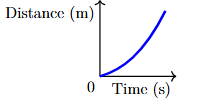
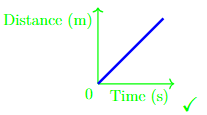
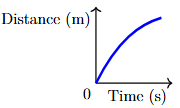
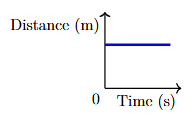
Which of the following distance-time graphs represents an object in uniform motion?
1

2

3

4

Official Solution
Correct Option: (2)
Concept: Uniform motion means an object travels with a constant velocity. This implies that the object covers equal distances in equal intervals of time. For a distance-time graph:
The slope of the graph represents the velocity of the object.
For uniform motion (constant velocity), the slope must be constant.
A graph with a constant slope is a straight line. Analyzing the Graphs:
Graph (1): This graph shows a curve where the distance covered in successive time intervals is increasing. The slope of the curve is increasing with time. This represents non-uniform motion, specifically accelerated motion (velocity is increasing).
Graph (2): This graph is a straight line passing through the origin with a constant positive slope. A constant slope means constant velocity. This represents uniform motion where the object starts from the origin (distance=0 at time=0) and moves away at a steady speed.
Graph (3): This graph shows a curve where the distance covered in successive time intervals is decreasing (though the total distance is still increasing). The slope of the curve is decreasing with time. This represents non-uniform motion, specifically decelerated motion (velocity is decreasing but still positive, or the rate of increase of distance is slowing down).
Graph (4): This graph is a horizontal straight line. This means that the distance of the object remains constant as time passes. A constant distance implies that the object is not moving; its velocity is zero. An object at rest is technically in uniform motion (zero acceleration), but typically "uniform motion" in such questions implies a constant non-zero velocity. If this were a velocity-time graph, a horizontal line would indicate constant velocity. Conclusion: Graph (2) correctly depicts uniform motion because it is a straight line, indicating a constant rate of change of distance with respect to time (constant velocity). Therefore, the graph representing uniform motion is (2).
The slope of the graph represents the velocity of the object.
For uniform motion (constant velocity), the slope must be constant.
A graph with a constant slope is a straight line. Analyzing the Graphs:
Graph (1): This graph shows a curve where the distance covered in successive time intervals is increasing. The slope of the curve is increasing with time. This represents non-uniform motion, specifically accelerated motion (velocity is increasing).
Graph (2): This graph is a straight line passing through the origin with a constant positive slope. A constant slope means constant velocity. This represents uniform motion where the object starts from the origin (distance=0 at time=0) and moves away at a steady speed.
Graph (3): This graph shows a curve where the distance covered in successive time intervals is decreasing (though the total distance is still increasing). The slope of the curve is decreasing with time. This represents non-uniform motion, specifically decelerated motion (velocity is decreasing but still positive, or the rate of increase of distance is slowing down).
Graph (4): This graph is a horizontal straight line. This means that the distance of the object remains constant as time passes. A constant distance implies that the object is not moving; its velocity is zero. An object at rest is technically in uniform motion (zero acceleration), but typically "uniform motion" in such questions implies a constant non-zero velocity. If this were a velocity-time graph, a horizontal line would indicate constant velocity. Conclusion: Graph (2) correctly depicts uniform motion because it is a straight line, indicating a constant rate of change of distance with respect to time (constant velocity). Therefore, the graph representing uniform motion is (2).