Consider the following statements (A) For the two shafts connected in parallel, the angle of twist of each shaft is same. (B) For the two shafts connected in series, the shear stress in each shaft is same. (C) The shear stress in a circular shaft under torsion varies linearly. (D) The shear stress at the centre of a circular shaft under torsion is zero. Choose the correct answer from the options given below:
1
(A), (B) and (D) only.
2
(A), (C) and (D) only
3
(A), (B), (C) and (D).
4
(B), (C) and (D) only.
Official Solution
Correct Option:
(2)
Statement A is true because when shafts are connected in parallel the angle of twist is the same for both shafts. Statement B is false because in shafts connected in series the shear stress varies due to the varying lengths and resistances of the shafts. Statement C is true as the shear stress in a circular shaft under torsion increases linearly with the radius from the center to the surface. Statement D is true because the shear stress is zero at the center of a shaft under torsion increasing with radius from the center to the outer surface
02
PYQ 2024
medium
mechanical-engineeringID: cuet-pg-
Consider the following statements about shear stresses in beams A The shear stress at neutral axis of a rectangular section is the maximum stress B The shear stress variation across a rectangular section is parabolic C The shear deformations are small as compared to bending deformation D The shear centre is also known as centre of moment
1
A, B and C only
2
B and C only
3
A, B, C and D
4
A, C and D only
Official Solution
Correct Option:
(3)
- Statement (A) is true because the maximum shear stress in a rectangular section occurs at the neutral axis. - Statement (B) is true because shear stress varies parabolically across the section of a beam. - Statement (C) is correct as shear deformations are typically much smaller than bending deformations in beams. - Statement (D) is also true because the shear centre is the point where the applied shear force does not cause any twisting, and it is also called the centre of moment.
03
PYQ 2024
medium
mechanical-engineeringID: cuet-pg-
The coefficient of restitution of a perfectly plastic impact is equal to:
1
Infinity
2
2
3
1
4
0
Official Solution
Correct Option:
(4)
In a perfectly plastic impact the objects involved in the collision do not rebound and the velocity of separation is zero. The coefficient of restitution is defined as the ratio of relative velocity after collision to relative velocity before collision. Since there is no rebound the coefficient of restitution equals zero
04
PYQ 2024
medium
mechanical-engineeringID: cuet-pg-
A specimen is subjected to a stress which follows sinusoidal variation with respect to the time from minimum zero value to a maximum value :
Mean value of Stress = 0
Amplitude of Stress =
Nature of Stress = Repeated Stress
Nature of Stress = Fluctuating Stress
Choose the correct answer from the options given below:
1
A, B and D only
2
A,B and C only
3
B and C only
4
B and D only
Official Solution
Correct Option:
(1)
Given that the stress follows a sinusoidal variation from zero to a maximum value of , we can conclude the following:
The mean value of the stress is , as the average of a sinusoidal wave is zero.
The amplitude of the stress is , which is half the maximum value of the sinusoidal variation.
The nature of the stress is fluctuating stress, as it varies periodically with time between the minimum and maximum values.
05
PYQ 2024
medium
mechanical-engineeringID: cuet-pg-
A shaft is subjected to Bending Moment ( ) and Torsional Moment ( ), the equivalent torsional moment in the shaft is:
1
2
3
4
Official Solution
Correct Option:
(1)
When a shaft is subjected to both bending moment ( ) and torsional moment ( ), the equivalent torsional moment is given by the formula:
This formula combines the effects of bending and torsional moments to represent the overall stress on the shaft.
06
PYQ 2024
medium
mechanical-engineeringID: cuet-pg-
In a plane stress system, two principal stresses are 785 N/mm² and 115 N/mm². If the system just causes yielding, what is the uni-axial yield stress of the material according to the Von Mises criterion:
1
887 N/mm²
2
734 N/mm²
3
635 N/mm²
4
903 N/mm²
Official Solution
Correct Option:
(2)
According to the Von Mises yield criterion, the equivalent stress σv is given by:
Substitute and :
Thus, the uni-axial yield stress is 734 N/mm².
07
PYQ 2025
medium
mechanical-engineeringID: cuet-pg-
The strain energy stored in a body due to a suddenly applied load compared to when it is applied gradually is
1
Two times
2
Three times
3
Four times
4
No Change
Official Solution
Correct Option:
(3)
Step 1: Understand the concept of strain energy.
Strain energy is the energy stored in a material due to deformation. If the load is applied suddenly, the strain energy stored is higher than when the load is applied gradually because the gradual loading allows the material to undergo deformation more slowly. Step 2: Derivation.
For a sudden load, the strain energy is four times the energy stored when the load is applied gradually, as the gradual loading follows a more stable path. Final Answer:
08
PYQ 2025
medium
mechanical-engineeringID: cuet-pg-
The following conditions must be satisfied for a perfect truss (m = number of members, j = number of joints):
1
2
3
4
Official Solution
Correct Option:
(1)
Step 1: Understand the condition for a perfect truss.
For a truss to be perfectly stable, the relationship between the number of members and the number of joints must satisfy the equation: Rearranging this equation, we get: Step 2: Conclusion.
This condition ensures that the truss is statically determinate, meaning that the system has just enough members and joints for stability, with no redundancies. Final Answer:
09
PYQ 2025
medium
mechanical-engineeringID: cuet-pg-
A principal plane is a plane of
1
minimum tensile stress
2
maximum tensile stress
3
zero shear stress
4
maximum shear stress
Official Solution
Correct Option:
(3)
Step 1: Define the principal planes.
In the theory of stress, principal planes are those planes where the shear stress is zero. These planes correspond to the principal stresses, which are the maximum and minimum normal stresses at a given point. Step 2: Conclusion.
Principal planes are the planes where the shear stress is zero and the normal stresses are at their extreme values. Final Answer:
10
PYQ 2025
medium
mechanical-engineeringID: cuet-pg-
At a point on the beam where shear force changes signs, the bending moment at that point is
1
zero
2
decreasing
3
maximum
4
increasing
Official Solution
Correct Option:
(1)
Step 1: Understand the relationship between shear force and bending moment.
At any point on a beam, the shear force is the derivative of the bending moment. When the shear force changes signs, the slope of the bending moment curve is zero, indicating that the bending moment at that point is zero as well. Step 2: Conclusion.
At the point where the shear force changes signs, the bending moment reaches zero. Final Answer:
11
PYQ 2025
medium
mechanical-engineeringID: cuet-pg-
The polar section modulus for a circular shaft of diameter "d" is:
1
2
3
4
Official Solution
Correct Option:
(1)
Step 1: Formula for polar section modulus.
The polar section modulus for a circular shaft is given by:
This formula is derived from the geometry of the circular shaft and is used in the calculation of torsional stress. Step 2: Conclusion.
The polar section modulus for a circular shaft of diameter is . Final Answer:
12
PYQ 2025
medium
mechanical-engineeringID: cuet-pg-
All the failure theories give nearly the same results when
1
(A) and (B) only
2
(B) only
3
(C) only
4
(A) only
Official Solution
Correct Option:
(1)
Step 1: Understand the conditions for failure theories.
The different failure theories (like Maximum Normal Stress, Maximum Shear Stress, etc.) give nearly the same results under certain conditions. Specifically, when one of the principal stresses is much larger than the others or when shear stresses are dominant. Step 2: Conclusion.
Failure theories are similar when principal stresses are unequal, particularly when one of them is much larger than the others, and when shear stresses are present. Final Answer:
13
PYQ 2025
medium
mechanical-engineeringID: cuet-pg-
According to maximum shear stress failure theory, yielding in material occurs when:
1
Maximum shear stress =
2
Maximum shear stress =
3
Maximum shear stress =
4
Maximum shear stress =
Official Solution
Correct Option:
(1)
Step 1: Understand the maximum shear stress failure theory.
According to the maximum shear stress failure theory (also known as Tresca's theory), yielding occurs when the maximum shear stress reaches a critical value. The maximum shear stress is calculated as: Where and are the maximum and minimum principal stresses, respectively. Step 2: Apply the theory to yield stress.
According to Tresca's theory, yielding will occur when: Therefore, the correct answer is: Maximum shear stress = . Final Answer:
14
PYQ 2025
medium
mechanical-engineeringID: cuet-pg-
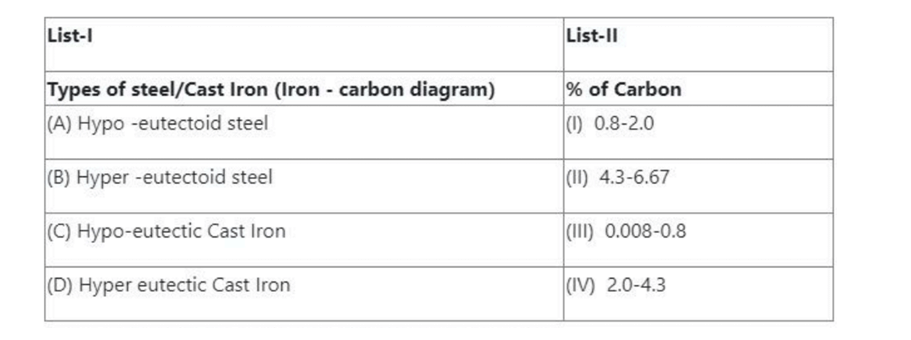
Match List-I with List-II Choose the correct answer from the options given below:
1
(A) (I), (B) (II), (C) (III), (D) (IV)
2
(A) (III), (B) (I), (C) (IV), (D) (II)
3
(A) (I), (B) (II), (C) (IV), (D) (III)
4
(A) (III), (B) (IV), (C) (I), (D) (II)
Official Solution
Correct Option:
(3)
Step 1: Understand the carbon content for various steels and cast iron. - Hypo-eutectoid steel has less than 0.8\% carbon (option I),
- Hyper-eutectoid steel has more than 0.8\% carbon but less than 2\% (option II),
- Hypo-eutectic cast iron has less than 2.0\% carbon (option III),
- Hyper-eutectic cast iron has more than 2.0\% carbon (option IV). Step 2: Conclusion
The correct matching is:
- (A) Hypo-eutectoid steel → (I),
- (B) Hyper-eutectoid steel → (II),
- (C) Hypo-eutectic Cast Iron → (IV),
- (D) Hyper-eutectic Cast Iron → (III). Final Answer:
15
PYQ 2025
medium
mechanical-engineeringID: cuet-pg-
If a helical spring is halved in length, its spring stiffness remains:
1
same
2
halves
3
doubles
4
Triples
Official Solution
Correct Option:
(3)
Step 1: Understand the spring stiffness equation.
The spring stiffness of a helical spring is given by: Where:
- is the shear modulus,
- is the wire diameter,
- is the number of active coils,
- is the mean coil diameter. Step 2: Halving the length of the spring When the spring is halved in length, the number of active coils is halved, and since the stiffness is inversely proportional to the number of coils, the stiffness doubles. Step 3: Conclusion Therefore, the spring stiffness doubles when the length of the helical spring is halved. Final Answer:
16
PYQ 2025
medium
mechanical-engineeringID: cuet-pg-
The power required for turning a mild steel rod is found to be 0.1 kW/cm³/min. The maximum power available at the machine spindle is 4 kW. Assuming a cutting speed of 38 m/min and feed rate of 0.32 mm/rev, the maximum metal removal rate and depth of cut are respectively:
1
48 cm³/min and 3.29 mm
2
40 cm³/min and 3.29 mm
3
40 cm³/min and 4.29 mm
4
48 cm³/min and 4.29 mm
Official Solution
Correct Option:
(1)
Step 1: Formula for metal removal rate.
The metal removal rate is given by: Where:
- Cutting speed ,
- Feed rate . The power required for turning is given by: Step 2: Relate power and MRR. Given that the power per unit volume is 0.1 kW/cm³/min, and the maximum power available at the machine spindle is 4 kW, we can calculate the maximum and then solve for the depth of cut. Step 3: Calculate the depth of cut. Now, substitute the values for , cutting speed, and feed rate into the metal removal rate formula: Final Answer:
17
PYQ 2026
medium
mechanical-engineeringID: cuet-pg-
Which mechanical drive is specifically used to impart a reciprocating or oscillatory motion to another body in contact?
1
Gear Drive
2
Belt Drive
3
Cam and Follower
4
Chain Drive
Official Solution
Correct Option:
(3)
Concept:
Different mechanical drives are used to transmit motion and power. Some are specifically designed to convert rotary motion into reciprocating or oscillatory motion. Step 1: Understanding the requirement.
The question asks for a mechanism that imparts reciprocating or oscillatory motion to another body in contact. Step 2: Identifying the correct mechanism.
A Cam and Follower mechanism converts rotary motion of the cam into reciprocating or oscillatory motion of the follower. The follower remains in contact with the cam surface. Step 3: Eliminating incorrect options.
Gear Drive transmits rotary motion between shafts.
Belt Drive transmits motion using belts and pulleys.
Chain Drive transmits rotary motion using chains and sprockets.
Conclusion:
Thus, the correct answer is Cam and Follower.
18
PYQ 2026
medium
mechanical-engineeringID: cuet-pg-
What is the stress developed when a steel rod of radius is stretched by a force?
1
2
3
4
Official Solution
Correct Option:
(2)
Concept:
Stress is defined as force per unit area:
Step 1: Convert given values into SI units.
Force:
Radius:
Step 2: Calculate cross-sectional area.
Step 3: Compute stress.
Conclusion:
Thus, the stress developed is .
19
PYQ 2026
medium
mechanical-engineeringID: cuet-pg-
A ball is thrown vertically upward with a velocity of ; if it takes 10 sec for the upward journey, how long does the downward journey take?
1
2
3
4
Official Solution
Correct Option:
(2)
Concept:
In vertical motion under gravity (neglecting air resistance), the time taken to go up is equal to the time taken to come down to the same level. Step 1: Understanding the motion.
The ball is projected upward and returns back under the influence of gravity. The motion is symmetric. Step 2: Using symmetry of motion.
Time of ascent = Time of descent (for same height). Step 3: Apply given data.
Upward journey time = Conclusion:
Thus, the downward journey also takes .
20
PYQ 2026
medium
mechanical-engineeringID: cuet-pg-
What is the natural frequency of a free vibration system defined by the equation ?
1
2
3
4
Official Solution
Correct Option:
(2)
Concept:
The standard equation of free vibration is:
where is the प्राकृतिक angular frequency (rad/s), and:
Step 1: Compare with standard equation.
Given:
So,
Step 2: Calculate natural frequency.
Step 3: Correcting interpretation.
The angular frequency rad/s corresponds to:
Conclusion:
Thus, the natural frequency is .
21
PYQ 2026
medium
mechanical-engineeringID: cuet-pg-
The polar section modulus for a circular shaft of diameter is given by which formula?
1
2
3
4
Official Solution
Correct Option:
(1)
Concept:
Polar section modulus is used in torsion problems to determine the strength of a shaft. It is defined as:
where is the polar moment of inertia and is the outer radius. Step 1: Write the polar moment of inertia.
For a solid circular shaft:
Step 2: Substitute radius .
Step 3: Simplify the expression.
Conclusion:
Thus, the correct formula is .
About Mechanics Of Materials - CUET-PG
Mechanics Of Materials is a vital chapter for CUET-PG aspirants. Mastering the concepts covered in this chapter is essential for securing a top rank.
By rigorously practicing the previous year questions associated with this chapter, you can identify high-yield topics, understand the examiner's perspective, and boost your confidence during the actual exam.
Frequently Asked Questions
Why focus on Mechanics Of Materials PYQs?
Analyzing PYQs for this specific chapter reveals the most frequently tested concepts and the typical complexity of questions, allowing you to tailor your study plan efficiently.
How to best use this analysis?
Review the topic breakdown to see which sub-topics within Mechanics Of Materials carry the most weight. Then, tackle the questions iteratively to solidify your understanding.