A rectangular park is 45 m long and 30 m wide. A 25 m wide path is constructed all along outside the park. The area of the path is :
1
1750 m2
2
1250 m2
3
400 m2
4
500 m2
Official Solution
Correct Option:
(3)
The correct option is (C) :400 m2.
02
PYQ 2023
medium
quantitative-aptitudeID: cuet-ug-
Find the perimeter of a rhombus whose one diagonal is 16 cm long and area is 240 cm .
1
2
3
4
Official Solution
Correct Option:
(1)
Let the diagonals of the rhombus be and .
Given, one diagonal cm and the area of the rhombus cm .
The area of a rhombus is given by the formula:
$ . Half the lengths of the diagonals are cm and cm.
By the Pythagorean theorem, the side of the rhombus can be found using the right-angled triangle formed by half of each diagonal:
\) .
\) $
Therefore, the perimeter of the rhombus is 68 cm.
03
PYQ 2025
medium
quantitative-aptitudeID: cuet-ug-
If a solid sphere of radius 20 cm is moulded into 8 solid spherical balls of equal radius, then the radius of each ball will be:
1
10 cm
2
12 cm
3
5 cm
4
15 cm
Official Solution
Correct Option:
(1)
The volume of the original large sphere: Let the radius of each smaller sphere be . Since the large sphere is divided into 8 equal smaller spheres, total volume is conserved:
Divide both sides by : Thus, each smaller sphere has radius 10 cm.
04
PYQ 2025
medium
quantitative-aptitudeID: cuet-ug-
If the volume of a cube is 64 cm³, then the diagonal of cube is
1
4 cm
2
cm
3
cm
4
cm
Official Solution
Correct Option:
(2)
The volume of a cube is given by , where is the side length. Given that cm³, The diagonal of a cube is the space diagonal, which can be found using the Pythagorean theorem in three dimensions: This diagonal represents the longest distance between two opposite vertices of the cube.
05
PYQ 2025
medium
quantitative-aptitudeID: cuet-ug-
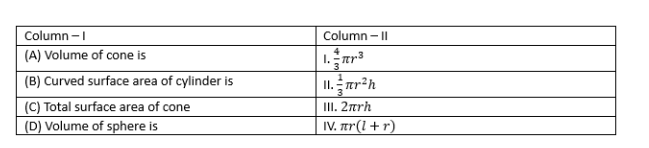
Match the following columns
1
(A)-(III), (B)-(II), (C)-(IV), (D)-(I)
2
(A)-(IV), (B)-(II), (C)-(I), (D)-(III)
3
(A)-(I), (B)-(III), (C)-(IV), (D)-(II)
4
(A)-(I), (B)-(II), (C)-(IV), (D)-(III)
Official Solution
Correct Option:
(3)
- (A) Volume of cone = (Formula for cone's volume)
- (B) Curved surface area of cylinder = (Lateral surface area without bases)
- (C) Total surface area of cone = (Sum of base area and curved surface)
- (D) Volume of sphere = (Complete volume formula)
About Mensuration - CUET-UG
Mensuration is a vital chapter for CUET-UG aspirants. Mastering the concepts covered in this chapter is essential for securing a top rank.
By rigorously practicing the previous year questions associated with this chapter, you can identify high-yield topics, understand the examiner's perspective, and boost your confidence during the actual exam.
Frequently Asked Questions
Why focus on Mensuration PYQs?
Analyzing PYQs for this specific chapter reveals the most frequently tested concepts and the typical complexity of questions, allowing you to tailor your study plan efficiently.
How to best use this analysis?
Review the topic breakdown to see which sub-topics within Mensuration carry the most weight. Then, tackle the questions iteratively to solidify your understanding.