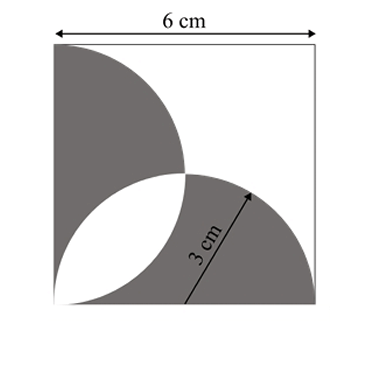
A square with sides of length 6 cm is given. The boundary of the shaded region is defined by two semi-circles whose diameters are the sides of the square, as shown.
The area of the shaded region is __________ cm .
1
2
18
3
20
4
Official Solution
Correct Option:
(1)
Step 1: Understand the figure. We have a square of side cm. Inside it, two semi-circles are drawn along adjacent sides of the square (each having diameter cm and radius cm). The shaded region is the portion inside the square but outside the overlapping area of the two semi-circles. Step 2: Compute area of one semi-circle. Radius cm. Area of one semi-circle . Step 3: Compute combined semi-circular areas. There are two semi-circles, so total area covered . Step 4: Interpret shaded region. The shaded region is exactly the union of these two semicircles (without double-counting the intersection). By symmetry, the shaded portion adds up to the equivalent of one and a half circles of radius 3. But geometric simplification shows the total shaded area . Final Answer:
About Higher Order Linear Odes - GATE-ES
Higher Order Linear Odes is a vital chapter for GATE-ES aspirants. Mastering the concepts covered in this chapter is essential for securing a top rank.
By rigorously practicing the previous year questions associated with this chapter, you can identify high-yield topics, understand the examiner's perspective, and boost your confidence during the actual exam.
Frequently Asked Questions
Why focus on Higher Order Linear Odes PYQs?
Analyzing PYQs for this specific chapter reveals the most frequently tested concepts and the typical complexity of questions, allowing you to tailor your study plan efficiently.
How to best use this analysis?
Review the topic breakdown to see which sub-topics within Higher Order Linear Odes carry the most weight. Then, tackle the questions iteratively to solidify your understanding.