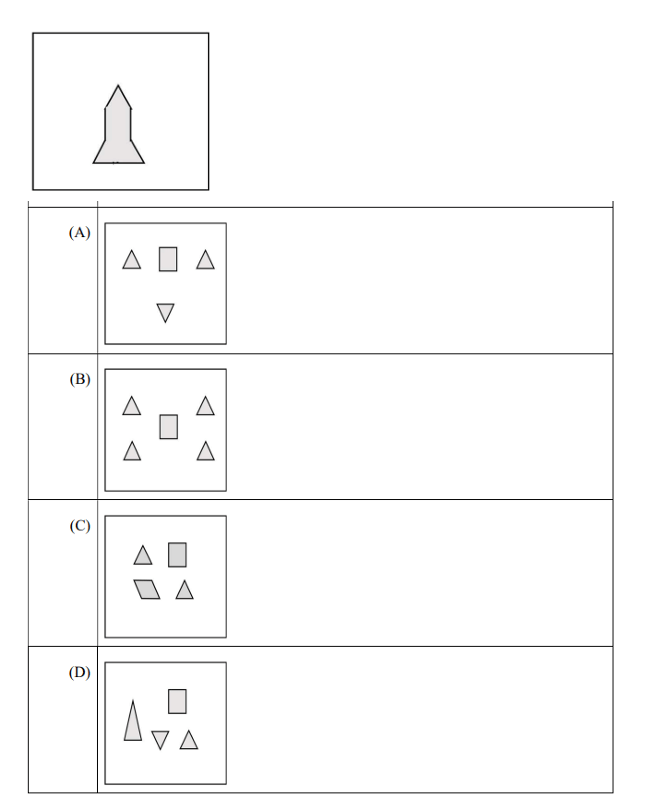
Which one of the groups given below can be assembled to get the shape that is shown above using each piece only once without overlapping with each other? (rotation and translation operations may be used).
1
A
2
B
3
C
4
D
Official Solution
Correct Option:
(2)
The shape in the question consists of several geometric components that need to be arranged to form the desired shape. The components in the given shape are a combination of triangles, rectangles, and other geometric figures. We need to analyze the available groups to determine which one can be assembled to form the target shape. Let’s break down the solution step-by-step: Step 1: Understanding the given shape.
The shape consists of two large triangular sections with a smaller triangular section at the top and a rectangular section in between. It is crucial to notice the relative positioning of the shapes and the angles, which suggest the need for specific rotations and translations to arrange the parts in the desired way. Step 2: Evaluating the options.
Let’s now analyze each option: - Option (A) Group 1: This group contains two triangles and a rectangle. If we attempt to assemble these shapes, we can notice that while the group has the right shapes, the positioning does not align properly to form the desired structure. The arrangement of the triangles does not match the required shape. - Option (B) Group 2: This group contains a combination of shapes that exactly match the structure of the given shape. By rotating and translating the pieces, we can assemble them into the desired configuration. The triangles can be rotated to fit into the correct positions, and the rectangle fits perfectly in between the two triangles, forming the exact shape shown in the question. - Option (C) Group 3: This group contains a similar set of shapes but with additional extra components that do not fit the structure. The extra pieces create a mismatch and cannot be used to form the target shape. - Option (D) Group 4: This group also has the necessary shapes, but the arrangement and the size of the components do not fit correctly. Even after rotation and translation, the pieces do not align properly to match the given shape. Step 3: Conclusion.
After carefully evaluating all the options, it is clear that Group 2 (Option B) is the correct choice. This group can be assembled into the exact shape shown in the question by rotating and translating each piece appropriately. Thus, the correct answer is (B) Group 2.
02
PYQ 2022
medium
general-aptitudeID: gate-ge-
Consider the following functions for non-zero positive integers, and : Which one of the following options is correct based on the above?
1
2
3
4
Official Solution
Correct Option:
(1)
Let us first evaluate and . Step 1: Evaluate From the given formula for :
Step 2: Evaluate From the given formula for :
Step 3: Compare the results. Since and , we conclude that . Therefore, the correct answer is (A).
03
PYQ 2022
medium
general-aptitudeID: gate-ge-
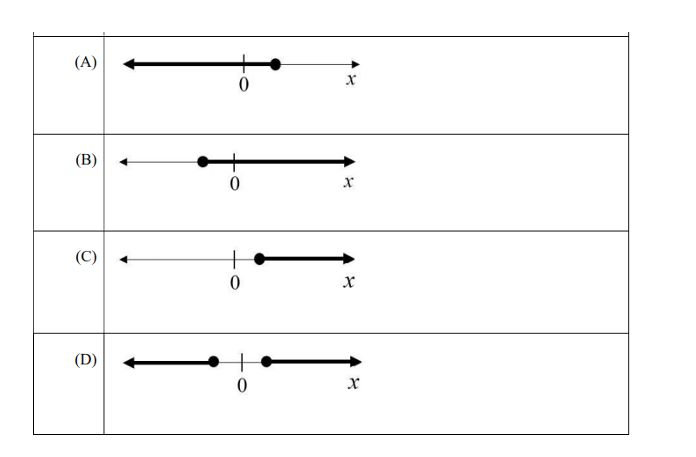
Which one of the following is a representation (not to scale and in bold) of all values of satisfying the inequality on the real number line?
1
A
2
B
3
C
4
D
Official Solution
Correct Option:
(3)
First, let's solve the inequality:
Multiply both sides by 3 to eliminate the denominator:
Expanding both sides:
Now, move the terms involving to one side:
Simplifying:
Now, divide by 9:
Thus, the solution is , which corresponds to a closed circle on and extending to the right. The representation that matches this solution is option (C).
About Geometry - GATE-GE
Geometry is a vital chapter for GATE-GE aspirants. Mastering the concepts covered in this chapter is essential for securing a top rank.
By rigorously practicing the previous year questions associated with this chapter, you can identify high-yield topics, understand the examiner's perspective, and boost your confidence during the actual exam.
Frequently Asked Questions
Why focus on Geometry PYQs?
Analyzing PYQs for this specific chapter reveals the most frequently tested concepts and the typical complexity of questions, allowing you to tailor your study plan efficiently.
How to best use this analysis?
Review the topic breakdown to see which sub-topics within Geometry carry the most weight. Then, tackle the questions iteratively to solidify your understanding.