GATE-GE SERIES
Geomatics

Satellite Communications

11 previous year questions.

Volume: 11 Ques
Yield: Medium

High-Yield Trend

11
2025

Chapter Questions
11 MCQs

01
PYQ 2025
medium
geomatics ID: gate-ge-

Principal Component Analysis is performed on a 4-band IRS satellite image. The eigenvalues computed from the covariance matrix are 887.60, 75.20, 37.60 and 6.73, respectively. The percentage of total variance explained by the third principal component ( ) is_______________(rounded off to 2 decimal places).}

02
PYQ 2025
medium
geomatics ID: gate-ge-

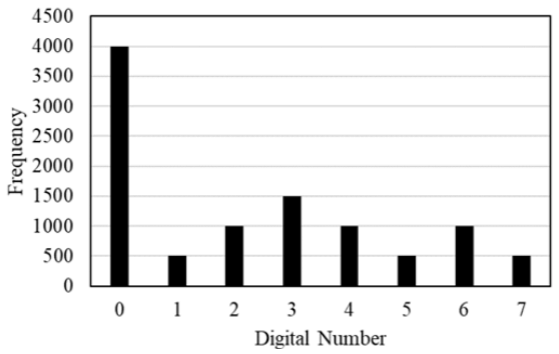
The histogram of a red band in a 3-bit satellite image is shown below. Which of the following statements is/are correct?Β 

1
There are more darker pixels in the image
2
There are more brighter pixels in the image
3
The mean digital number of the image is 1250
4
It may be predicted that approximately 40% of area in the image is covered by material with low spectral albedo in red band
03
PYQ 2025
medium
geomatics ID: gate-ge-

For the correlation matrix of a 4-band satellite image as shown below, which of the following statements is/are correct?
Band 1Band 2Band 3Band 4
Band 110.950.360.92
Band 20.9510.400.93
Band 30.360.4010.42
Band 40.920.930.421
1
Band 3 provides some unique information not found in other bands
2
There is high redundancy in band 2 and 4
3
The standard deviation of all the bands is equal
4
Image cannot be classified using bands 1 and 3 only
04
PYQ 2025
medium
geomatics ID: gate-ge-

Principal Component Analysis is performed on a 4-band IRS satellite image. The eigenvalues computed from the covariance matrix are 887.60, 75.20, 37.60 and 6.73, respectively. The percentage of total variance explained by the third principal component ( ) is __________ (rounded off to 2 decimal places).

05
PYQ 2025
medium
geomatics ID: gate-ge-
Which one of the following techniques is NOT used to atmospherically correct the satellite image?
1
Image normalization using histogram adjustment
2
Radiative transfer model
3
Image to image registration
4
Image normalization using regression
06
PYQ 2025
medium
geomatics ID: gate-ge-
The geophysical variables that can be measured/derived from the Global Navigation Satellite System observations is/are
1
ocean color
2
precipitable water vapor
3
soil moisture
4
seismic motion
07
PYQ 2025
medium
geomatics ID: gate-ge-
Which of the following conditions is/are essential for geostationary satellite orbits?
1
Eccentricity is zero
2
Inclination is close to zero
3
Prograde
4
Retrograde
08
PYQ 2025
medium
geomatics ID: gate-ge-
A country has 7 permanent Global Navigation Satellite System stations covering its territory. Their surveying organization generates a network solution after applying double differencing to the observations. These 7 permanent stations can view 5 to 10 common satellites at any given epoch. What is the range (minimum, maximum) of the number of independent double differenced observables possible?
1
(35, 70)
2
(30, 56)
3
(28, 48)
4
(24, 54)
09
PYQ 2025
medium
geomatics ID: gate-ge-
In the choke ring antenna there are concentric cylinders placed around the antenna that are of a certain depth to minimize the multipath effect. If the signal wavelength is , then the depth of the cylinders in the choke ring antenna should be
1

2

3

4

10
PYQ 2025
medium
geomatics ID: gate-ge-
In the context of Global Navigation Satellite System positioning, which of the following statement is correct?
1
In Differential Global Navigation Satellite System, the corrections to the coordinates of the user are transmitted from the reference station
2
text{Real-time kinematic positioning and stop-and-go positioning are both kinematic methods
3
Rapid-static positioning is not a relative positioning technique
4
Double differencing eliminates the clock errors and improves the noise in the differenced pseudorange observations
11
PYQ 2025
medium
geomatics ID: gate-ge-

In the context of Global Navigation Satellite System positioning, the Saastamoinen model provides a correction for ____________

1

2

3

4

About Satellite Communications - GATE-GE

Satellite Communications is a vital chapter for GATE-GE aspirants. Mastering the concepts covered in this chapter is essential for securing a top rank.

By rigorously practicing the previous year questions associated with this chapter, you can identify high-yield topics, understand the examiner's perspective, and boost your confidence during the actual exam.

Frequently Asked Questions

Why focus on Satellite Communications PYQs?

Analyzing PYQs for this specific chapter reveals the most frequently tested concepts and the typical complexity of questions, allowing you to tailor your study plan efficiently.

How to best use this analysis?

Review the topic breakdown to see which sub-topics within Satellite Communications carry the most weight. Then, tackle the questions iteratively to solidify your understanding.