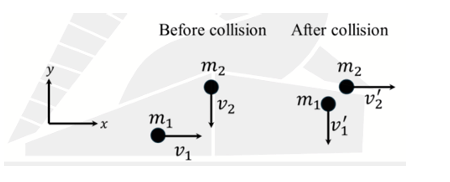
Two point-particles having masses and approach each other in perpendicular directions with speeds and , respectively, as shown in the figure below. After an elastic collision, they move away from each other in perpendicular directions with speeds and , respectively.
The ratio is
1
2
3
4
Official Solution
Correct Option:
(1)
Step 1: Understanding the Concept:
This problem involves a two-dimensional elastic collision. For any collision, linear momentum is conserved. For an elastic collision, kinetic energy is also conserved. The problem states that the initial velocities are perpendicular to each other, and the final velocities are also perpendicular to each other. Step 2: Key Formula or Approach:
1. Conservation of Linear Momentum (Vector): .
2. Conservation of Kinetic Energy (Scalar): .
3. Perpendicularity Conditions: and . Step 3: Detailed Explanation:
From the conservation of linear momentum, we can square the vector equation:
Expanding this using the distributive property of the dot product:
Using the perpendicularity conditions ( and ), this simplifies to:
The conservation of kinetic energy equation is:
We now have a system of two equations. Let's rearrange Equation 2:
And rearrange Equation 1:
Let and . The equations become:
and .
Substituting into the second equation gives:
This implies that either or .
If , then .
About Mechanics - IIT-JAM-PH
Mechanics is a vital chapter for IIT-JAM-PH aspirants. Mastering the concepts covered in this chapter is essential for securing a top rank.
By rigorously practicing the previous year questions associated with this chapter, you can identify high-yield topics, understand the examiner's perspective, and boost your confidence during the actual exam.
Frequently Asked Questions
Why focus on Mechanics PYQs?
Analyzing PYQs for this specific chapter reveals the most frequently tested concepts and the typical complexity of questions, allowing you to tailor your study plan efficiently.
How to best use this analysis?
Review the topic breakdown to see which sub-topics within Mechanics carry the most weight. Then, tackle the questions iteratively to solidify your understanding.