Introduction To Three Dimensional Geometry
16 previous year questions.
High-Yield Trend
Chapter Questions 16 MCQs
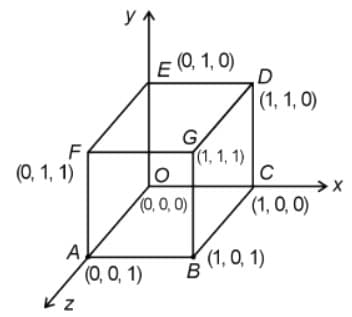
Let Q be the cube with the set of vertices {(x1, x2, x3) ∈ R3: x1, x2, x3 ∈ {0,1}}. Let F be the set of all twelve lines containing the diagonals of the six faces of cube Q. Let S be the set of all four lines containing the main diagonals of the cube Q; for instance, the line passing through the vertices (0,0,0) and (1,1,1) is in S. For lines l1 and l2, let d(l1,l2) denote the shortest distance between them. Then the maximum value of d(l1,l2) as l1 varies over f and l2 varies over S, is
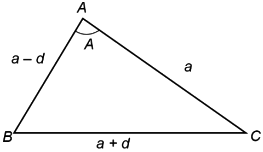
Consider an obtuse-angled triangle ABC in which the difference between the largest and the smallest angle is and whose sides are in arithmetic progression. Suppose that the vertices of this triangle lie on a circle of radius 1.Let a be the area of the triangle ABC. Then the value of (64a)2 is
Consider an obtuse-angled triangle ABC in which the difference between the largest and the smallest angle is and whose sides are in arithmetic progression. Suppose that the vertices of this triangle lie on a circle of radius 1.Then the inradius of the triangle ABC is
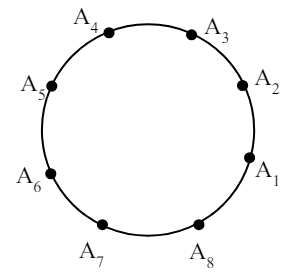
Let A1, A2, A3, A4,........, A8 be the vertices of the regular octagons that lie on the circle of radius 2. Let p be a point on the circle and let PAi denote the distance between the point P and Ai for i = 1,2,3,....,8. If P varies over the circle, then the maximum value of the product is PA1.PA2..........PA8, is
About Introduction To Three Dimensional Geometry - JEE-ADVANCED
Introduction To Three Dimensional Geometry is a vital chapter for JEE-ADVANCED aspirants. Mastering the concepts covered in this chapter is essential for securing a top rank.
By rigorously practicing the previous year questions associated with this chapter, you can identify high-yield topics, understand the examiner's perspective, and boost your confidence during the actual exam.
Frequently Asked Questions
Why focus on Introduction To Three Dimensional Geometry PYQs?
Analyzing PYQs for this specific chapter reveals the most frequently tested concepts and the typical complexity of questions, allowing you to tailor your study plan efficiently.
How to best use this analysis?
Review the topic breakdown to see which sub-topics within Introduction To Three Dimensional Geometry carry the most weight. Then, tackle the questions iteratively to solidify your understanding.