Which of the following compounds does not undergo mutarotation?
1
Glucose
2
Sucrose
3
Ribose
4
Fructose
Official Solution
Correct Option:
(2)
Concept:
Mutarotation occurs in reducing sugars having free anomeric carbon. Step 1: Glucose, ribose, and fructose are reducing sugars. Step 2: Sucrose is non-reducing (no free anomeric carbon). Step 3: Hence sucrose does not show mutarotation. Conclusion:
Correct answer = Sucrose
02
PYQ 2014
medium
biologyID: met-2014
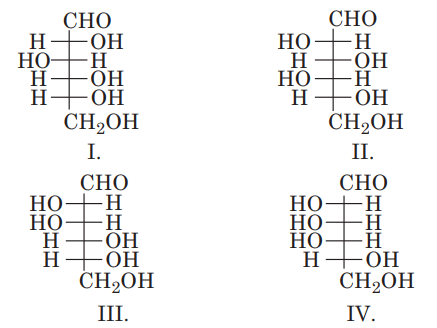
Which two of the following aldohexoses give the same osazone derivative?
1
I and IV
2
I and III
3
II and III
4
III and IV
Official Solution
Correct Option:
(2)
Concept:
Osazone formation depends only on first two carbons. Step 1: Osazone reaction involves C-1 and C-2. Step 2: Differences beyond C-2 are ignored. Step 3: Structures I and III differ only at C-1/C-2. Conclusion:
I and III give same osazone.
03
PYQ 2014
medium
biologyID: met-2014
If two isomers have been classified correctly as anomers, they may be also called
1
conformers
2
enantiomers
3
tautomers
4
diastereomers
Official Solution
Correct Option:
(4)
Concept:
Anomers are stereoisomers differing at the anomeric carbon. Step 1: Anomers differ at anomeric carbon. Step 2: They are not mirror images not enantiomers. Step 3: Hence, they are diastereomers. Conclusion:
Correct answer = Diastereomers
About Carbohydrates - MET
Carbohydrates is a vital chapter for MET aspirants. Mastering the concepts covered in this chapter is essential for securing a top rank.
By rigorously practicing the previous year questions associated with this chapter, you can identify high-yield topics, understand the examiner's perspective, and boost your confidence during the actual exam.
Frequently Asked Questions
Why focus on Carbohydrates PYQs?
Analyzing PYQs for this specific chapter reveals the most frequently tested concepts and the typical complexity of questions, allowing you to tailor your study plan efficiently.
How to best use this analysis?
Review the topic breakdown to see which sub-topics within Carbohydrates carry the most weight. Then, tackle the questions iteratively to solidify your understanding.