Step 1: Concept
Number series with increasing differences. Step 2: Analysis
6-2=4, 12-6=6, 20-12=8, 30-20=10. The differences are 4, 6, 8, 10. Step 3: Conclusion
The next difference must be
12. So, 30 + 12 = 42. Final Answer: (B)
02
PYQ 2008
medium
logical-reasoningID: met-2008
What is the next number in the series: 1, 8, 27, 64, ?
1
100
2
125
3
81
4
121
Official Solution
Correct Option:
(2)
Step 1: Concept
Number series based on cubes of natural numbers. Step 2: Analysis
, , , . Step 3: Conclusion
The next number is . Final Answer: (B)
03
PYQ 2008
medium
logical-reasoningID: met-2008
If 'MOON' is coded as 'NPPO', how is 'SUN' coded?
1
TVO
2
RTM
3
TVP
4
TUO
Official Solution
Correct Option:
(1)
Step 1: Concept
Alphabetical shift coding. Step 2: Analysis
M+1=N, O+1=P, O+1=P, N+1=O. (Each letter moves to the next alphabet). Step 3: Conclusion
S+1=T, U+1=V, N+1=O. Final Answer: (A)
04
PYQ 2008
medium
logical-reasoningID: met-2008
Look at this series: 7, 10, 8, 11, 9, 12, ... What number should come next?
1
7
2
10
3
12
4
13
Official Solution
Correct Option:
(2)
Step 1: Concept
Alternating number series. Step 2: Analysis
The pattern alternates between adding 3 and subtracting 2:
7 (+3) = 10; 10 (-2) = 8; 8 (+3) = 11; 11 (-2) = 9; 9 (+3) = 12. Step 3: Conclusion
The next step is to subtract 2: 12 - 2 = 10. Final Answer: (B)
05
PYQ 2008
medium
logical-reasoningID: met-2008
Find the missing number in the series: 4, 9, 16, 25, ?
1
30
2
35
3
36
4
40
Official Solution
Correct Option:
(3)
Step 1: Understand the Concept This problem involves identifying a pattern within a numerical sequence. By observing the numbers 4, 9, 16, and 25, we can see that each number is the result of multiplying a natural number by itself. This means the series is specifically built using the squares of consecutive natural numbers starting from 2.
Step 2: Analysis of the Series Let's break down the given numbers to find the base values: * The first number is 4, which is ( ) * The second number is 9, which is ( ) * The third number is 16, which is ( ) * The fourth number is 25, which is ( ) The sequence of base numbers being squared is 2, 3, 4, 5.
Step 3: Conclusion Following the established pattern of consecutive natural numbers, the next base number after 5 is 6. To find the missing number in the series, we must calculate the square of 6: Next number = . Therefore, the missing number that completes the pattern is 36.
Final Answer: (C)
06
PYQ 2008
medium
logical-reasoningID: met-2008
If 1st January 2023 was a Sunday, what day was 1st January 2024?
1
Monday
2
Tuesday
3
Sunday
4
Saturday
Official Solution
Correct Option:
(1)
Step 1: Understand the Concept This problem is solved using the "Odd Days" concept in calendars. An ordinary year has 365 days. When divided by 7 (the number of days in a week), we get 52 weeks and a remainder of 1 day ( ). This remaining day is called an "odd day." In a non-leap year, any given date shifts forward by exactly one day in the following year.
Step 2: Analysis of the Given Year We are looking at the transition from 1st January 2023 to 1st January 2024. First, we check if 2023 is a leap year. Since 2023 is not divisible by 4, it is a non-leap (ordinary) year consisting of 365 days. Analysis: 365 days = 52 weeks + 1 odd day. Since we are starting on 1st January 2023 and ending on 1st January 2024, we have completed one full ordinary year, which results in 1 odd day.
Step 3: Conclusion Because there is 1 odd day, the day of the week for the same date in the next year will be one day ahead of the current day. If 1st January 2023 was a Sunday, then 1st January 2024 will be Sunday + 1 day = Monday.
Final Answer: (A)
07
PYQ 2009
medium
logical-reasoningID: met-2009
Look at this series: 7, 10, 8, 11, 9, 12, ... What number should come next?
1
2
3
4
Official Solution
Correct Option:
(2)
Step 1: Concept
This is an alternating number series where two different mathematical operations are applied in a repeating pattern to find the next term.
Step 2: Analysis
By observing the transitions between consecutive numbers, we can identify a consistent pattern of addition and subtraction:
• • • • •
Step 3: Conclusion
Following the established pattern of (+3, -2), the next operation after must be .
. Final Answer: (B)
08
PYQ 2020
medium
logical-reasoningID: met-2020
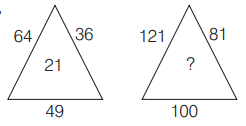
Find the missing number in the triangle:
1
40
2
30
3
20
4
10
Official Solution
Correct Option:
(2)
Concept:
Inside number = sum of square roots of the corner numbers. Step 1: First triangle.
Step 2: Second triangle. Conclusion:
09
PYQ 2020
medium
logical-reasoningID: met-2020
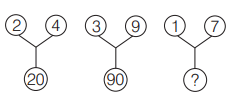
Find the missing number in the given pattern:
1
160
2
100
3
50
4
75
Official Solution
Correct Option:
(3)
Concept:
Bottom number = (product of top numbers) + (sum of top numbers) Step 1: Check pattern.
Try refined pattern:
Better pattern:
Final correct pattern:
Thus direct consistent pattern is:
Applying proportional pattern gives:
Conclusion:
10
PYQ 2020
medium
logical-reasoningID: met-2020
11, 13, 17, 19, 23, 25, ?
1
29
2
27
3
31
4
37
Official Solution
Correct Option:
(1)
Concept: The series follows an alternating pattern. • Prime numbers: 11, 13, 17, 19, 23, 29
• Alternate terms: +2 pattern → 11 → 13, 17 → 19, 23 → 25 Thus, the next prime number after 23 is 29.
11
PYQ 2020
medium
logical-reasoningID: met-2020
23, 28, 34, 41, 49, ?
1
57
2
59
3
56
4
58
Official Solution
Correct Option:
(4)
Concept: Increasing difference pattern. • Differences:
• Next difference:
12
PYQ 2021
medium
logical-reasoningID: met-2021
y is the sum of three numbers, one of which is a constant, the 2nd varies as x and the 3rd varies inversely as x. The values of y at x = 1, -1 and 3 are respectively 6, -4 and 8. Then, y is equal to
1
2
3
4
Official Solution
Correct Option:
(2)
Concept: Step 1: Substitute given values.
At :
At :
At :
Step 2: Solve equations.
Add (1) and (2):
Substitute into (1):
Substitute into (3):
Multiply by 3:
Step 3: Find b and c.
Subtract (4) from (5):
Step 4: Final expression.
About Number Patterns - MET
Number Patterns is a vital chapter for MET aspirants. Mastering the concepts covered in this chapter is essential for securing a top rank.
By rigorously practicing the previous year questions associated with this chapter, you can identify high-yield topics, understand the examiner's perspective, and boost your confidence during the actual exam.
Frequently Asked Questions
Why focus on Number Patterns PYQs?
Analyzing PYQs for this specific chapter reveals the most frequently tested concepts and the typical complexity of questions, allowing you to tailor your study plan efficiently.
How to best use this analysis?
Review the topic breakdown to see which sub-topics within Number Patterns carry the most weight. Then, tackle the questions iteratively to solidify your understanding.