Detailed Solution: Logical Equivalence of
Let’s dive into solving this logical equivalence problem step by step in a way that’s easy to understand, especially for students learning about propositional logic. The task is to determine which of the given options is logically equivalent to the expression , where , , and are simple statements. Logical equivalence means that the two expressions always have the same truth value regardless of the truth values of , , and . We’ll explore this using the definition of implication, De Morgan’s laws, and truth tables to ensure clarity.
Step 1: Understand the Given Expression
The expression is . In logic, the implication is equivalent to (this is a fundamental rule). So, let’s rewrite using this equivalence:
According to the associative and commutative properties of disjunction ( ), is the same as . This gives us a starting point to compare with the options. However, let’s also consider the contrapositive and other logical manipulations to find the exact match.
Step 2: Analyze the Options
We have four options to evaluate:
- Option 1:
- Option 2:
- Option 3:
- Option 4:
To determine the correct answer, we need to check which of these expressions is logically equivalent to . Logical equivalence can be tested by constructing a truth table or by using logical identities. Since this is a detailed solution, let’s use both methods for a thorough understanding.
Step 3: Use Logical Identities
Let’s manipulate further. The implication can also be explored through its contrapositive, which is another form of equivalence. The contrapositive of is . Using De Morgan’s law, , so the contrapositive becomes:
- This is equivalent to
- Using De Morgan’s law again,
- So, , which is the same as (consistent with our initial rewrite).
This manipulation suggests we should compare the options by rewriting them. Let’s test each option:
- Option 1: . Using De Morgan’s law, , so . This is different from because it includes and lacks the direct combination of .
- Option 2:
, and . So, . This is not the same as because the conjunction ( ) distributes differently and requires both conditions to hold, whereas allows either. - Option 3:
This is . Using the associative property, this simplifies to , which is the same as . This matches our rewritten form of . - Option 4:
This is the same as Option 2 and does not match due to the conjunction.
Step 4: Verify with Truth Table
To confirm, let’s use a truth table for and . We’ll test all combinations of , , and (8 rows):
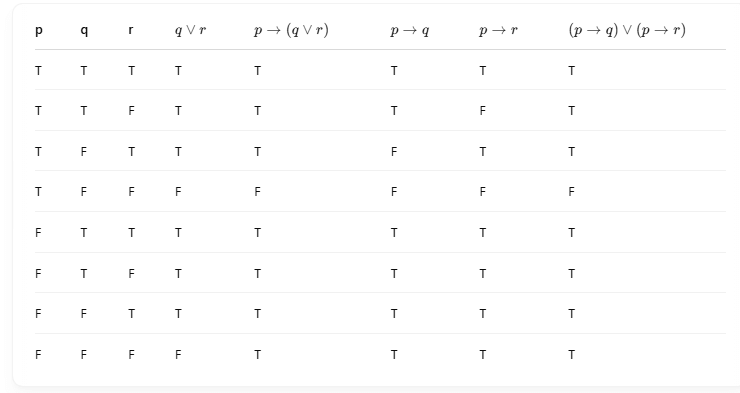
- is T unless is T and is F (only the 4th row).
- is T unless both and are F, which happens only when is T and both and are F (4th row).
The truth values match in all cases, confirming logical equivalence.
Step 5: Conclusion
The expression is logically equivalent to Option 3: . This solution leverages logical identities and a truth table, making it a robust method for students to learn and apply in similar problems.