An object is placed at a distance of in front of a concave mirror of focal length . The nature of image is
1
real and inverted and of smaller size
2
virtual and erect and of same size
3
real and erect
4
virtual and inverted
Official Solution
Correct Option: (1)
Distance of object u = - 40 cm. Focal length of concave mirror f = - 20 cm. By mirror formula
or
or Negative sign implies that image is in front of concave mirror, hence image is real. Magnification produced by concave mirror
The image is of the same size and inverted.
02
PYQ 2010
medium
physicsID: ojee-201
When white light passes through a glass prism, one gets spectrum on the other side of the prism. In the emergent beam, the ray which is deviating least is
1
violet ray
2
green ray
3
red ray
4
yellow ray
Official Solution
Correct Option: (3)
is least, so is also least.
03
PYQ 2010
medium
physicsID: ojee-201
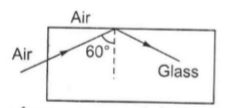
A light ray going from air is incident (as shown in figure) at one end of a glass fibre (refractive index ) making an incidence angle of on the lateral surface, so that it undergoes a total internal reflection. How much time would it take to traverse the straight fibre of length 1 km?
1
2
3
4
Official Solution
Correct Option: (4)
When total internal reflection just takes place form lateral surface i = C,ie,
Time taken by light to traverse some distance in a medium
04
PYQ 2024
easy
physicsID: ojee-202
How far should an object be from a concave spherical mirror of radius 36 cm to form a real image one-ninth its size?
1
170 cm
2
180 cm
3
190 cm
4
None
Official Solution
Correct Option: (2)
The magnification for a concave mirror is given by: where is the image distance and is the object distance. We are given that for a real image, so: This implies: The mirror equation is: For a concave mirror, the focal length is related to the radius of curvature by: Substitute cm into the mirror equation: Using the relation , substitute this into the equation: Simplifying: Solving for : Thus, the object should be placed 180 cm from the mirror.
05
PYQ 2024
medium
physicsID: ojee-202
The deviation produced by an equilateral prism, when a ray of light is incident on it, does not depend on:
1
Angle of prism
2
Colour of light
3
Material of the prism
4
Size of the prism
Official Solution
Correct Option: (4)
An equilateral prism is a type of optical prism with equal angles. When light passes through the prism, it undergoes refraction at both surfaces, leading to a deviation in its path. The amount of deviation is primarily influenced by the following factors:
Angle of prism: The amount of deviation is dependent on the angle of the prism as it determines the geometry and path length through the material.
Colour of light: Different colors of light (wavelengths) are refracted differently, causing variations in deviation due to dispersion.
Material of the prism: The refractive index of the material affects how much bending occurs, as the deviation is proportional to the refractive index.
However, the size of the prism does not affect the deviation angle. This is because the deviation depends on the material's refractive properties and the geometry of the path within the prism, not on the external dimensions of the prism itself. Therefore, in this context, the size of the prism is irrelevant to the deviation produced.
06
PYQ 2024
medium
physicsID: ojee-202
A concave lens forms the image of an object which is:
1
Virtual, inverted and diminished
2
Virtual, upright and diminished
3
Virtual, inverted and enlarged
4
Virtual, upright and enlarged
Official Solution
Correct Option: (2)
When dealing with lenses, it's important to understand how they form images of objects placed at various positions relative to the lens. For a concave lens, which is also known as a diverging lens, the properties of the image formed are consistent:
Virtual: The image formed by a concave lens is not actuable on a screen. Virtual images are formed on the same side of the lens as the object.
Upright: The image retains the same orientation as the object, so it appears in the same upright direction.
Diminished: The image is smaller than the object due to the lens's diverging properties.
Therefore, for a concave lens, the image of an object will be virtual, upright, and diminished.
07
PYQ 2025
medium
physicsID: ojee-202
A man of height is standing on level road where because of temperature variation, the refractive index of air is varying as , where is the height from the level road and is a positive constant. Find the distant point that man can see on the road.}
1
2
3
4
Official Solution
Correct Option: (1)
Step 1: Understanding the variation of refractive index. The refractive index is given as , where is the height. The ray of light will be bent due to this variation in the refractive index. The path of the light ray will curve towards the road. The angle of deviation increases with height. Step 2: Calculating the distance. From the formula for the refraction index and using the concept of ray bending, the distance that the man can see on the road depends on the height and the parameter . Solving the refraction problem gives the distance as . Step 3: Conclusion. The correct answer is (1) }.