Step 1: Given equation.
The given equation is
Step 2: Simplify the equation.
Using the logarithmic identity , we can rewrite the equation as:
Now, use the property to obtain:
Step 3: Equate the arguments.
Since the logarithms are equal, their arguments must also be equal. Thus:
Multiplying both sides by 3:
Step 4: Find the value of .
Now, square both sides of the equation to obtain:
Expanding the left-hand side:
Rearranging the terms:
Now, divide both sides by :
Simplifying:
Final Answer: 7.
02
PYQ 2025
medium
mathematicsID: ts-edcet
If , then the number of zeros is ________.
1
7
2
6
3
9
4
11
Official Solution
Correct Option:
(4)
Step 1: Polynomial Degree.
The given polynomial is:
The degree of the polynomial is determined by the highest power of , which is 11. Hence, the polynomial is of degree 11. Step 2: Maximum Number of Zeros.
According to the Fundamental Theorem of Algebra, a polynomial of degree has at most real or complex roots (zeros). Therefore, the polynomial can have at most 11 zeros. Step 3: Conclusion.
Since the degree of the polynomial is 11, the number of zeros is at most 11. Therefore, the number of zeros is 11.
Final Answer: 11.
03
PYQ 2025
medium
mathematicsID: ts-edcet
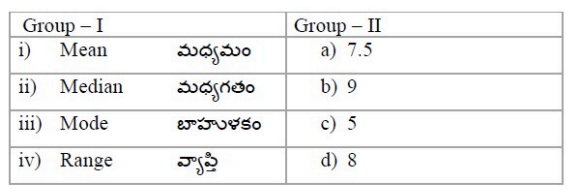
Match the following:
1
i - d, ii - a, iii - c, iv - b
2
i - a, ii - b, iii - c, iv - d
3
i - d, ii - c, iii - b, iv - a
4
i - d, ii - c, iii - a, iv - b
Official Solution
Correct Option:
(1)
Step 1: Understand the terms. - Mean: The average of the numbers.
- Median: The middle number in an ordered data set.
- Mode: The most frequent number in a data set.
- Range: The difference between the highest and lowest values in the data. Step 2: Match with the values. Given the numbers 5, 8, 14, 7, 9, 11, 5, we calculate: - Mean:
- Median: The middle value of the sorted list (5, 5, 7, 8, 9, 11, 14) is 9.
- Mode: The most frequent value is 5.
- Range: Thus, the correct matching is .
Final Answer: i - d, ii - a, iii - c, iv - b.
04
PYQ 2025
medium
mathematicsID: ts-edcet
The roots of the equation are
1
-2, 1, -2, -1
2
2, -1, -2, 1
3
-2, -1, -1, -2
4
2, 1, 1, 2
Official Solution
Correct Option:
(2)
Step 1: Rewriting the equation. The given equation is . Let , so the equation becomes:
Step 2: Solving the quadratic equation. Now, solve the quadratic equation by factoring:
So, or . Step 3: Substituting . Since , we substitute back to find the roots of :
- For , , so or .
- For , , so or . Step 4: Conclusion. Therefore, the roots of the equation are .
Final Answer: 2, -1, -2, 1.
05
PYQ 2025
medium
mathematicsID: ts-edcet
If
1
34
2
41
3
25
4
7
Official Solution
Correct Option:
(2)
Step 1: Defining variables.
Let and . The given equations then become:
Step 2: Solving the system of equations.
We can multiply equation (A) by 2 and subtract from equation (B) to eliminate . Multiplying (A) by 2:
Now subtract equation (B) from equation (C):
Thus,
Step 3: Substituting in equation (A).
Substitute in equation (A):
Thus,
Step 4: Finding .
We now have and . Solve these two equations: 1)
2) Add these equations:
Substitute into :
Finally, calculate :
Final Answer: 41.
06
PYQ 2025
medium
mathematicsID: ts-edcet
For , if the quadratic equation has two equal roots, then find the value of .
1
2
2
4
3
6
4
8
Official Solution
Correct Option:
(3)
Step 1: General form of the quadratic equation.
The given quadratic equation is:
Expanding the equation:
Step 2: Condition for equal roots.
For a quadratic equation to have equal roots, the discriminant must be zero. The discriminant is given by:
Here, , , and . Substituting these values into the discriminant formula:
For the roots to be equal, , so:
Step 3: Solve for .
Factorizing the equation:
Thus, or . Since , we conclude that:
Final Answer: 6.
About Basic Algebra - TS-EDCET
Basic Algebra is a vital chapter for TS-EDCET aspirants. Mastering the concepts covered in this chapter is essential for securing a top rank.
By rigorously practicing the previous year questions associated with this chapter, you can identify high-yield topics, understand the examiner's perspective, and boost your confidence during the actual exam.
Frequently Asked Questions
Why focus on Basic Algebra PYQs?
Analyzing PYQs for this specific chapter reveals the most frequently tested concepts and the typical complexity of questions, allowing you to tailor your study plan efficiently.
How to best use this analysis?
Review the topic breakdown to see which sub-topics within Basic Algebra carry the most weight. Then, tackle the questions iteratively to solidify your understanding.