An urn contains 3 black and 5 red balls. If 3 balls are drawn at random from the urn, the mean of the probability distribution of the number of red balls drawn is:
1
2
3
4
Official Solution
Correct Option:
(2)
Step 1: Understand the problem. The problem is related to finding the mean of the probability distribution for the number of red balls drawn when 3 balls are drawn from an urn containing 3 black and 5 red balls. The number of red balls that can be drawn ranges from 0 to 3, and we need to calculate the expected value (mean) of this distribution. Step 2: Calculating probabilities. The number of possible outcomes when drawing 3 balls from the urn is: Next, we calculate the probability of drawing 0, 1, 2, and 3 red balls. - For 0 red balls, all 3 balls must be black. The number of ways to choose 3 black balls is: So the probability is: - For 1 red ball, we need to choose 1 red ball and 2 black balls. The number of ways to do this is: So the probability is: - For 2 red balls, we need to choose 2 red balls and 1 black ball. The number of ways to do this is: So the probability is: - For 3 red balls, all 3 balls must be red. The number of ways to choose 3 red balls is: So the probability is: Step 3: Calculating the expected value. The expected value (mean) of the number of red balls drawn is the sum of each outcome multiplied by its probability: Simplifying: Thus, the mean of the probability distribution of the number of red balls drawn is .
02
PYQ 2024
easy
mathematicsID: ap-eamce
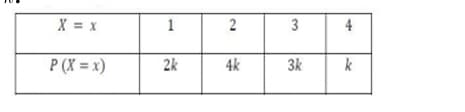
If the probability distribution of a random variable is given as follows, then find :
1
2
3
4
Official Solution
Correct Option:
(1)
Step 1: Use the property of probability distribution
The sum of all probabilities must equal 1:
Step 2: Solve for
About Probability Distribution - AP-EAMCET
Probability Distribution is a vital chapter for AP-EAMCET aspirants. Mastering the concepts covered in this chapter is essential for securing a top rank.
By rigorously practicing the previous year questions associated with this chapter, you can identify high-yield topics, understand the examiner's perspective, and boost your confidence during the actual exam.
Frequently Asked Questions
Why focus on Probability Distribution PYQs?
Analyzing PYQs for this specific chapter reveals the most frequently tested concepts and the typical complexity of questions, allowing you to tailor your study plan efficiently.
How to best use this analysis?
Review the topic breakdown to see which sub-topics within Probability Distribution carry the most weight. Then, tackle the questions iteratively to solidify your understanding.