Engineering Drawing Skills
12 previous year questions.
High-Yield Trend
Chapter Questions 12 MCQs
Match the List-I with List-II: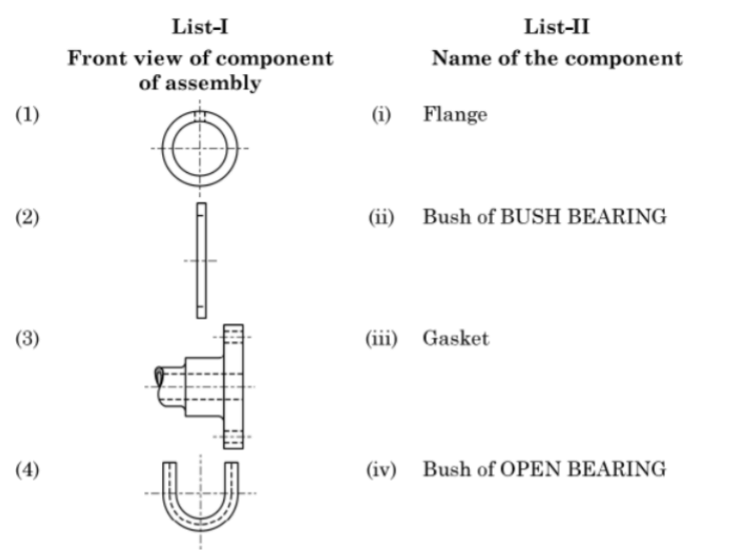
The above given top view corresponds to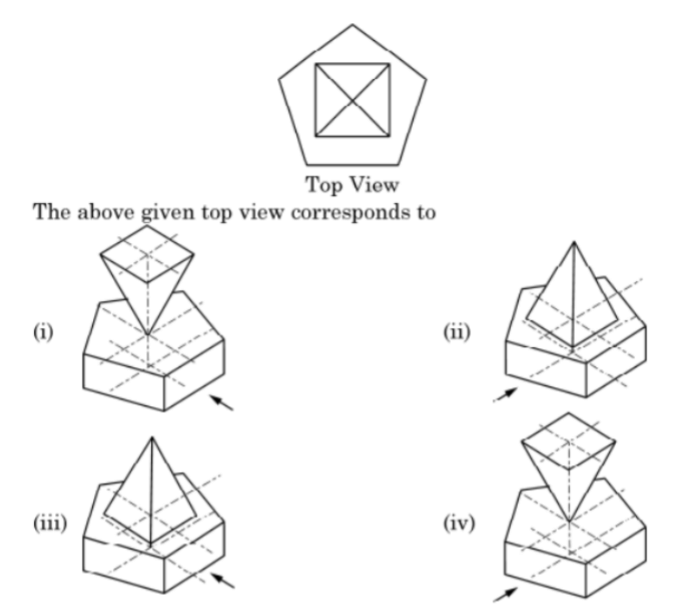
Select the correct statements for the given figure.
(i) A horizontal pyramid is placed with its axis parallel to both H.P. and V.P.
(ii) The solid has three triangular faces in total.
(iii) A horizontal pyramid is placed with its axis perpendicular to V.P.
(iv) It is an example of polyhedron.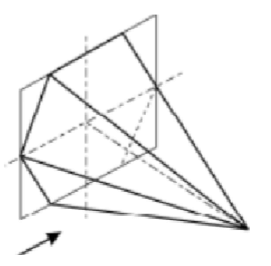
Orthographic projection of a cube is shown as :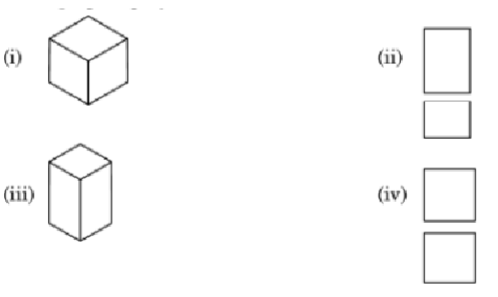
Fig. 2 shows the assembly of a SLEEVE AND COTTER JOINT. Disassemble the parts correctly and then draw to scale 1:1 its following views of the following components. Keeping the same position of both sleeve and cotter-B with respect to both H.P. and V.P.:
(i) SLEEVE
(a) Front view lower half in section
(b) Left side view
(ii) COTTER-B
(a) Front view
(b) Left side view
Print the title and scale used. Draw the projection symbol. Give 6 important dimensions.
Fig. 1 shows the details of the parts of a TURN-BUCKLE. Assemble all these parts correctly and then draw to scale 1 : 1 its following views. Keep 54 mm threaded portion of each rod inside the body of turn-buckle.
(i) Front view upper half in section
(ii) Right side view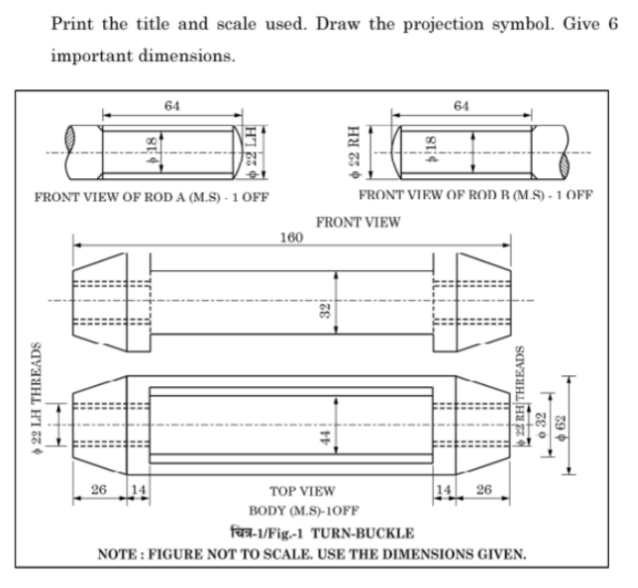
The complete circle of and the incomplete circle of in the top view of a vertical grub screw with diameter ‘d’ are drawn to __________
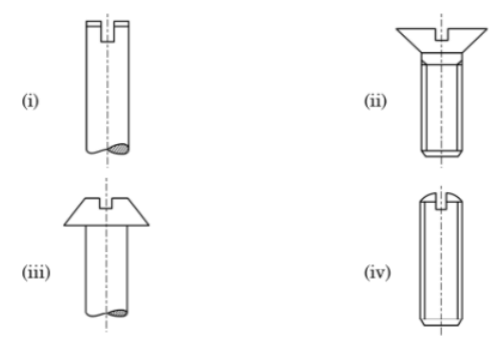
The front view of a vertical grub screw is represented by which of the following views?
About Engineering Drawing Skills - CBSE-CLASS-XII
Engineering Drawing Skills is a vital chapter for CBSE-CLASS-XII aspirants. Mastering the concepts covered in this chapter is essential for securing a top rank.
By rigorously practicing the previous year questions associated with this chapter, you can identify high-yield topics, understand the examiner's perspective, and boost your confidence during the actual exam.
Frequently Asked Questions
Why focus on Engineering Drawing Skills PYQs?
Analyzing PYQs for this specific chapter reveals the most frequently tested concepts and the typical complexity of questions, allowing you to tailor your study plan efficiently.
How to best use this analysis?
Review the topic breakdown to see which sub-topics within Engineering Drawing Skills carry the most weight. Then, tackle the questions iteratively to solidify your understanding.