Reading Comprehension
8 previous year questions.
High-Yield Trend
Chapter Questions 8 MCQs
Read the following passage carefully:
(1) A recent survey conducted by an independent research firm sought to measure levels of happiness among youth aged 16–24 years in seven countries. The findings revealed some intriguing insights into what makes today’s youth happiest, as well as which factors influence their overall well-being. In India, an overwhelming majority of the youth reported feeling satisfied with their lives, with 87% rating their overall happiness as ‘high’ or ‘very high.’ Financial security was identified as the primary source of happiness for 66%, followed by family support (89%), having a purpose in life (50%), and work or studies (40%). Unfortunately, 65% reported feeling stress related to academic performance or workload, while 25% reported feeling lonely. These figures point to a need for increased mental health support among India’s youth.
(2) These surveys also revealed that family support is an important source of contentment for young people across countries. In Europe, 59% of respondents said that their families were a major source of happiness; in France this figure was 67%, and 63% in Germany. In North America, 64% rated family as an important factor for well-being in Canada, while 61% did so in the United States. Similarly, 89% of survey respondents in India named family support as a major contributor to their overall contentment level.
(3) It is clear that stress has a significant impact on the happiness of today’s youth. The findings suggest that young people need better resources to manage their mental health and well-being. This may include access to counselling services, mindfulness activities and support groups to help them cope with challenging circumstances. It is also important to provide financial support so as to reduce some of the economic pressures.
(4) In India, 65% of youth surveyed reported feeling anxious about their academic performance or workload, while 25% felt lonely. These figures are especially significant given how important family support is for young people’s overall contentment.
Answer the following question, based on the above passage:
(1) As a young adult, life can be stressful and overwhelming at times. Juggling among school, work, social life, and other responsibilities, it can be easy to feel alone and disconnected from the world around us. Dogs are the ultimate companions for anyone looking to alleviate stress and loneliness. We’ll explore many reasons why dogs make the best companions for young adults.
(2) Unconditional love: Dogs are known for their loyalty and love for their owners, no matter what. They don’t judge us, criticize us, or hold grudges against us. No matter how flawed or imperfect we may be, our dogs will always love us unconditionally. This kind of unwavering support and affection can be incredibly comforting for young adults struggling to find their place in the world.
(3) Social connection: Dogs are great ice-breakers and conversation starters. Whether you’re walking them in the park, taking them to the dog beach, or simply hanging out at home, dogs have a way of bringing people together. For young adults who may feel isolated or disconnected from their peers, having a dog by their side can be a great way to connect with others and form new friendships.
(4) Increase physical activity: Dogs require regular exercise in order to stay healthy and happy. This means that young adults who own dogs are more likely to engage in physical activity themselves. Whether it’s going for a run, playing frisbee, or simply taking a leisurely stroll, getting out with your dog can be a great way to boost your mood and energy levels.
(5) Emotional support: Dogs are also great emotional support animals for those struggling with mental health issues such as anxiety and depression. Their presence alone can provide a sense of calm and comfort, and their ability to sense their owner’s emotions can be incredibly comforting. For young adults dealing with mental health challenges, having a dog as a companion can be a life-changing experience.
(6) Improve responsibility and self-care: Owning a dog also comes with a great deal of responsibility and self-care. Dogs require regular feeding, grooming, exercise, and attention, which can be a great way for young adults to develop a sense of responsibility and self-discipline. Additionally, having a dog as a companion can encourage young adults to take better care of themselves, such as making sure they get enough sleep, eat healthy, and engage in regular exercise.
(7) For all these reasons and more, dogs make fantastic companions for young adults. Whether you’re looking for emotional support, social connection, increased physical activity, or simply someone to love and be loved by, a dog can provide all these things and more. So the next time you’re feeling stressed or overwhelmed, consider finding a furry friend to take on the world with you.
Answer the following questions, based on the above passage:
"They wouldn't make you manager straight off, Soaf."
"I'll be like Mary Quant," Sophie said. "I'll be a natural. They'll see it from the start. I'll have the most amazing shop this city's ever seen."
Jansie, knowing they were both earmarked for the biscuit factory, became melancholy. She wished Sophie wouldn't say these things.
When they reached Sophie's street Jansie said, "It's only a few months away now, Soaf, you really should be sensible. They don't pay well for shop work, you know that, your dad would never allow it."
(Going Places)
Read the following extracts and answer the questions
He thought of the thirty kronor. To go up to the manor house would be like throwing himself voluntarily into the lion's den. He only wanted a chance to sleep here in the forge and then sneak awayas inconspicuously as possible.
The ironmaster assumed that he felt embarrassed because of his miserable clothing.
"Please don't think that I have such a fine home that you cannot show yourself there", He said... "Elizabeth is dead, as you may already have heard. My boys are abroad, and there is no one at home except my oldest daughter and myself. We were just saying that it was too bad we didn't have any company for Christmas. Now come along with me and help us make the Christmas food disappear a little faster."
(The Rattrap)
The British officer's secretary sent word to the Maharaja through the dewan that the durai himself did not have to kill the tiger. The Maharaja could do the actual killing. What was important to the durai was a photograph of himself holding the gun and standing over the tiger's carcass. But the Maharaja would not agree even to this proposal. If he relented now, what would he do if other British officers turned up for tiger hunts?
Because he prevented a British officer from fulfilling his desire, the Maharaja stood in danger of losing his kingdom itself.
(The Tiger King)
Read the following extracts and answer the questions
"That young master is so proud of his skill to save life that he saves any life," the cook said contemptuously.
"It is the children of whom we must think," Yumi said sadly.
"What will be their fate if their father is condemned as a traitor ?"
They did not try to hide what they said from the ears of Hana as she stood arranging the day's flowers in the veranda near by, and she knew they spoke on purpose that she might hear.
(The Enemy)
Read the following passage carefully:
(1) Introduction: Humans are social creatures with a deep desire to interact with one another. Recent developments in technology have made it possible for billions of people worldwide to use cell phones to satisfy this need. The current study aims to analyse the impact of smartphone use among various categories of people in Kerala, India. The present study will provide an insight into the extent and magnitude of people's reliance on smartphones to communicate in this modern age and the dwindling nature of social relationships.
(2) Methodology: A google form created questionnaire was used to gather information on the subject from a sample of participants who were from various districts in Kerala, India.
(3) Survey Examination: Among the 131 study participants, 66 were men and the remaining 65 were women. For convenience, the study considered only the main purpose for which a smartphone is used by any given individual.
(4) Results:
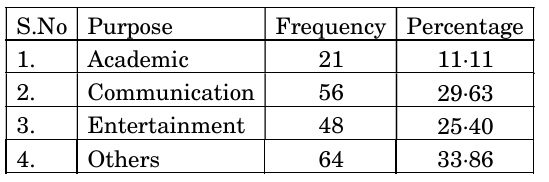
Individuals differed in their interests and preferences regarding their choice of communication medium. Some preferred direct conversation, while others conveyed their messages through virtual mediums of communication, that did not involve any face-to-face interaction.
(5) Implications for Interventions: It was observed that individuals were interested in using their smartphones even when they were dining. This constant use can have several disadvantages such as reckless use of mobile phones, including prolonged hours of radiation exposure, over-calorie intake due to binge eating, leading to obesity, and other health problems. It is also a vital tool to achieve social progress.
The use of phones while travelling can sometimes detract from an individual's enjoyment of the serenity of the environment, the scenic beauty of picnic spots, and affect the way an individual behaves and interacts with his or her co-travellers.
(6) Conclusion: It is true that most of the population under different age and gender categories use smartphones every day, but there is no significant fall in the duration spent in direct face-to-face conversation with fellow beings, except in very few individuals. The majority of people agree that traditional face-to-face communication is more comfortable, reliable, and expressive than text messages, phone calls, or electronic mail.
Answer the following questions, based on the above passage:
Read the following passage carefully:
(1) Gossip. All humans partake in some form, despite the age-old adage, "If you have nothing nice to say, don't say anything at all." Whether it's workplace chatter, the sharing of family news or group texts between friends, it's inevitable that anyone who participates in the above, talks about other people.
(2) People tend to think of gossip as synonymous with malicious rumours, put-downs, or the breathless propagation of a tabloid scoop. But researchers often define it more broadly as "talking about people who aren't present," says an assistant professor of psychology. "It's something that comes very naturally to us" - an integral part of conversation, information sharing, and even community building.
(3) "It's not necessarily negative," adds a professor of psychology. "It can be positive or neutral." Some researchers argue that gossip helped our ancestors survive. Evolutionary psychologists first pioneered this idea, comparing gossip to the grooming primates engage in as a means of bonding.
(4) People are usually resistant to thinking about gossip as anything but bad. It is true that there are some types of gossip that should be avoided, such as gossip that is purely harmful and serves no purpose like mean comments on someone's way of dressing. In such a scenario no one benefits. Gossip can also be both active and passive. Active gossiping refers to directly sharing negative information about someone else. An active gossiper initiates the conversation and actively spreads it. Passive gossiping on the other hand involves more subtle behaviour like hinting, dropping suggestive comments or participating in gossip by listening without actively contributing, but still allowing the gossip to spread through their presence.
(5) It's interesting to note that gossiping also says something about relationships people have with one another. The act of gossiping often implies a level of trust and closeness with someone, which are key aspects of a good friendship.
(6) Research has found that gossip can stave off loneliness, while other studies have found it can facilitate bonding and closeness and serve as a form of entertainment. So, keep on talking. And when your conversation turns to gossip, as it inevitably will, remember that some good can come of it - with the right intentions, of course.
Answer the following questions, based on the above passage:
About Reading Comprehension - CBSE-CLASS-XII
Reading Comprehension is a vital chapter for CBSE-CLASS-XII aspirants. Mastering the concepts covered in this chapter is essential for securing a top rank.
By rigorously practicing the previous year questions associated with this chapter, you can identify high-yield topics, understand the examiner's perspective, and boost your confidence during the actual exam.
Frequently Asked Questions
Why focus on Reading Comprehension PYQs?
Analyzing PYQs for this specific chapter reveals the most frequently tested concepts and the typical complexity of questions, allowing you to tailor your study plan efficiently.
How to best use this analysis?
Review the topic breakdown to see which sub-topics within Reading Comprehension carry the most weight. Then, tackle the questions iteratively to solidify your understanding.