Python Libraries
11 previous year questions.
High-Yield Trend
Chapter Questions 11 MCQs
Expected Series:
A 10
B 20
C 30
D 40
E 50
dtype: int64
Expected DataFrame:
 City State
0 Mumbai Maharashtra
1 Dehradun Uttarakhand
2 Bengaluru Karnataka
3 Hyderabad Telangana
Given code with mistakes:
import pandas data = [50, 15, 40] series = pd.series(data, Index=['x', 'y', 'z']) Print(series)
Expected output:
 COLOUR NAME QTY
0 Red Apple 10
1 Blue Berry 15
2 Green Guava 20
Given incomplete code:
import _______ as pd
data = [ {'COLOUR': 'Red', 'NAME': 'Apple', 'QTY': 10}, {'COLOUR': 'Blue', 'NAME': 'Berry', 'QTY': 15}, {_______, 'NAME': 'Guava', 'QTY': 20}
]
df = pd.DataFrame(_______)
print(_______)
Consider the DataFrame Doctor shown below: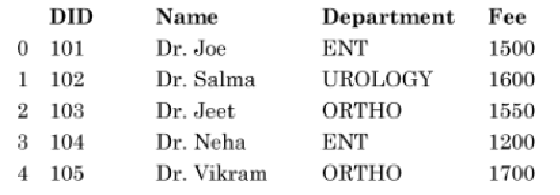
Write suitable Python statements for the following:
(i) To print the last three rows of the DataFrame Doctor.
(ii) To display the names of all doctors.
(iii) To add a new column 'Discount' with value of 200 for all doctors.
(iv) To display rows with index 2 and 3.
(v) To delete the column 'Department'.
Gurkirat has to fill in the blanks in the given Python program that generates a line plot as shown below. The given line plot represents the temperature (in degree Celsius) over five days as given in the table: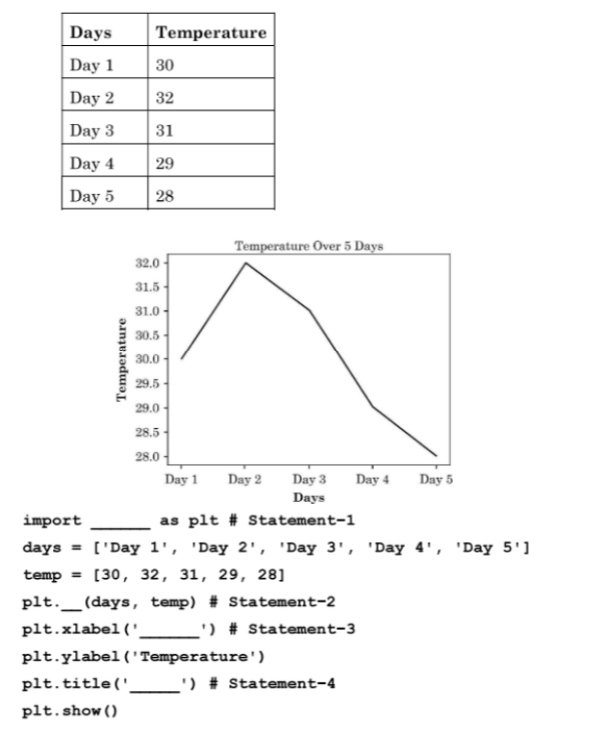
Write the missing statements according to the given specifications:
(i) Write the suitable code to import the required module in the blank space in the line marked as Statement-1.
(ii) Fill in the blank in Statement-2 with a suitable Python function name to create a line plot.
(iii) Refer to the graph shown and fill in the blank in Statement-3 to display the appropriate label for x-axis.
(iv) Refer to the graph shown and fill in the blank in Statement-4 to display the suitable chart title.
About Python Libraries - CBSE-CLASS-XII
Python Libraries is a vital chapter for CBSE-CLASS-XII aspirants. Mastering the concepts covered in this chapter is essential for securing a top rank.
By rigorously practicing the previous year questions associated with this chapter, you can identify high-yield topics, understand the examiner's perspective, and boost your confidence during the actual exam.
Frequently Asked Questions
Why focus on Python Libraries PYQs?
Analyzing PYQs for this specific chapter reveals the most frequently tested concepts and the typical complexity of questions, allowing you to tailor your study plan efficiently.
How to best use this analysis?
Review the topic breakdown to see which sub-topics within Python Libraries carry the most weight. Then, tackle the questions iteratively to solidify your understanding.