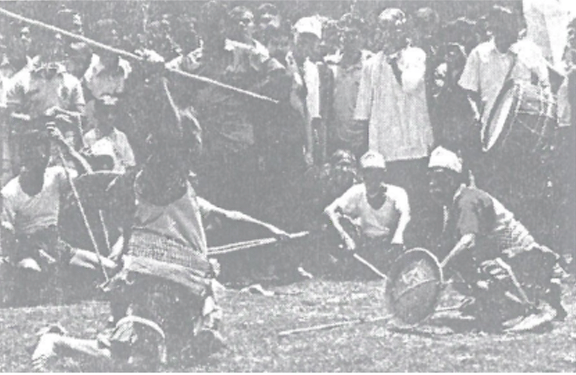
Apart from wrestling, there were other exercises that were recommended in order to increase physical strength as a preparation to the mastering of martial arts. What are the other exercises recommended? If you were to take up any form, what would that be and why?
Official Solution
Correct Option:
(1)
In traditional Indian martial training systems, physical conditioning was considered foundational before one could master weapons or combat techniques. Apart from wrestling (\textit{malla-yuddha}), several exercises were recommended to improve stamina, flexibility, and control.
Common Traditional Physical Exercises Included: Surya Namaskar (Sun Salutation): A sequence of yoga postures that improve flexibility, strength, and breath control. Danda and Baithak: Variations of push-ups and squats performed rhythmically, often used by wrestlers to build endurance. Mallakhamb: A form of aerial yoga involving acrobatics on a wooden pole or rope to enhance coordination and core strength. Weight Training with Gadā (Mace): Swinging the mace in controlled patterns to develop upper body power and balance. Running and Rope Climbing: Essential for cardiovascular fitness and grip strength.
These exercises not only built physical capacity but also discipline, balance, breath control, and mental focus—qualities necessary for mastering martial arts like Kalaripayattu or Silambam.
Personal Choice: If I were to take up any one form, it would be Mallakhamb. I find it a powerful blend of strength, flexibility, and artistic movement. It pushes the body to engage muscles that regular workouts often ignore and improves both physical and mental endurance. Its traditional roots also connect me with India’s indigenous systems of training, which are sustainable and holistic.
If you were to introduce any one Indian traditional martial art form in your school, which one would that be and why?
Official Solution
Correct Option:
(1)
If I were to introduce one Indian martial art in my school, it would be Kalaripayattu, the ancient martial art of Kerala. It is often regarded as one of the oldest martial systems in the world and is not just a combat technique, but a complete system of physical, mental, and spiritual development. Reasons:
Holistic Physical Development: Kalaripayattu improves flexibility, strength, reflexes, and stamina through movements, postures, and weapon handling. Focus and Discipline: The training cultivates inner focus, balance, and mental discipline—qualities beneficial for academic and personal life. Cultural Pride: Teaching such an indigenous form promotes awareness of India’s rich heritage and instills a sense of cultural identity. Self-Defense and Confidence: Students, especially young girls, benefit from the self-defense techniques, enhancing their safety and confidence.
Introducing Kalaripayattu in school would make education more well-rounded and culturally rooted.
There were popular martial exercises that were practised such as śastraśrama. Give details of any four śastraśramas.
Official Solution
Correct Option:
(1)
Śastraśramas were centers or traditions where martial training was imparted systematically in ancient and medieval India. These included armed and unarmed combat techniques along with ethical discipline and physical conditioning. Here are four major systems: Kalaripayattu (Kerala): Known as one of the world’s oldest martial arts, it includes body control, strikes, weaponry, and healing techniques (āyurveda-based). Silambam (Tamil Nadu): Focuses on stick fighting, using speed, agility, and complex footwork. Gatka (Punjab): Originating from Sikh martial culture, Gatka involves the use of swords, spears, and sticks in fluid, rhythmic movement. Mardani Khel (Maharashtra): Practised by Maratha warriors, it involves sword and lance fighting, often on horseback.
These traditions integrated physical excellence with moral training, ensuring warriors upheld dharma (righteous conduct) along with strength.
There are two statements marked as Assertion (A) and Reason (R). Mark your answer as per the codes provided below: Assertion (A): Valari vicu uses a kind of boomerang made of wood, ivory or iron. Reason (R): It is also used for defense.
1
Both (A) and (R) are true and (R) is the correct explanation of (A).
2
Both (A) and (R) are true, but (R) is not the correct explanation of (A).
3
(A) is true, (R) is false.
4
(A) is false, (R) is true.
Official Solution
Correct Option:
(1)
Valari vicu is a traditional martial art form practiced primarily in the southern regions of Tamil Nadu. It involves the use of the valari—a curved, boomerang-like weapon that can be made of materials such as wood, ivory, or iron. These valaris were designed to be thrown toward a distant target, allowing warriors to attack from a range. This makes Assertion (A) factually accurate: the art form is centered around the use of a unique boomerang-like implement. Reason (R) is also true. The valari wasn’t only used for attack but also played a role in defense strategies. Its aerodynamic shape and skillful use allowed the wielder to strike enemies from a distance, reducing the chance of close combat injuries. It provided tactical advantages, especially in guerrilla-style warfare, by keeping adversaries at bay. Furthermore, the Reason clearly supports the Assertion, as the weapon’s design and use for defense explain its significance in the martial tradition. Therefore, both statements are true, and the reason is a valid explanation for the assertion.
Study the picture and answer the question that follows: Which of the following options best signifies this particular martial art called Gadka?
1
It is a training in remote resistance of or attack on an enemy.
2
The practice of this martial art form requires training with dangerous weapons dagger, mace, sword.
3
The training involved encircling the pillar with twisting movements.
4
A wooden stick and a shield are usually used in the match.
Official Solution
Correct Option:
(4)
Gadka is a traditional martial art form from Punjab. It is characterized by the use of a wooden stick (\textit{gadka}) and a small shield. Practitioners perform combat drills and mock duels in a choreographed manner using these simple yet symbolic weapons. This martial form has cultural and religious significance in Sikh history and is often performed during festivals or religious events. Explanation of Other Options:
(A) Remote resistance is not the focus of Gadka, which is close-combat training. (B) Though traditional weapons exist in martial practices, Gadka emphasizes stick and shield. (C) This refers more to exercises like Mallakhamb, not Gadka.
Lathi—a polished bamboo stick—is used to ward off the enemy through various wielding techniques, steps, and positioning.
Official Solution
Correct Option:
(1)
The lathi, or stick, is one of the oldest and most accessible weapons used in India across regions and social groups. Its popularity stems from several practical, cultural, and strategic factors.
Reasons for popularity:
Affordability and Availability: Bamboo and hardwood sticks are inexpensive and easily available in most parts of India. This made them ideal for both self-defense and formal training across all economic classes. Versatility and Safety: A lathi can be used for both attack and defense. Its non-lethal nature also made it suitable for training and police use. Techniques included thrusts, blocks, spins, and footwork patterns. Cultural Integration: Traditional martial arts like \textit{Silambam} (Tamil Nadu), \textit{Lathi Khela} (Bengal), and \textit{Thang-ta} (Manipur) all incorporate stick-fighting techniques. It is deeply rooted in local customs and even rural sports. Ease of Training: Compared to swords or complex weapons, lathi requires less infrastructure and can be practiced in open fields, making it ideal for village communities and local youth. Utility in Policing and Public Order: Even today, police forces across India are equipped with lathis for crowd control due to their deterrent power and symbolic authority.
The lathi represents the combination of accessibility, effectiveness, and cultural continuity. It is not just a weapon but a symbol of self-discipline, tradition, and grassroots martial heritage.
About Indian Martial Arts - CBSE-CLASS-XII
Indian Martial Arts is a vital chapter for CBSE-CLASS-XII aspirants. Mastering the concepts covered in this chapter is essential for securing a top rank.
By rigorously practicing the previous year questions associated with this chapter, you can identify high-yield topics, understand the examiner's perspective, and boost your confidence during the actual exam.
Frequently Asked Questions
Why focus on Indian Martial Arts PYQs?
Analyzing PYQs for this specific chapter reveals the most frequently tested concepts and the typical complexity of questions, allowing you to tailor your study plan efficiently.
How to best use this analysis?
Review the topic breakdown to see which sub-topics within Indian Martial Arts carry the most weight. Then, tackle the questions iteratively to solidify your understanding.