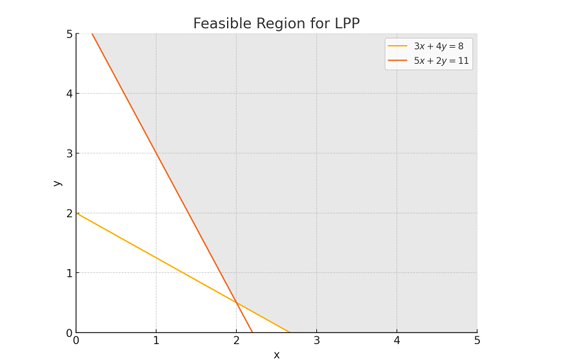
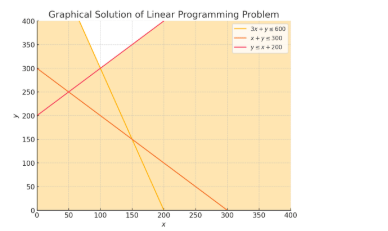
Step 1: Draw lines: Step 2: Feasible region is unbounded region above both lines in first quadrant. Step 3: Find corner points of feasible region:
- Intersection of lines: solve Multiply 1st by 2: Multiply 2nd by 4: . Subtract: . Put in 2nd: . Corner point: . Also find intercepts and check minimum on boundary. Finally: Evaluate at corner points.
02
PYQ 2023
medium
mathematicsID: cbse-cla
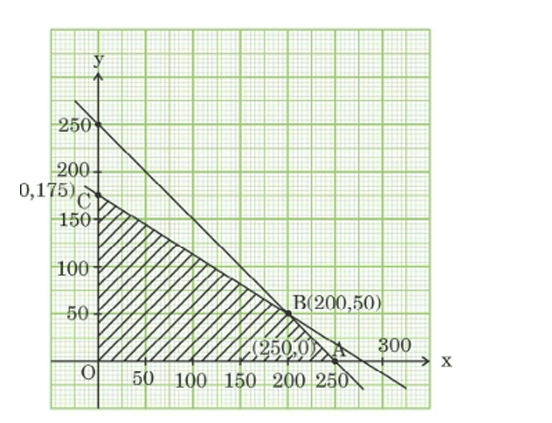
The corner points of the bounded feasible region of an LPP are O(0, 0), A(250, 0), B(200, 50) and C(0, 175). If the maximum value of the objective function occurs at the points A(250, 0) and B(200, 50), then the relation between a and b is:
1
2
3
4
Official Solution
Correct Option: (2)
The maximum of the objective function occurs at both points A and B. So, At A(250, 0): At B(200, 50): Since for maximum: Oops! Wait β but the question says , so the coefficient of is , so the calculation is correct. So, So the answer is (A) not (B). Correct option is (A).
03
PYQ 2023
medium
mathematicsID: cbse-cla
The point which lies in the half-plane is:
1
(0, 8)
2
(1, 1)
3
(5, 5)
4
(2, 2)
Official Solution
Correct Option: (2)
Plug points into : - (0, 8): (not )
- (1, 1): (OK)
- (5, 5): (not OK)
- (2, 2): (not OK) So only (1, 1) works.
04
PYQ 2024
medium
mathematicsID: cbse-cla
Solve the following linear programming problem graphically:MaximiseSubject to the constraints:
Official Solution
Correct Option: (1)
Step 1: Graphical Representation of Constraints. To solve the problem graphically, we plot the constraint equations: 1. (line passing through (6,0) and (0,6)) 2. (vertical line at ) 3. (horizontal line at ) 4. (first quadrant restriction) The feasible region is the intersection of these constraints.
Step 2: Identifying Corner Points of Feasible Region. From the graph, the common feasible region forms a bounded polygon. The corner points of this region are:
Step 3: Compute Objective Function at Corner Points. Evaluating at each corner:
Step 4: Determine Maximum Value. The maximum value occurs at point with:
Conclusion: The maximum value of is at .
05
PYQ 2024
medium
mathematicsID: cbse-cla
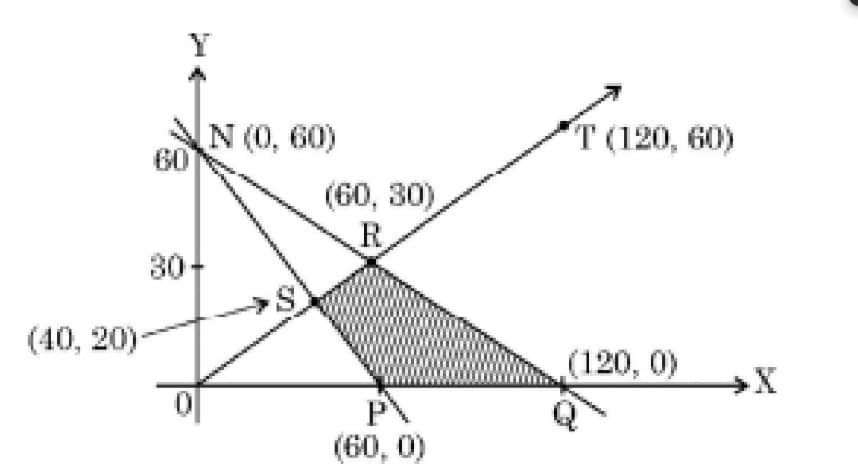
Assertion (A): The corner points of the bounded feasible region of a L.P.P. are shown below. The maximum value of occurs at infinite points. Reason (R): The optimal solution of a LPP having bounded feasible region must occur at corner points.
1
Both Assertion (A) and Reason (R) are true and Reason (R) is the correct explanation of Assertion (A).
2
Both Assertion (A) and Reason (R) are true and Reason (R) is not the correct explanation of Assertion (A).
3
Assertion (A) is true, but Reason (R) is false.
4
Assertion (A) is false, but Reason (R) is true.
Official Solution
Correct Option: (2)
Step 1: {Analyze Assertion (A)} From the graph, the line passes through two corner points and , providing the same maximum value. This indicates that the maximum value occurs at infinite points along this segment. Thus, Assertion (A) is true.
Step 2: {Analyze Reason (R)} In general, the optimal solution of an LPP occurs at corner points of the feasible region. This is true; however, in this case, the solution lies along a line segment connecting two corner points. Thus, Reason (R) is not the correct explanation of Assertion (A).
Step 3: {Conclusion} Both Assertion (A) and Reason (R) are true, but Reason (R) does not explain Assertion (A). Hence, the correct answer is option (B).
06
PYQ 2024
medium
mathematicsID: cbse-cla
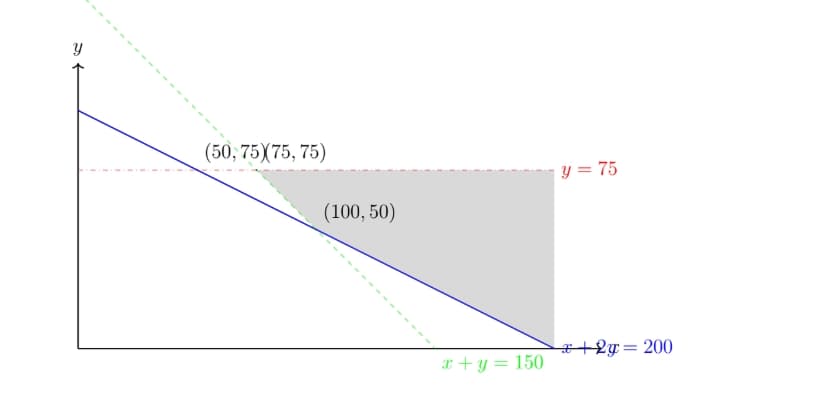
The maximum value of for a L.P.P. whose feasible region is given below is:
1
2
3
4
Official Solution
Correct Option: (3)
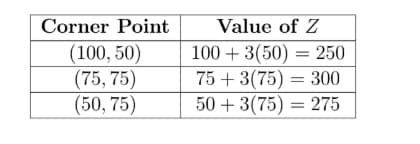
Step 1: {Identify the corner points of the feasible region} From the graph, the vertices of the feasible region are:
Step 2: {Substitute corner points into } Evaluate at each vertex:
Step 3: {Find the maximum value} The maximum value of occurs at , where .
Step 4: {Verify the options} The maximum value is , which corresponds to option (C).
07
PYQ 2025
hard
mathematicsID: cbse-cla
Solve the following linear programming problem graphically:Maximise Subject to the constraints:
Official Solution
Correct Option: (1)
We need to graph the constraints and find the feasible region. - From , we have . - From , we have . - The last constraint is , which restricts the values to the first quadrant. After plotting the constraints, the feasible region is formed, and we can evaluate at the vertices of the feasible region. The vertex points are: (0, 0), (4, 2), (5, 3). Now calculate at these points:
- At (0, 0), .
- At (4, 2), .
- At (5, 3), . Thus, the maximum value of at the point (5, 3).
08
PYQ 2025
medium
mathematicsID: cbse-cla
Solve the following Linear Programming Problem using graphical method : Maximize subject to the constraints
Official Solution
Correct Option: (1)
1. Plot the constraints: The constraints are plotted as lines: - - - 2. Determine the feasible region: The feasible region is the area where all the inequalities are satisfied. This is the region bounded by the lines. 3. Find the corner points of the feasible region: - Intersection of and : The corner point is . - Intersection of and : The corner point is . - Intersection of and : The corner point is . 4. Evaluate the objective function at the corner points: - At , - At , - At , The maximum value of is 25000 at the corner point . 5. Final Answer: The optimal solution is , , and the maximum value of .
09
PYQ 2025
hard
mathematicsID: cbse-cla
The corner points of the feasible region in graphical representation of a L.P.P. are and . If be the objective function, then:
1
is maximum at minimum at
2
is maximum at minimum at
3
is maximum at minimum at
4
is maximum at minimum at
Official Solution
Correct Option: (3)
To find the maximum and minimum values of , evaluate at each of the corner points: - At - At - At Thus, the maximum value of is at and the minimum is at .
10
PYQ 2025
medium
mathematicsID: cbse-cla
Assertion : In a Linear Programming Problem, if the feasible region is empty, then the Linear Programming Problem has no solution. Reason (R): A feasible region is defined as the region that satisfies all the constraints.
1
Both Assertion (A) and Reason (R) are true and the Reason (R) is the correct explanation of the Assertion (A).
2
Both Assertion (A) and Reason (R) are true, but Reason (R) is not the correct explanation of the Assertion (A).
3
Assertion (A) is true, but Reason (R) is false.
4
Assertion (A) is false, but Reason (R) is true.
Official Solution
Correct Option: (1)
- Assertion : In a Linear Programming Problem, if the feasible region is empty, then the Linear Programming Problem has no solution. This assertion is true. The feasible region represents the set of all points that satisfy the given constraints of the Linear Programming Problem. If the feasible region is empty, it means that no solution exists that satisfies all the constraints simultaneously. Hence, the Linear Programming Problem has no solution when the feasible region is empty. - Reason (R): A feasible region is defined as the region that satisfies all the constraints. This is also true. The feasible region represents all the points that satisfy the system of inequalities or equalities that define the constraints of the Linear Programming Problem. If this region is empty, no solution can be found that satisfies all constraints. Since both Assertion and Reason (R) are true, and Reason (R) correctly explains Assertion , the correct answer is option .
11
PYQ 2025
hard
mathematicsID: cbse-cla
The corner points of the feasible region of a Linear Programming Problem are , , , , and . If be the objective function, and maximum value of is obtained at and , then the relation between and is :
1
2
3
4
Official Solution
Correct Option: (2)
Since the maximum value of is obtained at and , we have the following system of equations for the objective function at these points: - At : - At : For the maximum value of to be the same at both points, we set , which gives the relation: Thus, the correct relation is .
12
PYQ 2025
easy
mathematicsID: cbse-cla
The feasible region of a linear programming problem with objective function , is bounded, then which of the following is correct?
1
It will only have a maximum value.
2
It will only have a minimum value.
3
It will have both maximum and minimum values.
4
It will have neither maximum nor minimum value.
Official Solution
Correct Option: (3)
In a linear programming problem, the objective function is of the form , where and are constants, and and are the decision variables. The feasible region of a linear programming problem is the set of all points that satisfy the constraints of the problem. Step 1: Feasible Region is Bounded
The term "bounded" means that the feasible region is a closed and finite region in the plane. This means that there is a well-defined region within which all feasible solutions exist, and no solution lies outside this region. Step 2: Objective Function Behavior
The objective function is a linear function. A linear function either increases or decreases in one direction. Because the feasible region is bounded, it is confined within a certain region of the coordinate plane. The linear objective function will attain its extreme values at the vertices (or corner points) of the feasible region. Step 3: Existence of Both Maximum and Minimum
Because the feasible region is bounded, the objective function will reach both a maximum value and a minimum value at these corner points. This is a property of linear programming problems with a bounded feasible region. - If the region is bounded, the objective function will always attain its maximum and minimum at one of the vertices.
- The maximum value corresponds to the largest value of at a corner point, and the minimum value corresponds to the smallest value of at a corner point. Thus, a bounded feasible region guarantees that both a maximum and a minimum value will exist for the objective function. Step 4: Conclusion
Therefore, the correct answer is:
13
PYQ 2025
hard
mathematicsID: cbse-cla
Solve the following linear programming problem graphically: Maximise Subject to the constraints:
Official Solution
Correct Option: (1)
This is a linear programming problem with the objective function and constraints. Step 1: Plot the constraints
We start by plotting the constraints on the graph: 1. : The line is , which intersects the axes at and .
2. : The line is , which intersects the axes at and .
3. : A vertical line at .
4. : A horizontal line at . Step 2: Identify the feasible region The feasible region is the area that satisfies all the constraints. The region is bounded by the lines formed by the constraints. Step 3: Evaluate the objective function Once we have the feasible region, evaluate at the vertices of the feasible region. The maximum value of will occur at one of these vertices. Step 4: Find the optimal solution After evaluating at the vertices, the point where is maximized gives the optimal solution.
14
PYQ 2025
hard
mathematicsID: cbse-cla
Solve the following LPP graphically: Maximize: Subject to:
Official Solution
Correct Option: (1)
Step 1: Convert inequalities to equations
Line 1:
Line 2:
Line 3:
Step 2: Find Intercepts
Line 1: ,
Line 2: ,
Line 3: ,
Step 3: Graph and Feasible Region
Plot all three lines and shade the region that satisfies all constraints including and .
Step 4: Find Corner Points (Intersections)
Line 1 & Line 2: Solve: Multiply (i) by 2: Subtract from (ii): So point A:
Line 2 & Line 3: Substitute: So point B:
Line 1 & Line 3: Substitute: So point C:
Step 5: Evaluate at Each Corner Point
Point
(0, 0)
0
β Final Answer:
Maximum value of is at two corner points:
15
PYQ 2025
easy
mathematicsID: cbse-cla
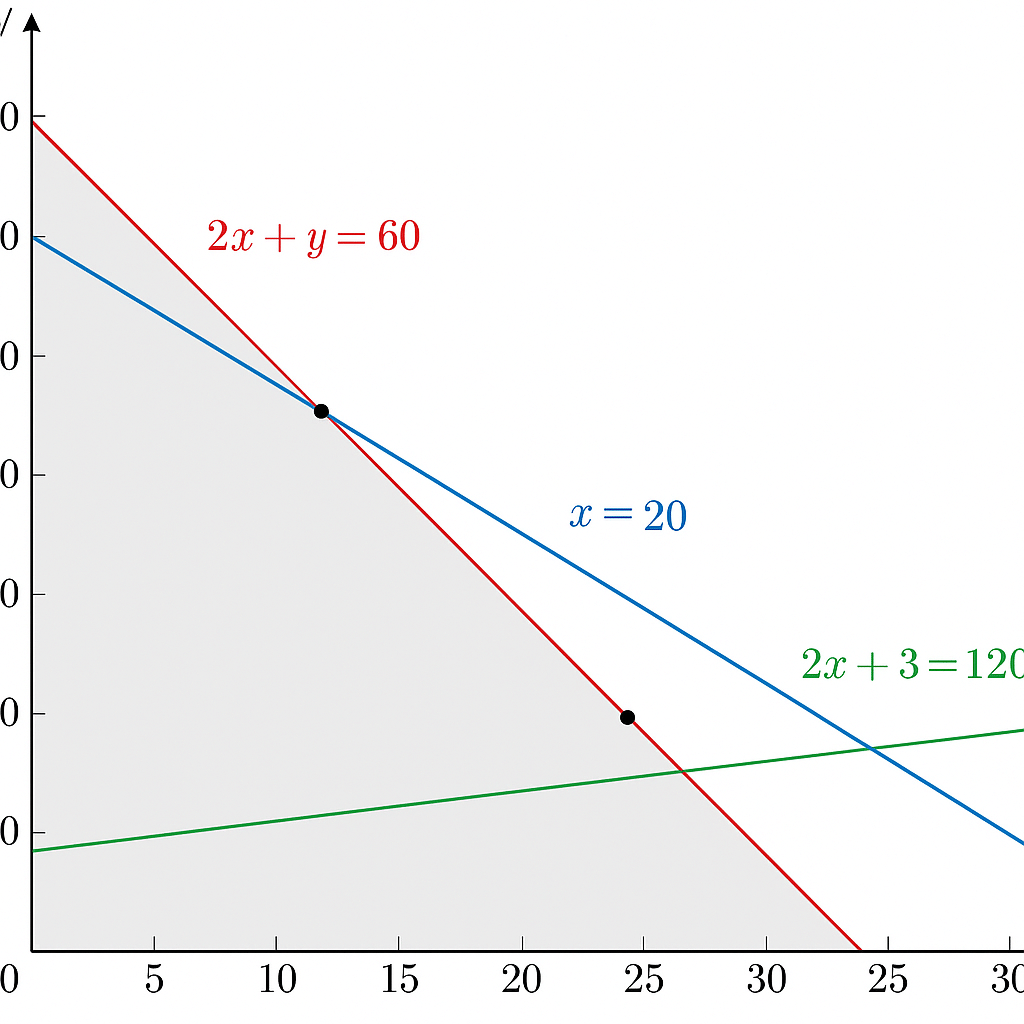
A manufacturer makes two types of toys A and B. Three machines are needed for production with the following time constraints (in minutes): Each machine is available for 6 hours = 360 minutes. Profit on A = Rupee 20, on B = Rupee 30. Formulate and solve the LPP graphically.
Official Solution
Correct Option: (1)
Step 1: Let the variables be Let = number of Toy A units produced Let = number of Toy B units produced Step 2: Write the Objective Function We want to maximize profit: Step 3: Translate constraints from machine limits
M1:
M2:
M3:
Non-negativity:
Step 4: Draw the Feasible Region Step 5: Find Corner Points of Feasible Region We solve the equations of intersecting lines to find vertices of the region: (i) Intersection of and : (ii) Intersection of and : (iii) Intersection of and : Step 6: Evaluate Objective Function at Each Corner Point Step 7: Select Optimal Value Final Answer:
16
PYQ 2025
medium
mathematicsID: cbse-cla
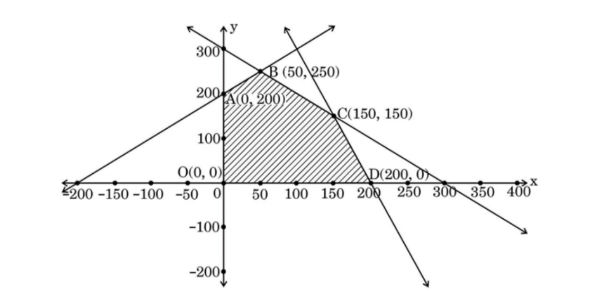
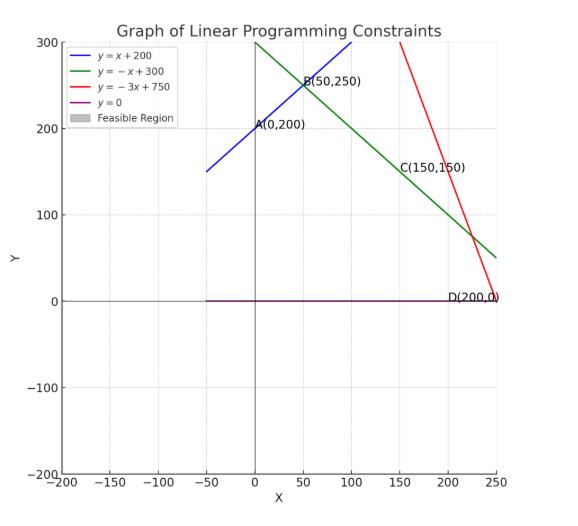
For the given graph of a Linear Programming Problem, write all the constraints satisfying the given feasible region.
Official Solution
Correct Option: (1)
From the given graph, we can identify the constraints that form the feasible region. The vertices of the region are , , , and . Using the equation of the line passing through any two points, we can write the inequalities corresponding to the constraints. 1. From Point A(0, 200) to B(50, 250):
The slope is calculated as:
Using the point in the equation of the line:
Thus, the first constraint is:
2. From Point B(50, 250) to C(150, 150):
The slope is:
Using point :
Thus, the second constraint is:
3. From Point C(150, 150) to D(200, 0):
The slope is:
Using point :
Thus, the third constraint is:
4. From Point D(200, 0) to O(0, 0):
The slope is:
The equation is simply:
Thus, the fourth constraint is:
Constraints:
The constraints for the feasible region are:
These constraints define the feasible region in the given Linear Programming Problem.
17
PYQ 2025
easy
mathematicsID: cbse-cla
Solve the following Linear Programming Problem graphically:
Minimise
subject to the constraints:
Official Solution
Correct Option: (1)
18
PYQ 2025
medium
mathematicsID: cbse-cla
In an LPP, corner points of the feasible region determined by the system of linear constraints are . If , where is to be minimized, the condition on and so that the minimum of occurs at and will be:
1
2
3
4
Official Solution
Correct Option: (2)
We are given the objective function:
and it is to be minimized over the feasible region formed by the points:
Let us evaluate at each of the corner points: At point : At point : At point : We are told that the minimum of occurs at both and . So we must have:
19
PYQ 2025
hard
mathematicsID: cbse-cla
The maximum value of subject to the constraints , , is:
1
3
2
4
3
7
4
0
Official Solution
Correct Option: (2)
We are given the objective function:
Subject to the constraints:
These constraints define a feasible region in the first quadrant bounded by the line , the -axis and the -axis. Let us identify the corner points (vertices) of the feasible region: 1. When : 2. When : 3. Intersection of and : So, the corner points are: Now, evaluate at each vertex: - At :
- At :
- At : Maximum value of is:
20
PYQ 2026
medium
mathematicsID: cbse-cla
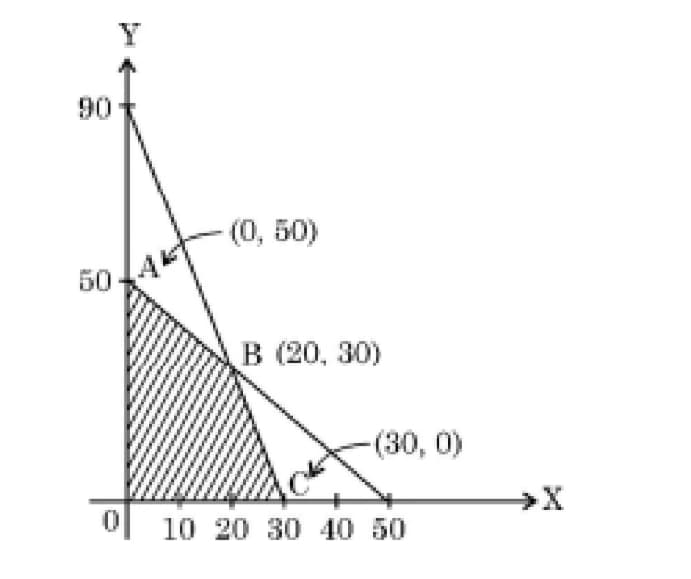
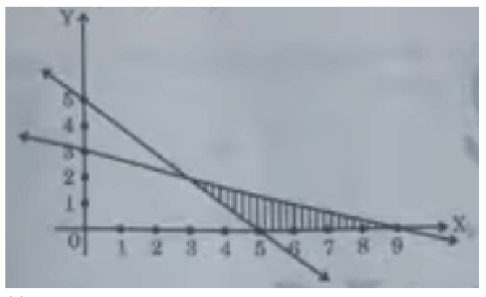
For the feasible region shown below, the non-trivial constraints of the linear programming problem are
1
2
3
4
Official Solution
Correct Option: (1)
Step 1: Understand the graph. From the given figure we observe two boundary lines forming the feasible region. The shaded region lies below both lines. Thus the inequalities will be of the form . Step 2: Identify the first line. The first line passes through the intercepts: Equation of this line is Since the region is below the line Step 3: Identify the second line. The second line passes through the intercepts: Equation of this line becomes Again the feasible region lies below this line Step 4: Combine the constraints. Thus the two non-trivial constraints are Step 5: Conclusion. Therefore the correct pair of inequalities representing the feasible region is Final Answer:
21
PYQ 2026
medium
mathematicsID: cbse-cla
In a linear programming problem, the linear function which has to be maximized or minimized is called
1
a feasible function
2
an objective function
3
an optimal function
4
a constraint
Official Solution
Correct Option: (2)
Step 1: Understand the concept of Linear Programming. Linear Programming (LP) is a mathematical technique used to optimize (maximize or minimize) a linear function subject to certain constraints. In LP problems we usually have three major components: β’ Decision variables
β’ Constraints
β’ Objective function Step 2: Definition of Objective Function. The function that we want to optimize (either maximize profit or minimize cost) is called the objective function. For example: where is the quantity we want to maximize or minimize. Step 3: Difference from other options. β’ Feasible function: refers to feasible solutions satisfying constraints.
β’ Optimal function: not a standard LP term.
β’ Constraint: inequalities restricting the solution region. Thus the linear function to be maximized or minimized is called the objective function. Final Answer:
22
PYQ 2026
medium
mathematicsID: cbse-cla
Solve the following linear programming problem graphically: Maximize Subject to the constraints
Official Solution
Correct Option: (1)
Step 1: Write the given constraints. The constraints of the linear programming problem are Since and are nonβnegative, the feasible region will lie in the first quadrant. Step 2: Convert inequalities into equations. To draw the boundary lines, convert the inequalities into equations: Step 3: Find intercepts of the first line. For : If , If , Thus the line passes through points Step 4: Find intercepts of the second line. For : If , If , Thus the line passes through Step 5: Determine the feasible region. The feasible region is obtained by satisfying all the inequalities simultaneously in the first quadrant. The corner points of the feasible region are Step 6: Find intersection of the two lines. Solve Multiply the second equation by 3: Subtract the first equation: Substitute into : Thus intersection point is Step 7: Compute the value of at each corner point. At : At : At : At : Step 8: Determine the maximum value. The maximum value of occurs at Step 9: Final conclusion. The optimal solution of the linear programming problem is and the maximum value of the objective function is Final Answer: