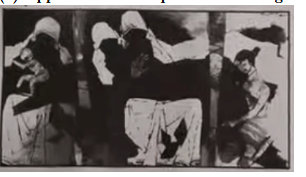
Pahari miniature reflects the freedom the artists were given to show diversity of artistic expression within miniature style. Choose one of the paintings given below and answer:
(i) Write the name of the artist and the sub-school of painting.
(ii) Explain any two characteristics of the sub-school.
(a) Krishna with Gopis
OR
(b) Nand, Yashoda and Krishna with kinsmen going to Vrindavan
Official Solution
Correct Option: (1)
Option Chosen: Krishna with Gopis(i) Name of Artist and Sub-school: Artist: {Manaku} (associated with early Pahari tradition) Sub-school: Guler sub-school (which later influenced Kangra style) (ii) Two Characteristics of the Sub-school:1. Emotional and Lyrical Expression: The Guler sub-school is known for its delicate and poetic representation of emotions. In paintings like {Krishna with Gopis}, the artist focuses on:
Graceful gestures and soft facial expressions
Romantic and devotional mood (Bhakti and Shringara rasa)
Intimate interaction between divine and human figures
This reflects the influence of Vaishnavism and devotional poetry. 2. Naturalistic and Soft Colour Palette: The Guler style moved away from bold and rigid compositions of earlier schools and introduced:
Soft, harmonious colors
Gentle landscapes with rolling hills and trees
Refined shading and delicate brushwork
Nature is treated as a lyrical background rather than a decorative element, enhancing the overall serenity of the painting. Additional Features of the Guler School (for enrichment):
Influence of Mughal naturalism in anatomy and detailing
Graceful female figures with slender forms
Balanced composition with rhythmic movement
Transition phase leading to the fully developed Kangra style
Explanation of the Painting Theme: The painting {Krishna with Gopis} represents Krishna surrounded by devotees (Gopis), symbolizing:
Divine love and devotion
Spiritual union between the soul and the divine
Celebration of Krishnaβs playful and compassionate nature
The circular composition often used in such paintings enhances unity and harmony. Conclusion: The Guler sub-school of Pahari miniature painting is marked by emotional sensitivity, refined aesthetics, and naturalistic elegance. Paintings like {Krishna with Gopis} beautifully illustrate the freedom and expressive richness of the Pahari tradition.
02
PYQ 2026
easy
paintingID: cbse-cla
In Rajasthani Miniature paintings, women are seen riding horses and playing polo which reflects:
1
Women empowerment
2
Sympathy for women
3
Terrified women
4
Dependent women
Official Solution
Correct Option: (1)
Concept:
Rajasthani miniature paintings often depict royal life, traditions, and cultural values of medieval Rajasthan. These artworks frequently highlight themes like valor, romance, and social status. Step 1: Understanding the depiction.
Women shown riding horses and playing polo indicate:
Active participation in elite and traditionally male activities
Royal freedom and confidence
Step 2: Symbolic meaning.
Such portrayals symbolize:
Strength and independence
Elevated social status of royal women
Cultural representation of empowered femininity
Step 3: Elimination of other options.
Sympathy for women β Not indicated by active roles
Terrified women β Opposite of confident imagery
Dependent women β Contradicted by independence shown
Conclusion:
The depiction of women riding horses and playing polo reflects their strength, confidence, and social empowerment in royal settings.
03
PYQ 2026
medium
paintingID: cbse-cla
The colour schemes and subject-matter themes are very attractive in the two styles given below. Answer the following by picking your sub-school from your syllabus:
(a) Kishangarh sub-school
OR
(b) Mewar sub-school
(i) Write the name of the artist and the painting from your syllabus.
(ii) Explain any two characteristic features of this sub-school.
Official Solution
Correct Option: (1)
Option Chosen: Kishangarh Sub-school(i) Name of the Artist and Painting: Artist: {Nihal Chand} Painting: {Bani Thani} School: Kishangarh School of Rajasthani Miniature Painting (ii) Two Characteristic Features of Kishangarh Sub-school:1. Idealized and Stylized Facial Features: The Kishangarh style is renowned for its highly refined and poetic representation of human figures, especially female beauty. Typical features include:
Long, arched eyebrows
Lotus-shaped elongated eyes
Sharp nose and delicate chin
Graceful and slender body proportions
The painting {Bani Thani} is often called the βIndian Mona Lisaβ due to its mysterious expression and stylized elegance. 2. Romantic and Devotional Themes: Kishangarh paintings are deeply influenced by:
Krishna-Radha devotion
Romantic poetry and Bhakti traditions
The paintings portray divine love with:
Dreamlike landscapes
Soft color palettes
Emotional depth and lyrical beauty
Additional Features of Kishangarh Style:
Use of delicate pastel shades and smooth tonal transitions
Fine and precise brushwork
Harmonious compositions with lyrical rhythm
Influence of court culture under Raja Sawant Singh
About the Painting {Bani Thani:} The painting represents an idealized image of feminine beauty and is believed to be inspired by:
The poetess and singer Vishnupriya (Bani Thani)
Radha as the divine beloved
It combines romance, devotion, and aesthetic perfection. Conclusion: The Kishangarh sub-school stands out for its refined elegance, poetic imagination, and devotional charm. Through artists like Nihal Chand and masterpieces like {Bani Thani}, it represents one of the most graceful traditions of Rajasthani miniature painting.
04
PYQ 2026
medium
paintingID: cbse-cla
The depiction of female figures in Mughal miniature school is less. However, in the paintings from your course, the artist has shown female figures and Mughal grandeur in:
1
Chand Bibi playing polo
2
Marriage procession of Dara Shikoh
3
Maru-Ragini
4
Kabir and Raidas
Official Solution
Correct Option: (1)
Concept:
Mughal miniature paintings usually emphasize:
Court life and emperors
Royal events and grandeur
Limited depiction of women
However, some works uniquely highlight powerful female figures. Step 1: Understanding the question.
We need a painting that:
Shows Mughal grandeur
Includes a prominent female figure
Step 2: Analyze the options.
Marriage procession of Dara Shikoh β Focus on royal procession, not specifically female-centered
Maru-Ragini β Rajput/Pahari theme, not Mughal
Kabir and Raidas β Bhakti saints, not Mughal courtly grandeur
Chand Bibi playing polo β Strong female figure with royal and courtly setting
Step 3: Conclusion.
The painting that combines:
Female empowerment
Royal Mughal-like grandeur
is:
05
PYQ 2026
hard
paintingID: cbse-cla
The painting Hazrat Nizamuddin Auliya and Amir Khusro belongs to which sub-school of Deccan Miniature?
1
Golconda sub-school
2
Ahmednagar sub-school
3
Hyderabad sub-school
4
Bijapur sub-school
Official Solution
Correct Option: (4)
Concept:
Deccan miniature painting developed in different regional courts, forming sub-schools such as:
Ahmednagar
Bijapur
Golconda
Hyderabad
Each sub-school has distinct themes and stylistic features. Step 1: Identify the theme.
The painting of Hazrat Nizamuddin Auliya and Amir Khusro depicts:
Sufi saints
Spiritual and devotional context
Step 2: Match with Deccan styles.
Among Deccan schools:
Bijapur school is known for:
Sufi themes
Rich colors and spiritual subjects
Step 3: Eliminate other options.
Golconda β More courtly and decorative themes
Ahmednagar β Earlier Deccan style
Hyderabad β Later development influenced by Mughal styles
Conclusion:
The painting belongs to the Bijapur sub-school of Deccan miniature painting.
06
PYQ 2026
hard
paintingID: cbse-cla
Devanagari script has been used by the artist in the painting:
1
Shiva and Sati
2
Falcon on Bird Rest
3
Ganesha
4
Kabir and Raidas
Official Solution
Correct Option: (4)
Concept:
The use of scripts in paintings often reflects:
Step 2: Identify the relevant painting.
Among the options:
Shiva and Sati β Mythological, not known for script usage
Falcon on Bird Rest β Mughal naturalistic theme
Ganesha β Religious but not specifically linked with inscriptions
Kabir and Raidas β Bhakti saints often associated with vernacular inscriptions
Step 3: Conclusion.
Since Kabir and Raidas are linked to the Bhakti tradition and vernacular devotional literature, Devanagari script is used in:
07
PYQ 2026
hard
paintingID: cbse-cla
Name the painting done by the artist "Ustad Faqirullah Khan":
1
Kabir and Raidas
2
Marriage procession of Dara Shikoh
3
Krishna lifting Mount Govardhan
4
Krishna on Swing
Official Solution
Correct Option: (2)
Concept:
Ustad Faqirullah Khan was a Mughal court painter known for:
Royal themes
Court scenes
Historical events related to Mughal nobility
Step 1: Identify the artistic style.
Mughal miniature paintings typically focus on:
Courtly life
Royal ceremonies
Historical documentation
Step 2: Match the theme with the artist.
Among the options:
Kabir and Raidas β Bhakti saints (not Mughal court focus)
Krishna themes β Common in Rajput/Pahari schools
Marriage procession of Dara Shikoh β Mughal royal subject
Step 3: Conclusion.
Since Ustad Faqirullah Khan was associated with Mughal royal subjects, the painting linked to him is:
08
PYQ 2026
hard
paintingID: cbse-cla
Assertion (A): During Akbar period, painting was a combined effort of a group of artists working together in the royal workshop.
Reason (R): Basic draft drawing, grinding and filling of colours and adding details were usually distributed. However, they may also have been produced single handedly.
1
Both (A) and (R) are true and (R) is the correct explanation of (A).
2
Both (A) and (R) are true, but (R) is not the correct explanation of (A).
3
(A) is true, but (R) is false.
4
(A) is false, but (R) is true.
Official Solution
Correct Option: (1)
Concept:
During Emperor Akbarβs reign, Mughal painting flourished under the royal atelier (workshop) system. Artists worked collaboratively to produce detailed manuscripts and miniatures. Step 1: Evaluate Assertion (A).
Akbarβs royal workshop:
Employed multiple artists
Encouraged collaborative painting
Produced large illustrated manuscripts
Hence, Assertion (A) is true. Step 2: Evaluate Reason (R).
The reason explains:
Division of artistic tasks (sketching, colouring, detailing)
Collective production process
This accurately describes Mughal atelier practices. Thus, Reason (R) is also true. Step 3: Check explanation relationship.
Since:
The division of work directly explains collaborative painting
Reason (R) correctly explains Assertion (A). Conclusion:
Both statements are true, and the reason correctly explains the assertion.
09
PYQ 2026
hard
paintingID: cbse-cla
Observe the painting and answer the following:
(a) Write the name of artist, painting, a human value and medium.
(b) Write in detail its subject-matter.
(c) Appreciate its compositional arrangement aesthetically in four points.
Official Solution
Correct Option: (1)
(a) Artist, Painting, Human Value and Medium:
Artist: {Amrita Sher-Gil}
Painting: {Mother India}
Medium: Oil on canvas
Human Value: Compassion / Motherhood / Emotional resilience
(b) Subject-matter in Detail: The painting portrays rural Indian women, especially a mother figure, representing the suffering and strength of Indian womanhood. Amrita Sher-Gil focuses on:
The emotional bond between mother and child
Silent endurance of rural women
Social realities of poverty and hardship
The figures are rendered with a sense of heaviness and stillness, reflecting:
Inner sorrow
Psychological depth
Social realism
The mother figure symbolizes not only an individual but also the metaphorical βMother India,β embodying the nationβs resilience during difficult times. (c) Aesthetic Appreciation of Compositional Arrangement:1. Strong Central Focus: The main figure is prominently placed, drawing immediate attention. The composition revolves around emotional gravity rather than decorative elements. 2. Use of Dark and Muted Tones: The artist employs earthy and subdued colours, creating a melancholic and introspective mood. This enhances the emotional depth of the subject. 3. Simplified Background: Minimal background details ensure that the viewerβs focus remains on the figures and their expressions. The simplicity strengthens narrative intensity. 4. Sculptural Treatment of Figures: The solid, volumetric forms resemble sculptural masses. This gives the painting a sense of permanence and dignity. Additional Observations:
Balanced grouping of figures
Emotional storytelling through posture rather than action
Fusion of Indian themes with European realism
Conclusion: Through powerful composition and emotional realism, Amrita Sher-Gilβs {Mother India} reflects the silent strength and suffering of Indian women. The painting stands as a landmark in modern Indian art, combining empathy, realism, and cultural identity.