CUET-PG SERIES
Chemical-thermal-and-polymer-engineering

Control Systems

8 previous year questions.

Volume: 8 Ques
Yield: Medium

High-Yield Trend

8
2025

Chapter Questions
8 MCQs

01
PYQ 2025
medium
chemical-thermal-and-polymer-engineering ID: cuet-pg-
The unit step response of the transfer function has:
1
a damped oscillatory characteristic
2
is overdamped
3
has a non-zero slope at the origin
4
is unstable
02
PYQ 2025
medium
chemical-thermal-and-polymer-engineering ID: cuet-pg-
A first-order system with unity gain and time constant is subjected to sinusoidal input having a frequency of . The amplitude ratio for such system is:
1
0.25
2

3
1
4

03
PYQ 2025
medium
chemical-thermal-and-polymer-engineering ID: cuet-pg-
A step change of magnitude is introduced to a system having the transfer function The percent overshoot is:
1
50
2
33.6
3
16.3
4
0
04
PYQ 2025
easy
chemical-thermal-and-polymer-engineering ID: cuet-pg-
The transfer function of a PID controller is:
05
PYQ 2025
medium
chemical-thermal-and-polymer-engineering ID: cuet-pg-
Bode diagram is a plot of (AR is amplitude ratio; is frequency factor and is phase angle):
1
log AR vs log and vs log
2
log AR vs and log vs log
3
AR vs log and log vs log
4
AR vs and vs
06
PYQ 2025
medium
chemical-thermal-and-polymer-engineering ID: cuet-pg-

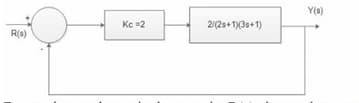
The Block diagram for a control system is shown below: 
1
0.2
2
0.3
3
0.4
4
0.5
07
PYQ 2025
medium
chemical-thermal-and-polymer-engineering ID: cuet-pg-
The characteristic equation for the system is Using Routh test, the value of Kc that will keep the system stable is:
1
17.5
2
4
3
13.5
4
3.5
08
PYQ 2025
easy
chemical-thermal-and-polymer-engineering ID: cuet-pg-
The Bode diagram stability criterion is applicable when:

About Control Systems - CUET-PG

Control Systems is a vital chapter for CUET-PG aspirants. Mastering the concepts covered in this chapter is essential for securing a top rank.

By rigorously practicing the previous year questions associated with this chapter, you can identify high-yield topics, understand the examiner's perspective, and boost your confidence during the actual exam.

Frequently Asked Questions

Why focus on Control Systems PYQs?

Analyzing PYQs for this specific chapter reveals the most frequently tested concepts and the typical complexity of questions, allowing you to tailor your study plan efficiently.

How to best use this analysis?

Review the topic breakdown to see which sub-topics within Control Systems carry the most weight. Then, tackle the questions iteratively to solidify your understanding.