Step 1: Understanding the Concept:
- Combinational Circuits: Output depends only on current inputs. No memory elements.
- Sequential Circuits: Output depends on current inputs and previous states. Uses memory (flip-flops). Step 2: Detailed Explanation:
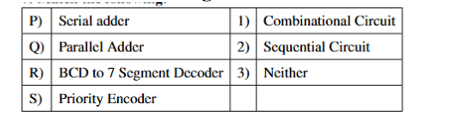
- P) Serial Adder: Adds bits bit-by-bit over time. It requires a flip-flop to store the carry for the next bit addition. Thus, it is a Sequential Circuit (2).
- Q) Parallel Adder: Adds all bits of a word simultaneously using logic gates. No memory is needed. Thus, it is a Combinational Circuit (1).
- R) BCD to 7 Segment Decoder: Converts a 4-bit BCD input to 7 output signals to drive a display. It is a Combinational Circuit (1).
- S) Priority Encoder: Encodes inputs based on priority using purely logic gates. It is a Combinational Circuit (1). Step 3: Final Answer:
The correct match is P-2, Q-1, R-1, S-1.
02
PYQ 2026
medium
computer-scienceID: cuet-pg-
What is the number of clock pulses required to completely load and then unload a 4-bit register?
1
4
2
7
3
16
4
32
Official Solution
Correct Option:
(2)
Step 1: Understanding the Concept:
A serial-in serial-out (SISO) shift register loads bits one by one. To "completely load" means filling all flip-flops. To "unload" means shifting all stored bits out through the output terminal. Step 2: Detailed Explanation:
1. To load bits into an -bit register, it takes clock pulses. For a 4-bit register, loading takes 4 pulses.
2. After the 4th pulse, the first bit is already at the output.
3. To shift out the remaining bits, we need more pulses.
4. Total pulses = . Step 3: Final Answer:
The total clock pulses required is 7.
About Digital Logic - CUET-PG
Digital Logic is a vital chapter for CUET-PG aspirants. Mastering the concepts covered in this chapter is essential for securing a top rank.
By rigorously practicing the previous year questions associated with this chapter, you can identify high-yield topics, understand the examiner's perspective, and boost your confidence during the actual exam.
Frequently Asked Questions
Why focus on Digital Logic PYQs?
Analyzing PYQs for this specific chapter reveals the most frequently tested concepts and the typical complexity of questions, allowing you to tailor your study plan efficiently.
How to best use this analysis?
Review the topic breakdown to see which sub-topics within Digital Logic carry the most weight. Then, tackle the questions iteratively to solidify your understanding.