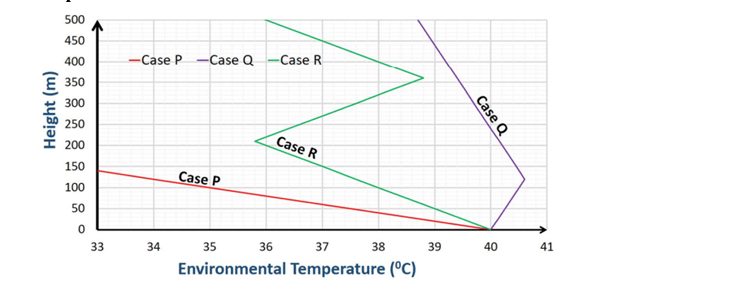
Consider the figure shown below for three different cases. Which of the following statement(s) is/are correct for surface level emissions, given the environmental temperature?
1
Case P represents unstable atmosphere and results in higher dispersion of emissions.
2
Case Q represents subsidence inversion and results in higher dispersion of emissions than Case P.
3
Case Q represents elevated inversion and results in lower dispersion of emissions than Case P.
4
Case R represents subsidence inversion and results in lower dispersion of emissions than Case P.
Official Solution
Correct Option: (1)
To determine atmospheric stability, compare the environmental lapse rate with the adiabatic lapse rate (temperature decrease with height). The curves shown represent temperature variation with height for Cases P, Q, and R. Step 1: Analyze Case P.
Case P shows temperature decreasing significantly with height. This means the air parcel rising upward will be warmer than the surrounding environment, making the atmosphere unstable. Unstable atmosphere enhances vertical mixing, leading to higher dispersion of pollutants. Thus, option (A) is correct. Step 2: Analyze Case Q.
Case Q shows a sharply increasing temperature with height → strong inversion. This is an elevated inversion, which suppresses vertical mixing. This results in lower dispersion, not higher. Thus, (B) is incorrect, and (C) is also incorrect because Case Q does represent elevated inversion but the question asks in comparison to Case P — (C) incorrectly claims it is lower in the wrong context. Step 3: Analyze Case R.
Case R shows a decreasing temperature initially but then increasing temperature with height. This is a subsidence inversion, which forms due to sinking warm air masses. It also suppresses vertical dispersion. Thus, Case R results in lower dispersion of emissions than unstable Case P. Therefore, (D) is correct. Final Answer: (A), (D)
02
PYQ 2022
medium
air-and-noise-pollutionID: gate-es-
A bag filter is used for removal of particulate matter having a range of sizes. The correct sequence of air filtration mechanisms for their removal, in order of decreasing size, is
1
Diffusion, Impaction, Disintegration
2
Disintegration, Impaction, Interception
3
Diffusion, Impaction, Interception
4
Impaction, Interception, Diffusion
Official Solution
Correct Option: (1)
Step 1: Understand filtration mechanisms by particle size. Impaction removes large particles (coarse PM) because they cannot follow air streamlines and impact directly onto filter fibers. Interception removes medium-size particles that follow streamlines but touch fibers and get captured. Diffusion removes the smallest particles (PM , ultrafine) due to Brownian motion. Step 2: Arrange from largest to smallest particle size. Largest particles → Impaction Medium particles → Interception Smallest particles → Diffusion Thus the correct decreasing size sequence is: This corresponds to option (D). Final Answer: (D)
03
PYQ 2023
medium
air-and-noise-pollutionID: gate-es-
The sub index values of NO , SO and PM are 80, 80 and 100, respectively. According to the National Air Quality Index (NAQI) released by the Government of India in the year 2015, the overall NAQI is:
1
80
2
260
3
100
4
151
Official Solution
Correct Option: (3)
Step 1: Recall the NAQI calculation rule. The National Air Quality Index (2015) uses sub-indices for each pollutant (NO , SO , PM , PM , O , CO, NH , Pb, etc.). The overall NAQI is defined as the maximum of these sub-indices, not the average or sum. This is because the pollutant with the worst effect on health should decide the overall quality. Step 2: Apply the given values. - Sub-index for NO - Sub-index for SO - Sub-index for PM Step 3: Choose the maximum. The overall NAQI = . Step 4: Eliminate wrong options. - Option (A) 80 → wrong, because not the maximum. - Option (B) 260 → wrong, because NAQI is not calculated by adding values. - Option (D) 151 → wrong, because NAQI is not calculated by averaging values. Therefore, the correct answer is 100. Final Answer: