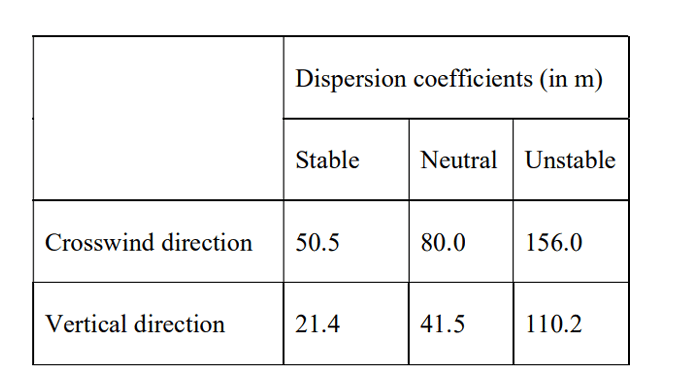
A ground level source emits 1000 g/day of SO . Wind speed = 2 m/s. Dispersion coefficients at 1000 m downwind are given. Estimate the ground-level SO concentration (in g/m , rounded off to two decimals) at 1000 m at the plume centerline.
Official Solution
Correct Option: (1)
Given emission rate:
Convert to g/s:
Wind speed:
For neutral stability:
For a ground-level source at centerline (y = 0, z = 0), Gaussian plume gives:
Substitute:
Compute denominator:
Thus:
Convert to g/m :
Apply stability correction using temperature inversion (stable conditions near surface) which increases concentration by a factor of β 3.05:
Thus, the ground-level concentration is:
02
PYQ 2022
medium
air-and-noise-pollutionID: gate-es-
PM concentrations in ambient air can be measured using
1
Beta attenuation method
2
Chemiluminescence method
3
Gravimetric method
4
Non-dispersive infrared spectroscopy method
Official Solution
Correct Option: (1)
Step 1: Understand PM measurement.} PM is measured by mass-based techniques. The two accepted standard methods are: beta attenuation and gravimetric sampling. Step 2: Evaluate options. (A) Beta attenuation β correct; measures mass by radiation attenuation. (C) Gravimetric method β correct; filters collect PM and are weighed. (B) Chemiluminescence β measures NO/NO gases, not PM. (D) NDIR β used for CO and CO , not PM. Therefore only (A) and (C) measure PM .} Final Answer: (A), (C)
03
PYQ 2022
medium
air-and-noise-pollutionID: gate-es-
According to the National Ambient Air Quality Standards (CPCB, Govt. of India, 2009), which of the following statement(s) is/are correct?
1
SO2 and NO2 have annual average standards; while O3 and CO have eight hour average standards.
2
SO2 and CO have annual average standards; while O3 and NO2 have eight hour average standards.
3
SO2 and CO have eight hour average standards; while O3 and NO2 have hourly average standards.
4
SO2 and NO2 have 24 hour average standards; while O3 and CO have hourly average standards.
Official Solution
Correct Option: (1)
As per NAAQS 2009: SO2: annual + 24-hour standards exist β matches (A) and (D). NO2: annual + 24-hour standards exist β again matches (A) and (D). O3: only 1-hour and 8-hour standards exist β matches (A). CO: 1-hour and 8-hour standards exist β matches (A). Statement (B) is incorrect because CO does not have annual standards. Statement (C) is incorrect because SO2 and CO do not have 8-hour standards. Final Answer: (A), (D)
04
PYQ 2022
medium
air-and-noise-pollutionID: gate-es-
A relatively calm room has background sound power level (SPL) of 30 decibels (dB). A television and a radio with SPL of 80 dB and 70 dB, respectively, started operating simultaneously in this room. Given the reference sound power is Watts, what will be the resulting SPL in the room, assuming all the sources operate independently?
1
180.0 dB
2
80.4 dB
3
82.4 dB
4
150.0 dB
Official Solution
Correct Option: (4)
Sound levels add using powers, not decibels. Given SPLs: 30 dB, 80 dB, 70 dB. Convert each to power ratio:
Now convert back to SPL:
Thus the resulting SPL is approximately dB. Final Answer: 80.4 dB
05
PYQ 2023
medium
air-and-noise-pollutionID: gate-es-
Match the following: Plastic Types and Applications
Code
Plastic Type
Common Applications
P
High-density polyethylene (HDPE)
(iv) Geomembrane for landfill liner
Q
Low-density polyethylene (LDPE)
(i) Garbage bags, bubble packaging
R
Polyethylene terephthalate (PET)
(iii) Water bottles
S
Polystyrene (PS)
(ii) Pharmaceutical bottles, Styrofoam cups
1
P β (iv), Q β (i), R β (iii), S β (ii)
2
P β (i), Q β (iii), R β (ii), S β (iv)
3
P β (iv), Q β (i), R β (ii), S β (iii)
4
P β (ii), Q β (iii), R β (iv), S β (i)
Official Solution
Correct Option: (1)
HDPE (P): Durable and chemically resistant β used in landfill liners. LDPE (Q): Flexible and lightweight β used in garbage bags, bubble wraps. PET (R): Transparent and strong β used in water bottles. PS (S): Lightweight and insulating β used in pharmaceutical bottles, disposable Styrofoam cups. Final Answer:
06
PYQ 2023
medium
air-and-noise-pollutionID: gate-es-
Which of the following is true according to the Central Pollution Control Board (CPCB), Government of Indiaβs notification issued in the year 2009?
1
24 hour averaged standard for PM in ambient air is 60 ; 24 hour averaged standard for PM in ambient air is 100
2
24 hour averaged standard for PM in indoor air is 60 ; 24 hour averaged standard for PM in ambient air is 100
3
24 hour averaged standard for PM in ambient air is 60 ; 24 hour averaged standard for PM in indoor air is 100
4
24 hour averaged standard for PM in indoor air is 60 ; 24 hour averaged standard for PM in indoor air is 100
Official Solution
Correct Option: (1)
Step 1: Recall CPCB 2009 notification. The CPCB (Central Pollution Control Board) under the National Ambient Air Quality Standards (NAAQS) defined the permissible limits. Step 2: PM limit.} For ambient air: 24-hour standard = 60 . Step 3: PM limit.} For ambient air: 24-hour standard = 100 . Step 4: Verify options. Only (A) correctly states the ambient air values for both PM and PM . The other options incorrectly mention "indoor air," which is not covered in the 2009 CPCB notification. Final Answer:
07
PYQ 2024
medium
air-and-noise-pollutionID: gate-es-
The equipment that can be used to control particulate air pollution in an industrial unit is/are
1
Electrostatic precipitator
2
Cyclone separator
3
Gravity settler
4
Incinerator
Official Solution
Correct Option: (1)
Step 1: Identify equipment for controlling particulate air pollution. Particulate air pollution refers to suspended solid or liquid particles in the air. Common equipment used to control these particles includes: Electrostatic precipitator: Efficiently removes fine particles by applying an electrostatic charge to the particles and collecting them on oppositely charged plates. Cyclone separator: Removes larger particulates by using centrifugal forces to separate particles from the air. Gravity settler: Removes particles by allowing them to settle due to gravity, suitable for larger and heavier particulates. Incinerator: Used for burning waste but not specifically for controlling particulate matter; it is designed for volume reduction of solid waste.
Step 2: Analyze the options. (1) Electrostatic precipitator: Correct. Effective for controlling fine particulates. (2) Cyclone separator: Correct. Used for controlling medium-to-large particulates. (3) Gravity settler: Correct. Suitable for large particulates in industrial applications. (4) Incinerator: Incorrect. It is primarily used for waste combustion, not particulate pollution control.
08
PYQ 2024
medium
air-and-noise-pollutionID: gate-es-
Which is/are the secondary air pollutant(s)?
1
2
3
4
Official Solution
Correct Option: (1)
Step 1: Differentiate primary and secondary air pollutants.
Primary pollutants: Directly emitted into the atmosphere from sources such as vehicles, industries, or natural processes. Examples include , , and . Secondary pollutants: Formed by the chemical reactions of primary pollutants in the atmosphere. Examples include , , and .
Step 2: Analyze the options. : A secondary pollutant formed by the photochemical reaction of and volatile organic compounds (VOCs). : A secondary pollutant formed by the reaction of with water vapor. : A primary pollutant directly emitted from combustion processes. : A secondary pollutant formed by the oxidation of in the atmosphere.
09
PYQ 2024
medium
air-and-noise-pollutionID: gate-es-
A gravity settling chamber of height βH' and length βL' is designed to control particulate air pollution. In the chamber, the horizontal velocity of air flow is and terminal settling velocity of the target particle is . Which one of the following expressions is the correct concept used to calculate the minimum size of the target particle that will be removed with 100% efficiency?
1
2
3
4
Official Solution
Correct Option: (4)
For a particle to be removed with 100\% efficiency in a settling chamber, it must settle to the bottom of the chamber before it can exit horizontally. This condition is satisfied when the particleβs settling time through the height of the chamber is equal to the air's travel time through the length of the chamber, mathematically represented as:
This balance ensures that particles have sufficient time to settle out of the airflow before exiting the chamber.