Given below are two statements and two conclusions. Statement 1: All purple are green.
Statement 2: All black are green. Conclusion I: Some black are purple.
Conclusion II: No black is purple. Based on the above statements and conclusions, which one of the following options is logically CORRECT?
1
Only conclusion I is correct.
2
Only conclusion II is correct.
3
Either conclusion I or II is correct.
4
Both conclusion I and II are correct.
Official Solution
Correct Option:
(3)
We are given two statements: - Statement 1: "All purple are green" means that all purple objects are a subset of green objects.
- Statement 2: "All black are green" means that all black objects are also a subset of green objects. Now, let's examine the conclusions:
- Conclusion I: "Some black are purple" suggests that some black objects are also purple. This is not necessarily true based on the given statements, because the black objects are green but there is no direct information implying that any black objects must be purple. Thus, conclusion I is not logically correct.
- Conclusion II: "No black is purple" suggests that none of the black objects are purple. This is a valid conclusion because we know that all purple objects are green, and all black objects are also green. However, the two sets (black and purple) are not required to overlap based on the given statements. Therefore, conclusion II is logically correct. Since conclusion II is correct, the correct answer is (C), which states that either conclusion I or II is correct. Final Answer: Either conclusion I or II is correct.
02
PYQ 2022
medium
general-aptitudeID: gate-es-
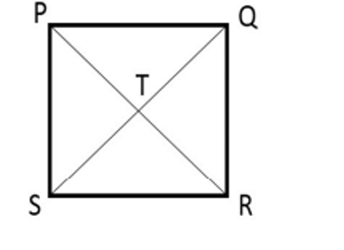
Consider the following square with the four corners and the center marked as P, Q, R, S and T respectively.
Let X, Y, and Z represent the following operations: X: rotation of the square by 180 degree with respect to the S-Q axis. Y: rotation of the square by 180 degree with respect to the P-R axis. Z: rotation of the square by 90 degree clockwise with respect to the axis perpendicular, going into the screen and passing through the point T. Consider the following three distinct sequences of operation (which are applied in the left to right order). (1) XYZ
(2) XY
(3) ZZZZ Which one of the following statements is correct as per the information provided above?
1
The sequence of operations (1) and (2) are equivalent
2
The sequence of operations (1) and (3) are equivalent
3
The sequence of operations (2) and (3) are equivalent
4
The sequence of operations (1), (2) and (3) are equivalent
Official Solution
Correct Option:
(2)
Step 1: Understanding the operations.
- Operation X is a rotation of 180 degrees with respect to the S-Q axis. This operation changes the orientation of the square.
- Operation Y is a rotation of 180 degrees with respect to the P-R axis. This also changes the orientation of the square.
- Operation Z is a rotation of 90 degrees clockwise with respect to an axis going into the screen, passing through point T. This will rotate the square around the specified axis. Step 2: Analyzing the sequences.
- Sequence (1): XYZ
First, operation X (180 degrees with respect to S-Q) is applied. Then, operation Y (180 degrees with respect to P-R) is applied. Finally, operation Z (90 degrees clockwise with respect to T) is applied. This sequence results in a certain final orientation. - Sequence (2): XY
This sequence applies operations X and Y only. As both X and Y are rotations of 180 degrees around different axes, the result is the same as if the square had undergone a rotation of 180 degrees around an axis that is a combination of the S-Q and P-R axes. - Sequence (3): ZZZZ
In this case, four 90-degree rotations are performed around point T, resulting in a full 360-degree rotation, which brings the square back to its original orientation. Therefore, the sequence (3) effectively leaves the square unchanged. Step 3: Conclusion.
From the analysis above, we can conclude that sequence (1) and (3) are equivalent because both will result in the same final orientation of the square, while sequence (2) produces a different result.
03
PYQ 2022
medium
general-aptitudeID: gate-es-
Mosquitoes pose a threat to human health. Controlling mosquitoes using chemicals may have undesired consequences. In Florida, authorities have used genetically modified mosquitoes to control the overall mosquito population. It remains to be seen if this novel approach has unforeseen consequences.
Which one of the following is the correct logical inference based on the information in the above passage?
1
Using chemicals to kill mosquitoes is better than using genetically modified mosquitoes because genetic engineering is dangerous
2
Using genetically modified mosquitoes is better than using chemicals to kill mosquitoes because they do not have any side effects
3
Both using genetically modified mosquitoes and chemicals have undesired consequences and can be dangerous
4
Using chemicals to kill mosquitoes may have undesired consequences but it is not clear if using genetically modified mosquitoes has any negative consequence
Official Solution
Correct Option:
(4)
The passage describes the use of both chemicals and genetically modified mosquitoes to control the mosquito population. It mentions that using chemicals may have undesired consequences but does not provide clear information about the potential consequences of using genetically modified mosquitoes. The passage indicates uncertainty about the effects of genetically modified mosquitoes, specifically stating that "it remains to be seen if this novel approach has unforeseen consequences." Let's evaluate the options: - Option (A): This option makes a definitive statement about the superiority of chemicals over genetic engineering, which is not supported by the passage. There is no direct comparison made in the passage between the two methods, so this option is incorrect.
- Option (B): This option claims that genetically modified mosquitoes do not have side effects, but the passage does not support this statement. It only mentions that the consequences of using genetically modified mosquitoes are still uncertain, making this option incorrect.
- Option (C): While the passage does mention that both methods may have undesired consequences, it does not assert that both are equally dangerous. Therefore, this option is not entirely accurate.
- Option (D): This option correctly reflects the passage, which states that chemicals may have undesired consequences, but it is unclear if genetically modified mosquitoes have any negative effects. Hence, option (D) is the correct answer.
04
PYQ 2022
medium
general-aptitudeID: gate-es-
In a class of five students P, Q, R, S and T, only one student is known to have copied in the exam. The disciplinary committee has investigated the situation and recorded the statements from the students as given below.Statement of P: R has copied in the exam. Statement of Q: S has copied in the exam. Statement of R: P did not copy in the exam. Statement of S: Only one of us is telling the truth. Statement of T: R is telling the truth. The investigating team had authentic information that S never lies.Based on the information given above, the person who has copied in the exam is:
1
R
2
Q
3
S
4
T
Official Solution
Correct Option:
(2)
Given that S never lies, S's statement that "Only one of us is telling the truth" must be true. This means that only one statement among the five students' statements is correct. Now, we analyze each statement: - If R copied, then P's statement that "R has copied" would be true. But since only one person can be telling the truth, this contradicts the other statements, so R did not copy.
- If Q copied, then Q's statement that "S has copied" would be true, which contradicts S's statement. So Q did not copy.
- If S copied, then S's statement is true, and only one of the others is true. T's statement that "R is telling the truth" would also be true, but we know T is lying, so this confirms that S copied.
- Therefore, the person who copied is .
About Logical Reasoning - GATE-ES
Logical Reasoning is a vital chapter for GATE-ES aspirants. Mastering the concepts covered in this chapter is essential for securing a top rank.
By rigorously practicing the previous year questions associated with this chapter, you can identify high-yield topics, understand the examiner's perspective, and boost your confidence during the actual exam.
Frequently Asked Questions
Why focus on Logical Reasoning PYQs?
Analyzing PYQs for this specific chapter reveals the most frequently tested concepts and the typical complexity of questions, allowing you to tailor your study plan efficiently.
How to best use this analysis?
Review the topic breakdown to see which sub-topics within Logical Reasoning carry the most weight. Then, tackle the questions iteratively to solidify your understanding.