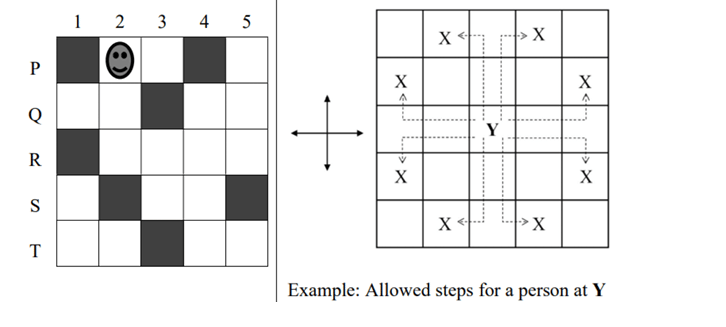
In the square grid shown on the left, a person standing at P2 position is required to move to P5 position. The only movement allowed for a step involves, "two moves along one direction followed by one move in a perpendicular direction". The permissible directions for movement are shown as dotted arrows in the right.
For example, a person at a given position Y can move only to the positions marked X on the right.
Without occupying any of the shaded squares at the end of each step, the minimum number of steps required to go from P2 to P5 is:
1
4
2
5
3
6
4
7
Official Solution
Correct Option: (2)
We need to determine the minimum number of steps to move from P2 to P5. The movement rule requires two steps in one direction followed by one step in a perpendicular direction. By following the movement restrictions and considering the allowed moves, we can visualize the path taken across the grid. Here is how it works: 1. From P2, the person can move two squares to the right and then one square down.
2. From the new position, another two steps to the right followed by one step upwards.
3. From here, another similar move will get the person close to P5. Counting all the steps, we see that it takes 5 moves to reach P5. Thus, the correct answer is (B) 5.
02
PYQ 2022
medium
general-aptitudeID: gate-ph-
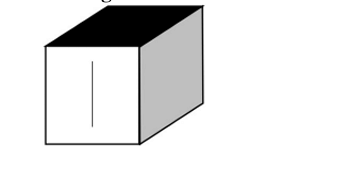
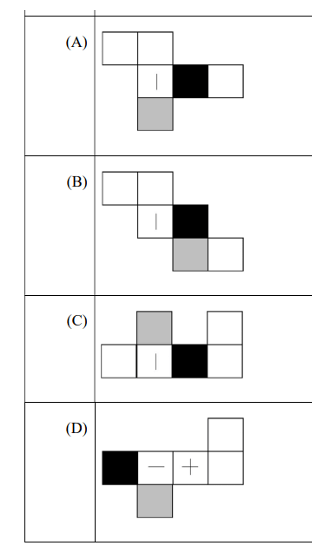
Consider a cube made by folding a single sheet of paper of appropriate shape. The interior faces of the cube are all blank. However, the exterior faces that are not visible in the above view may not be blank. Which one of the following represents a possible unfolding of the cube?
1
A
2
B
3
C
4
D
Official Solution
Correct Option: (2)
To solve this, we need to visualize how the cube is folded and how the faces would appear when unfolded into a two-dimensional shape. The cube has six faces, and when unfolded, the net of the cube will show these six faces. The visible and hidden faces must align correctly to form a proper cube. After examining each option, we observe that option (B) represents a valid unfolding of the cube. In this option, the layout of the faces allows them to be folded correctly into a cube with the given conditions. Thus, the correct answer is (B).
03
PYQ 2022
medium
general-aptitudeID: gate-ph-
Given the statements:
P is the sister of Q. Q is the husband of R. R is the mother of S. T is the husband of P.
Based on the above information, T is _________ of S.
1
the grandfather
2
an uncle
3
the father
4
a brother
Official Solution
Correct Option: (2)
- P is the sister of Q, so P and Q are siblings.
- Q is the husband of R, so R is married to Q.
- R is the mother of S, so S is R's child.
- T is the husband of P, so T is married to P. From this, T is the husband of P, who is the sister of Q. Therefore, T is the brother-in-law of Q. Since Q is S’s parent, T is the uncle of S. Step 1: Conclusion
T is the uncle of S, so the correct answer is (B).
04
PYQ 2022
medium
general-aptitudeID: gate-ph-
Healthy eating is a critical component of healthy aging. When should one start eating healthy? It turns out that it is never too early. For example, babies who start eating healthy in the first year are more likely to have better overall health as they get older.
1
Healthy eating is important for those with good health conditions, but not for others
2
Eating healthy can be started at any age, earlier the better
3
Eating healthy and better overall health are more correlated at a young age, but not at later ages
4
Eating healthy is important only in the first year of life
Official Solution
Correct Option: (2)
The passage emphasizes that healthy eating is a crucial part of healthy aging, and it is important to start eating healthy as early as possible. It specifically mentions that babies who start eating healthy in the first year are more likely to maintain better overall health as they grow older. This implies that eating healthy can be beneficial at any age, but it is most effective when started early. Therefore, the correct inference based on the passage is that healthy eating can be started at any age, but the earlier, the better. Thus, the correct answer is (B).
05
PYQ 2022
medium
general-aptitudeID: gate-ph-
P invested ₹ 5000 per month for 6 months of a year and Q invested ₹ x per month for 8 months of the year in a partnership business. The profit is shared in proportion to the total investment made in that year. If at the end of that investment year, Q receives of the total profit, what is the value of (in ₹)?
1
2500
2
3000
3
4687
4
8437
Official Solution
Correct Option: (2)
Let's calculate the total investment made by P and Q. P invests ₹5000 per month for 6 months, so P's total investment is: Q invests ₹x per month for 8 months, so Q's total investment is:
The total investment made by both P and Q is:
The total profit is shared in proportion to the total investment. We are given that Q receives of the total profit. Therefore, the fraction of the total profit received by Q is the ratio of Q's investment to the total investment, i.e., Since Q receives of the total profit, we can set up the equation:
Cross-multiply to solve for :
Thus, the value of is ₹3000.
06
PYQ 2022
medium
general-aptitudeID: gate-ph-
If
and is 50% more than , what is the ratio ?
1
2 : 15
2
16 : 15
3
1 : 5
4
16 : 45
Official Solution
Correct Option: (3)
Given the ratios:
We can write all terms in terms of . Start by expressing , , and in terms of :
Now, is 50% more than , so:
Thus, the ratio is:
Step 1: Conclusion
The ratio is , so the correct answer is (C).
07
PYQ 2025
medium
general-aptitudeID: gate-ph-
Rohit goes to a restaurant for lunch at about 1 PM. When he enters the restaurant, he notices that the hour and minute hands on the wall clock are exactly coinciding. After about an hour, when he leaves the restaurant, he notices that the clock hands are again exactly coinciding. How much time (in minutes) did Rohit spend at the restaurant?
1
minutes
2
minutes
3
minutes
4
minutes
Official Solution
Correct Option: (3)
Step 1: Calculate the frequency of coinciding hands. The hands of a clock coincide approximately every 65.45 minutes. Step 2: Determine the time Rohit spent at the restaurant. Given that the clock hands coincide approximately every 65.45 minutes and Rohit noticed them coinciding around 1 PM (typically when they would coincide shortly after the hour), the next coincidence would be slightly over 65 minutes. Thus, minutes, as an approximation, fits perfectly with our expectation based on the clock's behavior.