Which of the following is the correct structure for the given organic compound, based on the type of substitution in an S 2 reaction?
1
1-Bromo-2-chloro-3-butene
2
1-Bromo-2-chloro-4-butene
3
1-Bromo-3-chloro-2-butene
4
1-Bromo-3-chloro-5-butene
Official Solution
Correct Option:
(1)
Step 1: Understanding the Problem. The question asks for the correct organic structure for a compound undergoing an S 2 reaction, which is a bimolecular nucleophilic substitution. In such reactions, the nucleophile attacks the electrophilic carbon while the leaving group departs. Step 2: Analyzing the Options. - (A) 1-Bromo-2-chloro-3-butene is the correct structure that fits the S 2 reaction conditions as it provides the right positioning of substituents for substitution at the electrophilic carbon.
- (B), (C), and (D) are incorrect because they involve improper positions for the leaving groups, which would make the S 2 mechanism less favorable. Step 3: Conclusion. The correct answer is (A) 1-Bromo-2-chloro-3-butene as it follows the proper structural formation for an S 2 reaction.
02
PYQ 2025
medium
chemistryID: gujcet-2
Which of the following is the correct structure of a compound showing electrophilic addition reaction with a halogen?
1
2
3
4
Official Solution
Correct Option:
(4)
Step 1: Understanding the Reaction. The question asks for the structure of a compound undergoing electrophilic addition with halogens. Electrophilic addition involves an electron-deficient species (like a halogen) attacking a double bond, which opens up the bond and adds the halogen across it. Step 2: Analyzing the Options. - (A) (benzene) does not undergo electrophilic addition with halogens under normal conditions because it requires special conditions like halogenation using a catalyst.
- (B) is a simple alkyl halide, but it does not undergo electrophilic addition.
- (C) is a chlorinated benzene, which undergoes substitution reactions, not electrophilic addition.
- (D) represents a chloroalkane that can undergo electrophilic addition, fitting the conditions. Step 3: Conclusion. The correct answer is (D) as it fits the conditions for an electrophilic addition reaction with halogens.
03
PYQ 2026
medium
chemistryID: gujcet-2
Which of the following compound is not allylic chloride?
1
2
3
Chlorocyclohexene with chlorine directly attached to the double-bond carbon
4
Cyclohexene derivative having chlorine on the carbon adjacent to the double bond
Official Solution
Correct Option:
(3)
Step 1: Understand the meaning of allylic chloride. An allylic chloride is a compound in which the chlorine atom is attached to an carbon atom that is adjacent to a carbon-carbon double bond. In simple words, chlorine should be on the carbon next to the double bond, not on the double-bonded carbon itself. Step 2: Differentiate allylic chloride from vinylic chloride. If chlorine is attached directly to a carbon atom involved in the double bond, then the compound is called a vinylic chloride, not an allylic chloride. This is the key point needed to solve the question. Step 3: Analyse the given options.
(A) : Chlorine is on the carbon adjacent to the double bond, so it is an allylic chloride.
(B) : Again, chlorine is on the carbon next to the double bond, so it is allylic chloride.
(C) In this structure, chlorine is directly attached to a double-bond carbon of the ring. Therefore, it is a vinylic chloride, not an allylic chloride.
(D) Here chlorine is attached to the carbon adjacent to the double bond in the ring, so it is allylic chloride.
Step 4: Conclusion. Hence, the compound that is not an allylic chloride is option , because it is a vinylic chloride. Final Answer:Option (C).
04
PYQ 2026
medium
chemistryID: gujcet-2
Which catalyst is used in Wacker process?
1
2
3
4
Official Solution
Correct Option:
(4)
Step 1: Understand the Wacker process. The Wacker process is an industrial method used for the oxidation of ethene to acetaldehyde. It involves the use of a palladium-based catalyst in aqueous medium. Step 2: Identify the catalyst. The main catalyst used in this process is palladium(II) chloride, , along with copper chloride as a co-catalyst. Step 3: Analyze options.
(A) : Not used in Wacker process.
(B) : Not used.
(C) : Not used.
(D) : Correct catalyst.
Step 4: Conclusion. Hence, the catalyst used in the Wacker process is . Final Answer: .
05
PYQ 2026
medium
chemistryID: gujcet-2
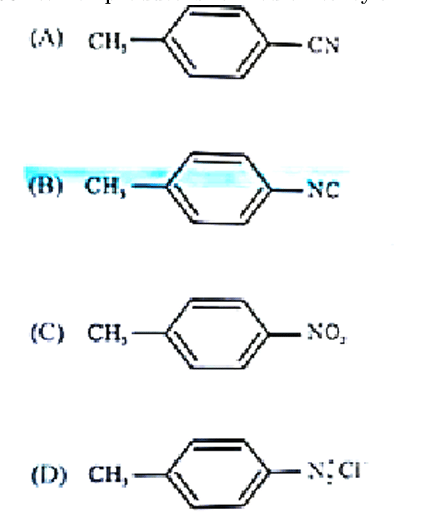
Which product is formed on carbylamine reaction with 4-methylaniline?
1
A
2
B
3
C
4
D
Official Solution
Correct Option:
(2)
Step 1: Recall the carbylamine reaction. The carbylamine reaction is shown by primary amines only. In this reaction, a primary amine reacts with chloroform and alcoholic potassium hydroxide to form an isocyanide or carbylamine. The general reaction is: Step 2: Identify the given amine. 4-methylaniline is a primary aromatic amine. Its structure is . Since it is a primary amine, it gives the carbylamine test. Step 3: Determine the product formed. In the carbylamine reaction, the amino group is converted into the isocyanide group . Therefore, 4-methylaniline forms 4-methylphenyl isocyanide, whose formula is: This corresponds to option (B). Step 4: Compare with the other options.
(A) : This is a nitrile, not the product of carbylamine reaction.
(B) : Correct. This is the isocyanide formed in the carbylamine reaction.
(C) : This is a nitro compound, not related to the carbylamine reaction.
(D) : This is a diazonium salt, formed in diazotisation, not in carbylamine reaction.
Step 5: Conclusion. Hence, the product formed in the carbylamine reaction of 4-methylaniline is . Final Answer: .
06
PYQ 2026
medium
chemistryID: gujcet-2
What is the correct order of basic strength in substituted amine in aqueous solution?
1
2
3
4
Official Solution
Correct Option:
(3)
Step 1: Understanding basic strength of amines. Amines behave as bases because the nitrogen atom contains a lone pair of electrons, which can accept a proton. Greater the availability of this lone pair, greater will be the basic strength of the amine. Alkyl groups generally increase electron density on nitrogen due to the effect, so substituted amines are usually more basic than ammonia. Step 2: Effect in aqueous solution. In aqueous solution, basic strength does not depend only on the effect. It also depends on the stability of the protonated amine formed after accepting a proton. This stability is strongly affected by solvation. Secondary ammonium ions are well stabilised by both electron donation and effective solvation, so secondary amines are generally the strongest bases in water. Step 3: Compare primary, secondary and tertiary amines. For ethyl-substituted amines in aqueous medium, the general order is: This happens because:
Secondary amine :} It gets strong effect and its conjugate acid is sufficiently solvated, so it is the most basic.
Primary amine : It is also more basic than ammonia, but less basic than secondary amine.
Tertiary amine :} Though it has a strong effect, its conjugate acid is less effectively solvated because of steric hindrance, so its basic strength decreases in water.
Ammonia : It has no alkyl groups, so it is the least basic among these.
Step 4: Conclusion. Therefore, the correct order of basic strength in aqueous solution is: Final Answer: .
07
PYQ 2026
medium
chemistryID: gujcet-2
What will be the name of product on ammonolysis of benzyl chloride and reaction of amine so formed with two moles of ?
1
N, N-dimethylphenylmethanamine
2
N, N-diphenylmethanamine
3
N, N-diphenyl ethanamine
4
N-methyl, N-phenyl methanamine
Official Solution
Correct Option:
(1)
Step 1: Ammonolysis of benzyl chloride. Benzyl chloride is . On ammonolysis, chlorine is replaced by the amino group, forming benzylamine. So, the first amine formed is benzylamine, also called phenylmethanamine. Step 2: Reaction of benzylamine with one mole of . Benzylamine is a primary amine. When it reacts with methyl chloride, one hydrogen attached to nitrogen is replaced by a methyl group, giving N-methylbenzylamine. Step 3: Reaction with the second mole of . The secondary amine formed above reacts with another mole of methyl chloride. The second hydrogen on nitrogen is also replaced by a methyl group, giving a tertiary amine: N,N-dimethylbenzylamine. Its IUPAC name is N,N-dimethylphenylmethanamine. Step 4: Conclusion. Hence, the final product formed is N,N-dimethylphenylmethanamine. Final Answer:N, N-dimethylphenylmethanamine.
08
PYQ 2026
medium
chemistryID: gujcet-2
Which of the following statement is true for the Benzenediazonium fluoroborate?
1
When it heated with in presence of Cu, it gives aniline.
2
On heating, it does not decompose to yield fluorobenzene.
3
It is water insoluble and stable at room temperature.
4
It is water soluble and unstable at room temperature.
Official Solution
Correct Option:
(3)
Step 1: Understand the nature of benzenediazonium fluoroborate. Benzenediazonium fluoroborate is a diazonium salt represented as . It is a special diazonium salt because it is comparatively more stable than ordinary benzenediazonium chloride or bromide. This increased stability is due to the presence of the fluoroborate ion. Step 2: Recall its important property. Unlike many diazonium salts, benzenediazonium fluoroborate is water insoluble and can be isolated in solid form. It is also stable at room temperature. On heating, it undergoes decomposition to give fluorobenzene. This reaction is known as the Balz-Schiemann reaction. Step 3: Analyze the options.
(A) Incorrect. This statement is not related to the normal behavior of benzenediazonium fluoroborate, and it does not give aniline in this way.
(B) Incorrect. On heating, benzenediazonium fluoroborate does decompose to yield fluorobenzene.
(C) Correct. It is water insoluble and stable at room temperature.
(D) Incorrect. This is opposite to the actual property.
Step 4: Conclusion. Therefore, the true statement about benzenediazonium fluoroborate is that it is water insoluble and stable at room temperature. Final Answer:It is water insoluble and stable at room temperature.
09
PYQ 2026
medium
chemistryID: gujcet-2
Which of the following compound is used for production of Nylon-6,6?
1
Adipic acid
2
Succinic acid
3
Malonic acid
4
Glutaric acid
Official Solution
Correct Option:
(1)
Step 1: Recall the monomers of Nylon-6,6. Nylon-6,6 is a condensation polymer. It is prepared by the reaction between hexamethylenediamine and adipic acid. These two monomers combine with elimination of water molecules to form the polyamide chain known as Nylon-6,6. Step 2: Understand the name Nylon-6,6. The first in Nylon-6,6 represents the six carbon atoms present in the diamine, that is, hexamethylenediamine. The second represents the six carbon atoms present in the dicarboxylic acid, that is, adipic acid. Hence, adipic acid is the required acid component for the preparation of Nylon-6,6. Step 3: Comparison with other options.
(A) Adipic acid: Correct. It is one of the monomers used in Nylon-6,6 production.
(B) Succinic acid: Incorrect. It has only four carbon atoms and is not used for Nylon-6,6.
(C) Malonic acid: Incorrect. It has only three carbon atoms and is not the acid used here.
(D) Glutaric acid: Incorrect. It has five carbon atoms and is also not used in Nylon-6,6 preparation.
Step 4: Conclusion. Thus, the compound used for the production of Nylon-6,6 is adipic acid. Final Answer:Adipic acid.
10
PYQ 2026
medium
chemistryID: gujcet-2
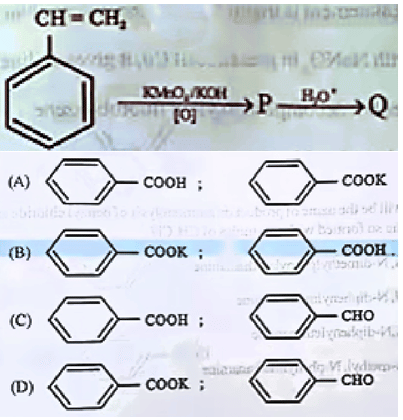
Identify P and Q in above reaction respectively.
1
A
2
B
3
C
4
D
Official Solution
Correct Option:
(2)
Step 1: Identify the starting compound. The given aromatic compound is styrene, that is, vinyl benzene . It contains a benzene ring attached to an unsaturated side chain. Side-chain oxidation of alkyl or alkenyl benzene with strong oxidising agents usually converts the entire side chain into a carboxyl group attached to the benzene ring. Step 2: Action of . When styrene is treated with alkaline potassium permanganate , oxidation takes place. Under alkaline conditions, the product obtained first is the potassium salt of benzoic acid, that is, potassium benzoate . Therefore, is potassium benzoate. Step 3: Conversion of into . On further treatment, the potassium salt gets converted into the free acid by acidification. Thus, potassium benzoate changes into benzoic acid . Hence, is benzoic acid. Step 4: Analysis of options.
(A) ; : Incorrect. The order is reversed.
(B) ; : Correct. Oxidation in alkaline medium gives potassium benzoate first, then acidification gives benzoic acid.
(C) ; : Incorrect. Benzaldehyde is not formed in this oxidation sequence.
(D) ; : Incorrect. The second product is benzoic acid, not benzaldehyde.
Step 5: Conclusion. Therefore, is potassium benzoate and is benzoic acid. Final Answer: and .
11
PYQ 2026
medium
chemistryID: gujcet-2
Which of the following aldehyde does not give Cannizzaro reaction?
1
HCHO
2
3
Benzaldehyde
4
Official Solution
Correct Option:
(4)
Step 1: Condition for Cannizzaro reaction. Cannizzaro reaction is shown by those aldehydes which do not contain any -hydrogen atom. In the presence of concentrated base, such aldehydes undergo disproportionation to give one molecule of alcohol and one molecule of carboxylate salt. Step 2: Check each option for presence of -hydrogen.
(A) HCHO: Formaldehyde has no -carbon and therefore no -hydrogen. It gives Cannizzaro reaction.
(B) : Chloral has no -hydrogen because the -carbon is attached to three chlorine atoms. It gives Cannizzaro reaction.
(C) Benzaldehyde: The carbon next to the aldehyde group is part of the benzene ring, so there is no -hydrogen available. It gives Cannizzaro reaction.
(D) : Propanal contains -hydrogen atoms on the carbon adjacent to the group. Therefore, it does not give Cannizzaro reaction.
Step 3: Reason for exception. Aldehydes having -hydrogen usually undergo aldol reaction in basic medium instead of Cannizzaro reaction. Since propanal has -hydrogen, it does not undergo Cannizzaro reaction. Step 4: Conclusion. Hence, the aldehyde which does not give Cannizzaro reaction is . Final Answer: .
12
PYQ 2026
medium
chemistryID: gujcet-2
. Find product in above reaction.
1
Ethyne
2
Ethanol
3
Ethene
4
Ethanal
Official Solution
Correct Option:
(3)
Step 1: Reduction of acetic acid by . Acetic acid, , is reduced by to give the corresponding primary alcohol. Therefore, compound is ethanol, . Step 2: Reaction of ethanol with . Alcohols react with to form alkyl chlorides. Hence, ethanol is converted into ethyl chloride, . So, compound is ethyl chloride. Step 3: Reaction of ethyl chloride with alcoholic KOH. Alcoholic KOH causes dehydrohalogenation of alkyl halides. In this reaction, one molecule of HCl is eliminated from ethyl chloride, producing an alkene. Thus, ethyl chloride gives ethene, . Step 4: Conclusion. So, the final product obtained in the reaction sequence is ethene. Final Answer:Ethene.
13
PYQ 2026
medium
chemistryID: gujcet-2
What is the IUPAC name of Mesityl oxide?
1
3-methylpent-4-en-2-one
2
4,4-dimethylbut-3-en-2-one
3
4-methylpent-3-en-2-one
4
1-methylpent-2-en-4-one
Official Solution
Correct Option:
(3)
Step 1: Recall the structure of mesityl oxide. Mesityl oxide is a well-known compound obtained from the condensation of acetone. Its structure is . This compound contains both a ketone group and a carbon-carbon double bond, so its IUPAC name must reflect both functionalities correctly. Step 2: Choose the longest carbon chain. The longest chain containing the ketone group and the double bond has five carbon atoms. Therefore, the parent hydrocarbon is pentene with a ketone functional group, so the base name will be derived from pentenone. Step 3: Number the chain correctly. In IUPAC nomenclature, the ketone group gets priority in numbering. So numbering is done from the end nearer to the carbonyl carbon. This gives:
ketone group at carbon 2,
double bond between carbon 3 and carbon 4,
one methyl substituent at carbon 4.
Thus, the correct IUPAC name becomes . Step 4: Conclusion. Hence, the IUPAC name of mesityl oxide is 4-methylpent-3-en-2-one. Final Answer:4-methylpent-3-en-2-one.
14
PYQ 2026
medium
chemistryID: gujcet-2
Which reaction is used to prepare 2-hydroxy benzaldehyde from phenol?
1
Reimer-Tiemann reaction
2
Kolbe's reaction
3
Williamson synthesis
4
Etard's reaction
Official Solution
Correct Option:
(1)
Step 1: Understanding the target compound. 2-hydroxy benzaldehyde is commonly known as salicylaldehyde. It contains a benzene ring having both a hydroxyl group and an aldehyde group at the ortho position with respect to each other. Since the starting compound is phenol, we need a reaction that introduces a formyl group into the aromatic ring of phenol. Step 2: Identify the correct named reaction. The Reimer-Tiemann reaction is the specific reaction used for the formylation of phenol in the presence of chloroform and alkali. In this reaction, phenol gives mainly ortho-hydroxy benzaldehyde, that is, 2-hydroxy benzaldehyde or salicylaldehyde. Therefore, this reaction exactly matches the preparation asked in the question. Step 3: Comparison with the other options.
(A) Reimer-Tiemann reaction: Correct. It introduces the group into phenol and gives 2-hydroxy benzaldehyde as the major product.
(B) Kolbe's reaction: Incorrect. Kolbe's reaction introduces a carboxyl group into phenol to form salicylic acid, not an aldehyde.
(C) Williamson synthesis: Incorrect. Williamson synthesis is used for the preparation of ethers, not aldehydes from phenol.
(D) Etard's reaction: Incorrect. Etard's reaction is used to convert a side-chain methyl group on an aromatic ring into an aldehyde group, such as toluene to benzaldehyde.
Step 4: Conclusion. Hence, the reaction used to prepare 2-hydroxy benzaldehyde from phenol is the Reimer-Tiemann reaction. Final Answer:Reimer-Tiemann reaction.
15
PYQ 2026
medium
chemistryID: gujcet-2
Which product is not obtained when reacts with ?
1
2
3
4
Official Solution
Correct Option:
(2)
Step 1: Understanding the reaction of ethanol with sulphuric acid. Ethanol reacts with concentrated sulphuric acid in different ways depending on the temperature. Sulphuric acid acts both as a strong acid and as a dehydrating agent. Therefore, ethanol can give different products under different reaction conditions. Step 2: Products that can actually be formed. When ethanol reacts with concentrated , the following products may be obtained:
At lower temperature, ethanol forms ethyl hydrogen sulphate, .
Around , two molecules of ethanol combine to form diethyl ether, .
Around , dehydration of ethanol gives ethene, .
So options (A), (C), and (D) are all possible products of ethanol with sulphuric acid. Step 3: Identify the product not formed. , that is ethyne, is not formed directly when ethanol reacts with sulphuric acid. Sulphuric acid can dehydrate ethanol only up to the alkene stage, producing ethene. It does not convert ethanol into an alkyne under these normal reaction conditions. Step 4: Conclusion. Therefore, the product that is not obtained when ethanol reacts with sulphuric acid is ethyne, . Final Answer: .
16
PYQ 2026
medium
chemistryID: gujcet-2
Which of the following compound gives only primary alcohol on reaction with Grignard Reagent (RMgX)?
1
2
3
4
Official Solution
Correct Option:
(2)
Step 1: Grignard reaction rule. Grignard reagent carbonyl compounds ke saath react karta hai aur hydrolysis ke baad alcohol deta hai. Alcohol ka type carbonyl compound par depend karta hai. Step 2: Important concept.
Formaldehyde → Primary alcohol
Aldehyde (except HCHO) → Secondary alcohol
Ketone → Tertiary alcohol
Step 3: Option analysis.
(A) : Secondary alcohol banega
(B) : Sirf primary alcohol banata hai
(C) : Tertiary alcohol banega
(D) : Ye bhi ketone hai → tertiary alcohol
Step 4: Conclusion. Isliye sirf formaldehyde hi primary alcohol deta hai. Final Answer: .
17
PYQ 2026
medium
chemistryID: gujcet-2
What is the IUPAC name of methyl isopropyl ether?
1
2-methoxypropane
2
1-methoxypropane
3
Ethoxyethane
4
Methyl propyl ether
Official Solution
Correct Option:
(1)
Step 1: Structure understanding. Methyl isopropyl ether ka structure hota hai: . Ether me generally naming ke liye smaller group ko alkoxy aur larger group ko parent chain maana jata hai. Step 2: Parent chain selection. Yaha isopropyl group bada hai, jo propane ke equal hai. Methoxy group substituent ke form me present hai. Step 3: Position determination. Methoxy group propane ke second carbon par attached hai. Isliye correct naam hoga . Step 4: Conclusion. Hence, IUPAC name of methyl isopropyl ether is . Final Answer:2-methoxypropane.
18
PYQ 2026
medium
chemistryID: gujcet-2
Which of the following compound has chiral carbon atom?
1
2-chlorobutane
2
2, 2-dichlorobutane
3
1-chlorobutane
4
2-chloro 2-methylpropane
Official Solution
Correct Option:
(1)
Step 1: Recall the condition for chirality. A carbon atom is said to be chiral when it is attached to four different atoms or groups. Such a carbon is also called an asymmetric carbon atom. If any two attached groups are the same, then the carbon atom is not chiral. Step 2: Examine option (A) 2-chlorobutane. The structure of 2-chlorobutane is:
The second carbon atom is attached to:
All four groups are different, so this carbon atom is chiral. Step 3: Check the remaining options.
(B) 2,2-dichlorobutane: The second carbon has two identical chlorine atoms attached, so it cannot be chiral.
(C) 1-chlorobutane: The carbon attached to chlorine does not have four different groups, so it is achiral.
(D) 2-chloro 2-methylpropane: The central carbon is attached to three identical methyl groups, so it is not chiral.
Step 4: Conclusion. Therefore, the compound that contains a chiral carbon atom is 2-chlorobutane. Final Answer:2-chlorobutane.
19
PYQ 2026
medium
chemistryID: gujcet-2
By which reaction Freon-12 is manufactured from tetrachloromethane?
1
Finkelstein reaction
2
Grignard reaction
3
Stephen reaction
4
Swarts reaction
Official Solution
Correct Option:
(4)
Step 1: Identify the compound and process. Freon-12 (dichlorodifluoromethane, ) is prepared from tetrachloromethane ( ) by replacing chlorine atoms with fluorine atoms. This type of reaction involves halogen exchange. Step 2: Understand the Swarts reaction. The Swarts reaction is specifically used for the preparation of alkyl fluorides from alkyl chlorides or bromides using metallic fluorides such as , , or . This reaction replaces chlorine atoms with fluorine atoms. Step 3: Analyze the options.
(A) Finkelstein reaction: Incorrect. It is used for halogen exchange (Cl/Br to I) using sodium iodide in acetone.
(B) Grignard reaction: Incorrect. It involves formation of organomagnesium compounds.
(C) Stephen reaction: Incorrect. It is used for reduction of nitriles to aldehydes.
(D) Swarts reaction: Correct. It replaces chlorine atoms with fluorine atoms to form Freon-12.
Step 4: Conclusion. Since Freon-12 is obtained by replacing chlorine atoms in tetrachloromethane with fluorine atoms, the reaction involved is the Swarts reaction. Final Answer:Swarts reaction.
20
PYQ 2026
medium
chemistryID: gujcet-2
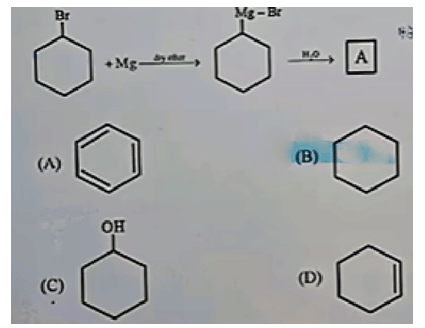
Identify `A' in the following reaction.
1
A
2
B
3
C
4
D
Official Solution
Correct Option:
(2)
Step 1: Formation of Grignard reagent. The given compound is bromocyclohexane. When an alkyl halide reacts with magnesium in dry ether, it forms the corresponding Grignard reagent. Therefore, bromocyclohexane reacts with magnesium to give cyclohexyl magnesium bromide. Step 2: Reaction of Grignard reagent with water. Grignard reagents are highly reactive organometallic compounds. On treatment with water, the carbon-magnesium bond gets hydrolysed. As a result, the alkyl group attached to magnesium simply picks up a hydrogen atom. So, cyclohexyl magnesium bromide on hydrolysis gives cyclohexane. Step 3: Analysis of the options.
(A) Cyclohexadiene: Incorrect. Hydrolysis of a Grignard reagent does not produce a diene.
(B) Cyclohexane: Correct. The Grignard reagent gives the corresponding alkane on hydrolysis.
(C) Cyclohexanol: Incorrect. Alcohol would be formed only if the Grignard reagent reacted with oxygen-containing compounds like aldehydes, ketones, or epoxides before hydrolysis.
(D) Cyclohexene: Incorrect. Hydrolysis does not lead to alkene formation in this reaction.
Step 4: Conclusion. Hence, the product `A' formed after hydrolysis of cyclohexyl magnesium bromide is cyclohexane. Final Answer:Cyclohexane.
21
PYQ 2026
medium
chemistryID: gujcet-2
A mixture of alkyl halide and aryl halide with sodium in dry ether. What is the name of reaction?
1
Fittig reaction
2
Finkelstein reaction
3
Wurtz-Fittig reaction
4
Wurtz reaction
Official Solution
Correct Option:
(3)
Step 1: Identify the reactants involved. The question states that there is a mixture of an alkyl halide and an aryl halide reacting with sodium metal in dry ether. This combination of reactants and conditions is very important for identifying the name of the reaction. Step 2: Recall the named reactions. When two alkyl halide molecules react with sodium in dry ether, the reaction is called the Wurtz reaction.
When two aryl halide molecules react with sodium in dry ether, the reaction is called the Fittig reaction.
When one alkyl halide and one aryl halide react together with sodium in dry ether, the reaction is called the Wurtz-Fittig reaction. Step 3: Compare with the given options.
(A) Fittig reaction: Incorrect. This reaction involves coupling of two aryl halides.
(B) Finkelstein reaction: Incorrect. This is a halogen exchange reaction, usually involving alkyl chlorides or bromides with sodium iodide in acetone.
(C) Wurtz-Fittig reaction: Correct. This reaction involves coupling between an alkyl halide and an aryl halide in the presence of sodium in dry ether.
(D) Wurtz reaction: Incorrect. This reaction involves coupling of two alkyl halides.
Step 4: Conclusion. Since the reaction is between an alkyl halide and an aryl halide in the presence of sodium in dry ether, the correct name of the reaction is Wurtz-Fittig reaction. Final Answer:Wurtz-Fittig reaction.
About Organic Chemistry - GUJCET
Organic Chemistry is a vital chapter for GUJCET aspirants. Mastering the concepts covered in this chapter is essential for securing a top rank.
By rigorously practicing the previous year questions associated with this chapter, you can identify high-yield topics, understand the examiner's perspective, and boost your confidence during the actual exam.
Frequently Asked Questions
Why focus on Organic Chemistry PYQs?
Analyzing PYQs for this specific chapter reveals the most frequently tested concepts and the typical complexity of questions, allowing you to tailor your study plan efficiently.
How to best use this analysis?
Review the topic breakdown to see which sub-topics within Organic Chemistry carry the most weight. Then, tackle the questions iteratively to solidify your understanding.