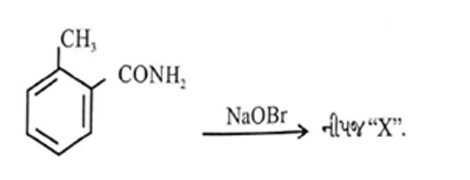
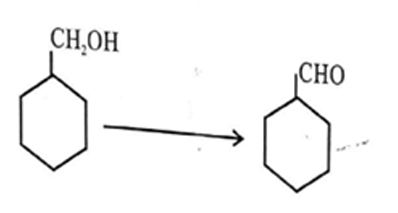
What is the product formed in the following reaction?
1
The reaction does not proceed with the given reagents.
2
An amine group is formed.
3
The reaction leads to a substitution product.
4
The reaction results in a new alkene.
Official Solution
Correct Option:
(2)
Step 1: Understanding the Reaction. This is an amination reaction where an amine is expected to form. The given reagents indicate a nucleophilic substitution or amination. Step 2: Analyzing the Options. - (A) The reaction does proceed with the given reagents, as shown in the reaction mechanism.
- (B) An amine group is indeed formed in this reaction.
- (C) A substitution product is not the primary product of this reaction.
- (D) This reaction does not result in an alkene; instead, it results in the formation of an amine. Step 3: Conclusion. The correct answer is (B) An amine group is formed.
02
PYQ 2025
medium
chemistryID: gujcet-2
For the given organic reaction, which of the following is the correct product formed when R' = CH , R'' = CH CH ?
1
2
3
4
Official Solution
Correct Option:
(1)
Step 1: Understanding the Reaction. The problem describes a reaction involving alkyl groups R', R'', and R''', which is likely a reaction where the organic molecule undergoes substitution or addition, leading to the formation of a new product. Step 2: Analyzing the Options. - (A) is the correct product formed from the reaction based on the structure.
- (B), (C), and (D) are incorrect because they involve incorrect alkyl substitutions. Step 3: Conclusion. The correct answer is (A) as it correctly represents the product of the given reaction.
03
PYQ 2025
medium
chemistryID: gujcet-2
Which of the following compounds can act as a base?
1
NH OH
2
NH NH
3
NH OH
4
CH OH
Official Solution
Correct Option:
(1)
Step 1: Understanding the Question. The question asks which compound can act as a base. Bases are substances that can accept protons or donate electron pairs. Step 2: Analyzing the Options. - (A) NH OH is an ammonium hydroxide solution, which acts as a base by accepting protons.
- (B) NH NH is a compound with amine groups but not a strong base in this context.
- (C) NH OH is hydroxylamine, which is a weak base.
- (D) CH OH (methanol) is a weak acid, not a base. Step 3: Conclusion. The correct answer is (A) NH OH.
04
PYQ 2025
medium
chemistryID: gujcet-2
What is the most suitable solvent for the reaction to proceed effectively?
1
Water
2
Alcohol
3
Ether
4
Acetone
Official Solution
Correct Option:
(2)
Step 1: Understanding the Reaction. The question is asking for the best solvent that would facilitate the reaction. The solvent choice plays a crucial role in the reaction rate and efficiency. Step 2: Analyzing the Options. - (A) Water is not the best choice for this reaction due to solubility issues with organic compounds.
- (B) Alcohol is the most suitable solvent as it can dissolve a wide range of organic compounds and is often used in substitution reactions.
- (C) Ether is less effective for this reaction as it is less polar compared to alcohol.
- (D) Acetone is not the most ideal solvent for this type of reaction. Step 3: Conclusion. The correct answer is (B) Alcohol as it is the most suitable solvent for the given reaction type.
05
PYQ 2025
medium
chemistryID: gujcet-2
What is the correct reagent to convert the given compound into the desired product?
1
2
Methyl Benzene
3
4
Official Solution
Correct Option:
(2)
Step 1: Understanding the Reaction. The question asks about the correct reagent to convert the given compound into the desired product. This involves understanding the reagents and how they facilitate specific transformations in organic chemistry. Step 2: Analyzing the Options. - (A) is used for ozonolysis, but it is not applicable in this case.
- (B) Methyl Benzene is correct as it shows the reaction to form methyl benzene.
- (C) is incorrect for this reaction.
- (D) is a strong oxidizing agent but does not lead to the desired methylation. Step 3: Conclusion. The correct answer is (B) Methyl Benzene as it correctly shows the desired reaction.
06
PYQ 2025
medium
chemistryID: gujcet-2
Which of the following is the best solvent for carrying out a nucleophilic substitution reaction with a halide?
1
Chlorine in water.
2
Chlorine in carbon tetrachloride.
3
Chlorine in acetic acid.
4
Chlorine in acetone.
Official Solution
Correct Option:
(4)
Step 1: Understanding the Solvent Choice. The choice of solvent is crucial in nucleophilic substitution reactions. Polar aprotic solvents like acetone are often preferred because they do not solvate the nucleophile strongly, allowing it to remain reactive. Step 2: Analyzing the Options. - (A) Chlorine in water is not suitable for nucleophilic substitution as water is a protic solvent.
- (B) Chlorine in carbon tetrachloride is not ideal as CCl is nonpolar and does not support nucleophilic substitution efficiently.
- (C) Chlorine in acetic acid is not a strong choice either as acetic acid is a polar protic solvent.
- (D) Chlorine in acetone is the best choice as acetone is a polar aprotic solvent that facilitates nucleophilic substitution. Step 3: Conclusion. The correct answer is (D) Chlorine in acetone.
07
PYQ 2025
medium
chemistryID: gujcet-2
Which of the following is the correct structure for the given organic compound, based on the reaction conditions?
1
2
3
4
Official Solution
Correct Option:
(1)
Step 1: Understanding the Reaction. The question involves identifying the correct structure based on the provided organic reaction. We need to focus on functional groups and their interactions during the reaction. Step 2: Analyzing the Options. - (A) is the correct structure, which fits the expected results after the reaction.
- (B) is incorrect because it does not match the expected product.
- (C) is incorrect as it suggests different functional groups.
- (D) does not fit the expected result either. Step 3: Conclusion. The correct answer is (A) as it fits the expected product.
08
PYQ 2025
medium
chemistryID: gujcet-2
What is the base used for the given reaction to produce the desired product?
1
2
3
4
Official Solution
Correct Option:
(4)
Step 1: Understanding the Base. In this question, we are asked to identify the base used in the given reaction. The base is crucial in nucleophilic substitution or elimination reactions. Step 2: Analyzing the Options. - (A) is not the correct base for this reaction.
- (B) is a primary amine, but it is not the desired base here.
- (C) is also not the correct base for this reaction.
- (D) is the correct base, as it is a secondary amine, making it effective in promoting the desired reaction. Step 3: Conclusion. The correct answer is (D) } as it is the correct base for this reaction.
About Organic Reactions - GUJCET
Organic Reactions is a vital chapter for GUJCET aspirants. Mastering the concepts covered in this chapter is essential for securing a top rank.
By rigorously practicing the previous year questions associated with this chapter, you can identify high-yield topics, understand the examiner's perspective, and boost your confidence during the actual exam.
Frequently Asked Questions
Why focus on Organic Reactions PYQs?
Analyzing PYQs for this specific chapter reveals the most frequently tested concepts and the typical complexity of questions, allowing you to tailor your study plan efficiently.
How to best use this analysis?
Review the topic breakdown to see which sub-topics within Organic Reactions carry the most weight. Then, tackle the questions iteratively to solidify your understanding.