IPU-CET SERIES Chemistry
Electrochemistry
11 previous year questions.
Volume: 11 Ques
Yield: Medium
High-Yield Trend
2
2018 2
2017 7
2016 Chapter Questions 11 MCQs
01
PYQ 2016
medium
chemistry ID: ipu-cet-
Which of the following is true for an acid-base concentration cell such as the one used by the pH meter?
1
Current always flows towards the more acidic solution
2
Current always flows towards the more basic solution
3
Current always flows towards the more neutral solution
4
Current always flows away from the more neutral solution
02
PYQ 2016
medium
chemistry ID: ipu-cet-
Using the above information, determine the standard reduction potential for the following reaction,
1
0.90 V
2
+1.66V
3
-0.62 V
4
-1.66 V
03
PYQ 2016
medium
chemistry ID: ipu-cet-
Rechargeable batteries have become an essential part of our environmentally conscientious society. The nickel-cadmium cell battery is a rechargeable battery used in small electronic devices. The half reactions that take place in the nickel-cadmium battery during discharge are: Half reaction 1: Cd(OH) (s) + 2e → Cd(s) + 2OH Half reaction 2: 2NiO (s) + H O + 2e → 2Ni(OH) (s) + 2OH What is the oxidising agent in the nickel cadmium battery during discharge?
1
Cd
2
CdOH
3
NiO
4
Ni(OH)
04
PYQ 2016
medium
chemistry ID: ipu-cet-
Which of the following is true for an electrolytic cell?
1
Reduction takes place at the anode
2
The reaction is spontaneous
3
Electrons start to flow from the cathode
4
An electrolytic cell requires a salt bridge
05
PYQ 2016
medium
chemistry ID: ipu-cet-
Given the following notation for an electrochemical cell,
Pt(s) H (g) H (aq) Ag (aq) Ag(s)
Which of the following represents the overall balanced (net) cell reaction?
Pt(s) H (g) H (aq) Ag (aq) Ag(s)
Which of the following represents the overall balanced (net) cell reaction?
1
H (g) + Ag (aq) → 2H (aq) + Ag(s)
2
H (g) + Ag(s) → H (aq) + Ag (aq)
3
Ag(s) + H (aq) → Ag (aq) + H (g)
4
None of the above
06
PYQ 2016
medium
chemistry ID: ipu-cet-
The following equations indicate reactions that occur spontaneously.
Fe(s) + NiCl (aq) FeCl (aq) + Ni(s)
Zn(s) + FeCl (aq) ZnCl (aq) + Fe(s)
Ni(s) + PbCl (aq) NiCl (aq) + Pb(s)
Which is the increasing order of the reactivity of the metals?
Fe(s) + NiCl (aq) FeCl (aq) + Ni(s)
Zn(s) + FeCl (aq) ZnCl (aq) + Fe(s)
Ni(s) + PbCl (aq) NiCl (aq) + Pb(s)
Which is the increasing order of the reactivity of the metals?
1
Fe
2
Pb
3
NiZn
4
Fe
07
PYQ 2016
medium
chemistry ID: ipu-cet-
Given that
Calculate the equilibrium constant K at 25°C for the following balanced reaction,
1
2
3
4
08
PYQ 2017
medium
chemistry ID: ipu-cet-
In a sodium-sulphur battery, what is the half reaction for sodium in the spontaneous direction?
1
2
3
4
09
PYQ 2017
medium
chemistry ID: ipu-cet-
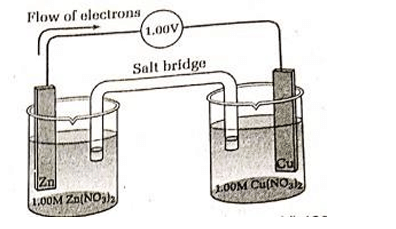
A cell has been set up as shown in the following diagram and E has been measured as 1.00V at 25°C. Calculate G for the reaction. 
1
-386 kJ
2
-193 kJ
3
1.00 kJ
4
193 kJ
10
PYQ 2018
medium
chemistry ID: ipu-cet-
Ammonia reacts with water to form the ammonium ion and hydroxide ion.
According to the Bronsted-Lowry definition of acids and bases, what is the conjugate acid of ammonia?
1
NH3
2
NH4+
3
OH-
4
H+
11
PYQ 2018
medium
chemistry ID: ipu-cet-
When 4A of current is passed through a 1.0L, 0.10 M Fe (aq) solution for 1 hour, it is partly reduced to Fe(s) and partly to Fe (aq). Identify the incorrect statement.
1
0.10 mole of electrons are required to convert all Fe to Fe
2
0.025 mol of Fe(s) will be deposited
3
0.075 mol of iron remains Fe
4
0.050 mol of iron remains as Fe