A Carnot cycle has the reversible processes in the following order
1
isothermal expansion, adiabatic expansion, isothermal compression and adiabatic compression
2
isothermal compression, adiabatic expansion, isothermal expansion and adiabatic compression
3
isothermal expansion, adiabatic compression, isothermal compression and adiabatic expansion
4
adiabatic expansion, isothermal expansion, adiabatic compression and isothermal compression
Official Solution
Correct Option:
(1)
As the Carnot engine works, the working substance of the engine undergoes a cycle known as Carnot cycle. The Carnot cycle consists of the following four strokes (i) First stroke (isothermal expansion) (ii) Second stroke (adiabatic expansion) (iii) Third stroke (isothermal compression) (iv) Fourth stroke (adiabatic compression)
02
PYQ 2012
medium
physicsID: jkcet-20
Which of the following is a true statement?
1
The total entropy of thermally interacting systems is conserved
2
Carnot engine has 100% efficiency
3
Total entropy does not change in a reversible process
4
Total entropy in an irreversible process can either increase or decrease
Official Solution
Correct Option:
(2)
Carnot engine have percent efficiency must be isothermal compression.
03
PYQ 2012
medium
physicsID: jkcet-20
Which of the following laws of thermodynamics forms the basis for the definition of temperature?
1
First law
2
Zeroth law
3
Second law
4
Third law
Official Solution
Correct Option:
(2)
The zeroth law of thermodynamics gives the definition of temperature.
04
PYQ 2012
medium
physicsID: jkcet-20
Which of the two
(i) compressing a gas isothermally until its volume is reduced by half (ii) compressing the same gas adiabatically until its volume is reduced by half, will require more work to be done?
1
(i)
2
(ii)
3
Both will require the same amount of work
4
It will depend upon the nature of the gas
Official Solution
Correct Option:
(2)
05
PYQ 2014
medium
physicsID: jkcet-20
When the gas expands with temperature using the relation for the temperature change of the work done is
1
2
3
4
Official Solution
Correct Option:
(3)
...(i)
...(ii) From Eqs. (i) and (ii)
06
PYQ 2015
medium
physicsID: jkcet-20
In a cyclic process, the change in the internal energy of a system over one complete cycle
1
Depends on the path
2
is always negative
3
Is always zero
4
is always positive
Official Solution
Correct Option:
(3)
In a cyclic process, initial and final states are same. Internal energy is a state function, therefore change in internal energy is zero.
07
PYQ 2016
medium
physicsID: jkcet-20
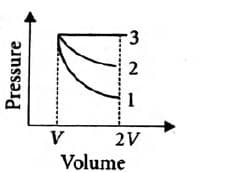
The processes and represent the respective isobaric, isothermal and adiabatic expansion of one mole of a gas initially at a pressure from volume to . The work done is
1
maximum in the process
2
maximum in the process
3
minimum in the process
4
minimum in the process
Official Solution
Correct Option:
(3)
Work done = area under curve As area under the curve is maximum for process and minimum for process , so the work done is maximum in the process and minimum in the process
08
PYQ 2016
easy
physicsID: jkcet-20
The temperature of source of a Carnot engine of efficiency when the heat exhausted is at is
Official Solution
Correct Option:
(1)
09
PYQ 2019
medium
physicsID: jkcet-20
A refrigerator is to maintain eatables kept inside at degree Celsius. If the room temperature is degree Celsius, then what is the coefficient of performance?
1
2
3
4
Official Solution
Correct Option:
(1)
Coefficient of performance ,
10
PYQ 2024
medium
physicsID: jkcet-20
Select the correct order of steps in which a working substance (gas) goes through in a refrigerator.
1
Expansion of gas, absorption of heat, heating of vapour, release of heat
2
Absorption of heat, expansion of gas, heating of vapour, release of heat
3
Heating of vapour, expansion of gas, absorption of heat, release of heat
4
Heating of vapour, absorption of heat, expansion of gas, release of heat
Official Solution
Correct Option:
(2)
Step 1: Understand the process in a refrigerator. In a refrigerator, the working substance (usually a gas) undergoes four main steps:
1. Absorption of heat from the refrigerated space. 2. Expansion of the gas, which cools it down further. 3. Heating of the vapor in the compressor, which turns it into a high-pressure gas. 4. Release of heat to the surroundings.
Step 2: Identify the correct sequence. The correct order is first absorbing heat, then expanding the gas, heating the vapor, and finally releasing heat.
11
PYQ 2024
medium
physicsID: jkcet-20
What are the total degrees of freedom if the number of species are 8, total streams are 3, stream temperature 3, stream pressure 3 and heat released 1, extent of reaction 2?
1
8
2
12
3
15
4
17
Official Solution
Correct Option:
(2)
Step 1: Degrees of Freedom and the Gibbs Phase Rule
The degrees of freedom in a system are given by the Gibbs Phase Rule:
Where: is the degrees of freedom, is the number of components (species), is the number of phases (streams in this case).
Step 2: Analyzing the Given Data
In the given question:
The number of species ( ) = 8,
The number of streams ( ) = 3.
Step 3: Substituting in the Gibbs Phase Rule Using the formula, we get:
However, the degrees of freedom also account for the independent variables like stream temperature (3), stream pressure (3), heat released (1), and extent of reaction (2). Step 4: Conclusion Thus, the total degrees of freedom are 12.
12
PYQ 2024
medium
physicsID: jkcet-20
Hess’s law states that a chemical reaction is independent of the route by which chemical reactions take place while keeping the same
1
initial conditions only
2
final conditions only
3
mid-conditions
4
initial and final conditions
Official Solution
Correct Option:
(4)
Step 1: Understanding Hess’s Law Hess’s law of constant heat summation states that the total enthalpy change of a reaction is the same, no matter what path the reaction takes, as long as the initial and final conditions are the same. Step 2: The Law in Action
This law implies that the change in enthalpy is a state function, meaning it depends only on the initial and final states of the system, not on the path taken between them. Step 3: Conclusion
Therefore, Hess’s law states that the chemical reaction's heat change is independent of the route, provided the initial and final conditions are the same.
About Thermodynamics - JKCET
Thermodynamics is a vital chapter for JKCET aspirants. Mastering the concepts covered in this chapter is essential for securing a top rank.
By rigorously practicing the previous year questions associated with this chapter, you can identify high-yield topics, understand the examiner's perspective, and boost your confidence during the actual exam.
Frequently Asked Questions
Why focus on Thermodynamics PYQs?
Analyzing PYQs for this specific chapter reveals the most frequently tested concepts and the typical complexity of questions, allowing you to tailor your study plan efficiently.
How to best use this analysis?
Review the topic breakdown to see which sub-topics within Thermodynamics carry the most weight. Then, tackle the questions iteratively to solidify your understanding.