Environmental Science
8 previous year questions.
High-Yield Trend
Chapter Questions 8 MCQs
Official Solution
Step 1: Introduction.
Sewage treatment is the process of removing contaminants, organic matter, and harmful microorganisms from wastewater before releasing it into the environment. It protects human health and maintains ecological balance.
Step 2: Stages of sewage treatment. \begin{enumerate} \item Primary treatment: Involves physical removal of large particles through filtration, sedimentation, and grit chambers. Removes about 30–40% of organic matter. \item Secondary treatment (Biological treatment): Utilizes microbes (bacteria, fungi, protozoa) to decompose organic matter. \item Tertiary treatment: Advanced stage involving chemical treatment, disinfection (chlorination, UV light), and nutrient removal (phosphates, nitrates). Ensures water is safe for release. \end{enumerate}
Step 3: Importance.
Official Solution
Step 1: Definition of sewage.
Sewage is the wastewater released from homes, industries, hospitals, and other sources. It contains organic matter, harmful microorganisms, suspended solids, and toxic chemicals.
Step 2: Biological treatment of sewage.
The biological treatment mainly refers to the secondary treatment of sewage, where microbes decompose organic matter. It includes: \begin{enumerate} \item Aeration tank: Sewage is pumped into aeration tanks where air is supplied. Aerobic microbes grow and form activated sludge. \item Decomposition: Microbes digest organic matter, reducing BOD (Biological Oxygen Demand). \item Settling tank: Activated sludge is allowed to settle. A part is recycled, and the rest is sent to anaerobic sludge digesters. \item Methane production: Anaerobic microbes decompose the sludge and release biogas (methane, CO2, hydrogen sulphide). \end{enumerate}
Step 3: Conclusion.
Biological treatment reduces organic pollutants and makes sewage water safe for disposal into rivers or reuse in irrigation.
Official Solution
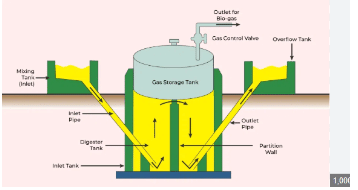
A biogas plant is a system that converts organic waste such as animal dung, plant material, and kitchen waste into biogas through anaerobic digestion. The biogas produced is primarily composed of methane (CH4) and carbon dioxide (CO2), which can be used for cooking and electricity generation.
Components of a Biogas Plant:
- Inlet Tank: Organic waste is mixed with water and fed into the digester.
- Digester: A sealed chamber where anaerobic bacteria break down the waste to produce biogas.
- Gas Holder: Collects the biogas generated during decomposition.
- Outlet Tank: The remaining slurry is removed and used as manure.
Advantages of Biogas:
- Provides a renewable and eco-friendly energy source.
- Reduces dependence on fossil fuels.
- Produces nutrient-rich organic fertilizer.

Official Solution
Final Answer: The conservation of biodiversity is crucial for sustaining the health of our planet. Addressing the causes of biodiversity loss and implementing effective conservation strategies can help ensure that the natural world continues to thrive for generations to come.
Official Solution
Final Answer: Applications of r-DNA technology in medicine include the production of insulin, gene therapy, vaccine production, and monoclonal antibodies for targeted therapies.
Official Solution
The Green Revolution refers to the series of agricultural advancements that led to increased food production in India through the use of high-yielding varieties of seeds, synthetic fertilizers, pesticides, and advanced irrigation techniques.
Step 2: Identify the key figure.
Dr. M.S. Swaminathan is widely regarded as the father of the Green Revolution in India, due to his work in developing high-yielding varieties of crops and promoting their adoption across India.
Final Answer:
Official Solution
Step 2: Define Logistic Growth. - Logistic growth describes population growth that is initially exponential but slows as the population reaches the carrying capacity of its environment. It is represented by the sigmoid curve.
Final Answer: - Commensalism is a relationship where one organism benefits and the other is unaffected. - Logistic growth refers to population growth that slows as it reaches the environment's carrying capacity.
Official Solution
Humus is the dark, organic material formed in soil when plants and animals decay. It is rich in essential nutrients like nitrogen, phosphorus, and potassium.
Step 2: Function of Humus
It helps improve soil structure, retains moisture, and promotes the growth of beneficial microorganisms. Humus is a key component for enhancing soil fertility.
Final Answer: Humus is the decomposed organic material in soil that enhances soil fertility by providing essential nutrients and improving soil structure.