‘An affluent individual who provides capital for a business start-up and early stage companies having a high-risk, high-return matrix usually in exchange for convertible debt or ownership equity.’
(i) Identify the source to raise finance available to an entrepreneur discussed in the above lines.
(ii) State any four features of the source of raising finance discussed in (i) above.
Official Solution
Correct Option:
(1)
(i) Source of Finance: The source of finance discussed is an Angel Investor.
(ii) Features of Angel Investors:
High-Risk, High-Return Investment: Angel investors typically fund start-ups with high growth potential, which also carry a significant risk of failure.
Equity or Convertible Debt: They usually invest in exchange for ownership equity or convertible debt in the business.
Early-Stage Involvement: Angel investors generally provide capital at the seed or start-up stage when traditional investors may hesitate to invest.
Affluent and Experienced Individuals: Most angel investors are wealthy individuals with experience in entrepreneurship or industry knowledge, often providing mentorship as well.
02
PYQ 2025
medium
entrepreneurshipID: cbse-cla
‘It is an equity-based investment in a growth-oriented small to medium business to enable the investor to accomplish objectives in return for minority shareholding in the business.’ This investment has to be carefully evaluated and analysed by an entrepreneur to find out the stage at which he/she requires this investment to assist in.
(i) Identify the type of capital discussed in the above lines.
(ii) Explain the three stages included in ‘Early Stage Financing’ if the capital identified in (i) above is required at this stage.
Official Solution
Correct Option:
(1)
(i) Type of Capital: The type of capital discussed is Venture Capital.
(ii) Three stages included in ‘Early Stage Financing’:
Seed Capital: This is the initial stage of venture capital financing. It is used for activities such as product development, market research, and business plan formulation. It is provided to entrepreneurs to transform an idea into a viable business plan.
Start-up Capital: This stage includes financing for product development and initial marketing. The firm may already have a prototype or pilot project, and this funding helps to begin production and sales activities.
First Stage Capital: This is provided when the company has started commercial production and sales but is not yet profitable. The funds are used to cover initial operating expenses, marketing, and working capital needs to grow the business.
03
PYQ 2025
medium
entrepreneurshipID: cbse-cla
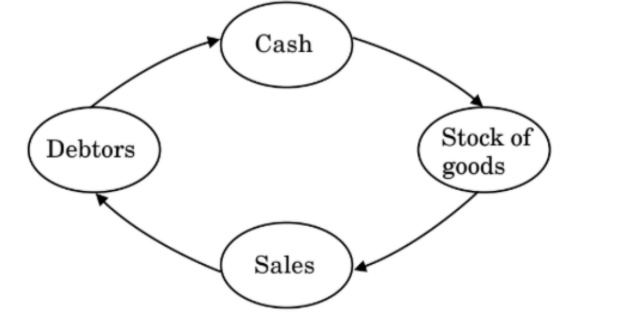
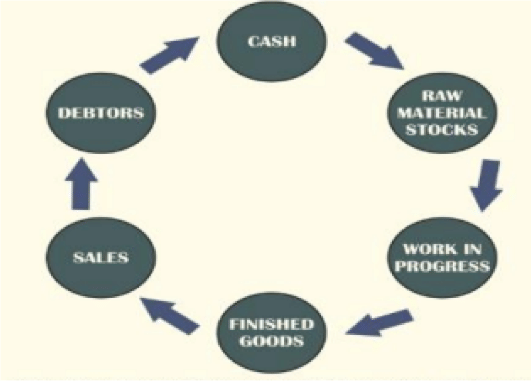
Given below is the ‘Cash Conversion Cycle’.(i) Identify the type of business to which the above cash conversion cycle belongs. (ii) Draw a ‘Cash Conversion Cycle’ for another type of business other than that identified in (i) above.
Official Solution
Correct Option:
(1)
(i) Type of Business: The above cash conversion cycle belongs to a Manufacturing Business. This is evident because the cycle includes the steps: Cash → Raw Materials → Work in Progress → Finished Goods → Debtors → Cash, which are typical stages involved in production and sales in a manufacturing setup.
(ii) Cash Conversion Cycle for a Service Business:
In a Service Business, there is no physical inventory. The cycle usually involves: Cash → Services Provided → Debtors (if service is on credit) → Cash.
04
PYQ 2025
medium
entrepreneurshipID: cbse-cla
Which of the following methods of floatation of new issues is used by the company when the company directly sells its securities to a limited number of sophisticated investors and at times does not want to disclose information to the open market?
1
Public Issue
2
Rights Issue
3
Private Placement
4
Offer to the Employees
Official Solution
Correct Option:
(3)
Private Placement is a method of issuing shares or securities directly to a select group of investors, typically institutional or sophisticated investors. It helps the company raise capital quickly without the need for public disclosure or regulatory compliance that applies to public issues. Other methods: Public Issue: Selling securities to the general public through stock exchanges. Rights Issue: Issuing new shares to existing shareholders in proportion to their holdings. Offer to Employees: Shares are offered specifically to company employees. Hence, the correct answer is (C) Private Placement.
05
PYQ 2025
medium
entrepreneurshipID: cbse-cla
Which of the following is not a current liability?
1
Outstanding rent
2
Short-term investment
3
Trade creditors
4
Short-term loans
Official Solution
Correct Option:
(2)
Current liabilities are obligations a company needs to settle within one year. They typically include: Outstanding rent: Money owed for rent, payable soon (Current liability). Trade creditors: Amounts payable to suppliers (Current liability). Short-term loans: Loans due within a year (Current liability). Short-term investments, however, are assets, not liabilities. They represent liquid assets that can be converted into cash within a year and are recorded under current assets. Hence, (B) Short-term investment is not a current liability.
06
PYQ 2025
medium
entrepreneurshipID: cbse-cla
‘Return on Investment’ is a critical profitability ratio. It is calculated as follows:
1
Equity
2
Debt
3
Total Capital Invested
4
Debt + Interest on Debt
Official Solution
Correct Option:
(3)
Return on Investment (ROI) is a profitability ratio that measures how efficiently a company is using its total capital invested to generate profits. It is calculated by dividing the net profit by the total capital invested (which includes both equity and debt capital) and multiplying by 100 to express as a percentage. Equity alone ignores debt, so it's not the denominator. Debt alone ignores equity and overall capital. Debt + Interest on Debt is incorrect as interest is an expense, not capital. Therefore, the correct answer is (C) Total Capital Invested.
07
PYQ 2025
medium
entrepreneurshipID: cbse-cla
In this method of pricing, goods are sold at higher prices so that fewer sales are needed to break even. It also helps the company in recovering the research and development costs which are associated with the development of a new product. This method of pricing is:
1
Penetrating pricing
2
Cost-plus pricing
3
Variable pricing
4
Creaming pricing
Official Solution
Correct Option:
(4)
The method described involves setting a high initial price for a new or innovative product. This approach is called Creaming pricing or Price Skimming. It targets consumers who are willing to pay more to be early adopters. It helps in: Recovering high research and development costs. Generating profits quickly with fewer sales. Establishing a premium image for the product. Other Options: Penetrating pricing: Involves setting a low initial price to gain market share quickly. Cost-plus pricing: Adds a fixed percentage to the cost of production. Variable pricing: Charges different prices to different customers based on demand or negotiation. Thus, the correct answer is (D) Creaming pricing.
About Business Finance - CBSE-CLASS-XII
Business Finance is a vital chapter for CBSE-CLASS-XII aspirants. Mastering the concepts covered in this chapter is essential for securing a top rank.
By rigorously practicing the previous year questions associated with this chapter, you can identify high-yield topics, understand the examiner's perspective, and boost your confidence during the actual exam.
Frequently Asked Questions
Why focus on Business Finance PYQs?
Analyzing PYQs for this specific chapter reveals the most frequently tested concepts and the typical complexity of questions, allowing you to tailor your study plan efficiently.
How to best use this analysis?
Review the topic breakdown to see which sub-topics within Business Finance carry the most weight. Then, tackle the questions iteratively to solidify your understanding.