When debentures are issued at premium with the term of redeeming them at par. The amount of premium received at the time of issue will be:
1
Debited to premium on Redemption of Debenture A/C
2
Credited to Premium on Redemption of Debentures A/C
3
Debited to Securities Premium Reserve A/C
4
Credited to securities premium Reserve A/C
Official Solution
Correct Option: (4)
The correct option is (D): Credited to securities premium Reserve A/C
02
PYQ 2022
medium
accountancyID: cuet-ug-
Romi Ltd. purchased building worth ₹1,50,000 machinery worth ₹1,40,000 and furniture worth ₹10,000 from xyz co. and took over its liabilities of ₹20,000 for a purchase consideration of ₹3.15,000. They paid the purchase consideration by issuing 12% debentures of ₹100 each at a premium of 5%. What will be the number of debentures issued by Romi Ltd.
1
4000
2
3500
3
3000
4
2000
Official Solution
Correct Option: (3)
To determine the number of debentures issued by Romi Ltd., follow these steps:
Determine the Total Assets Acquired:
Building: ₹1,50,000
Machinery: ₹1,40,000
Furniture: ₹10,000
Total assets = ₹1,50,000 + ₹1,40,000 + ₹10,000 = ₹3,00,000
Consider Liabilities Taken Over: Romi Ltd. took over liabilities worth ₹20,000.
Understand Purchase Consideration: The purchase consideration is ₹3,15,000.
Calculate the Debentures to Be Issued: The debentures are issued at 12% with a face value of ₹100 each but at a premium of 5%. Therefore, the issue price per debenture is:
Issue price = Face value + Premium = ₹100 + ₹5 = ₹105
Calculate Number of Debentures Issued:
Number of debentures
=
Purchase Consideration / Issue Price per Debenture
Number of debentures
=
₹3,15,000 / ₹105
Number of debentures
=
3000
Thus, the number of debentures issued by Romi Ltd. is 3000.
03
PYQ 2022
easy
accountancyID: cuet-ug-
Match List-I with List-II
LIST I: Basis of Debenture
LIST II: Types of Debenture
(A)
Tenure
(I)
Zero coupon rate
(B)
Interest rate point of view
(II)
Irreedemable
(C)
Security
(III)
Registration
(D)
Bearer
(IV)
Secured
Choose the correct answer from the options given below:
1
A-I. B-III, C-II, DIV
2
A-IV, B-I, C-III, D - II
3
A-II. B-I. C-IV, D-III
4
A-III. B - IV, C-I. D-II
Official Solution
Correct Option: (3)
To match List-I with List-II based on the attributes given, let's analyze each pair:
LIST I: Basis of Debenture
LIST II: Types of Debenture
(A)
Tenure
(I)
Zero coupon rate
(B)
Interest rate point of view
(II)
Irredeemable
(C)
Security
(III)
Registration
(D)
Bearer
(IV)
Secured
Matching Explanation:
(A) Tenure: Debentures can be redeemable or irredeemable based on the tenure. Thus, it matches with (II) Irredeemable.
(B) Interest rate point of view: From the interest rate perspective, the zero coupon rate involves no periodical interest. Hence, it matches with (I) Zero coupon rate.
(C) Security: Secured debentures are backed by assets. So, it matches with (IV) Secured.
(D) Bearer: Bearer debentures relate to the registration, hence they match with (III) Registration.
Accordingly, the correct answer is:
A-II, B-I, C-IV, D-III
04
PYQ 2022
medium
accountancyID: cuet-ug-
Securities premium Reserve can be utilised A. to return excess money received on application B. to write off preliminary expenses C. to issue partly paid bonus shares D. for premium paid on Redemption of Debentures or preference shares E. for buy back of shares Choose the correct answer from the options given below:
1
A, B, C only
2
B, C, E only
3
C, D, E only
4
B, D, E only
Official Solution
Correct Option: (4)
The correct option is (D): B, D, E only
05
PYQ 2022
easy
accountancyID: cuet-ug-
If debentures are converted into equity shares, it is a/an :
Official Solution
Correct Option: (1)
06
PYQ 2022
medium
accountancyID: cuet-ug-
Identify the correct sequence to find out profit after tax while preparing comparative income statement A. Deduct expenses B. Find out total revenue by adding other incomes to revenue from operations C. Find out profit after tax D. Deduct tax E. Calculate profit before tax Choose the correct answer from the options given below:
1
E. B, A, D, C
2
B. A, E, D, C
3
B. E, A, C, D
4
E, C, B, A, D
Official Solution
Correct Option: (2)
Step 1: Find Total Revenue (B)
Start by calculating the total revenue. This includes revenue from operations (e.g., sales) and other incomes (e.g., interest, dividends). This matches step B: "Find out total revenue by adding the other incomes to revenue from operations."
Step 2: Deduct Expenses (A)
Subtract all expenses (e.g., cost of goods sold, operating expenses, depreciation) from the total revenue. This gives us the profit before tax. This matches step A: "Deduct expenses."
Step 3: Calculate Profit Before Tax (E)
The result after deducting expenses is the profit before tax. This matches step E: "Calculate the profit before tax."
Note: Steps C ("Find out the profit after tax") and D ("Deduct the tax") come after finding profit before tax, as they are used to calculate profit after tax, not profit before tax.
Evaluate the Options
Let’s check the given options to find the correct sequence for calculating profit before tax:
Option 1: E, B, A, D, C: Starts with calculating profit before tax (E), which is incorrect since we need to find revenue and deduct expenses first.
Option 2: B, A, E, D, C: Starts with finding total revenue (B), deducts expenses (A), and calculates profit before tax (E). This is the correct sequence for finding profit before tax. The remaining steps (D, C) are for profit after tax.
Option 3: B, E, A, C, D: Starts with finding revenue (B), but jumps to calculating profit before tax (E) before deducting expenses (A), which is out of order.
Option 4: E, C, B, A, D: Starts with calculating profit before tax (E) and profit after tax (C), which doesn’t make sense as a starting point.
Final Answer
The correct sequence to find profit before tax is B, A, E, which matches Option 2: B, A, E, D, C.
07
PYQ 2022
hard
accountancyID: cuet-ug-
Calculate the amount of yearly interest payable on 9% debentures (10,000 debentures of ₹100) issued as collateral security.
1
No Interest payable
2
₹90,000
3
₹9000
4
₹99000
Official Solution
Correct Option: (1)
Step 1: Understand Debentures Issued as Collateral Security
Debentures issued as collateral security are held as a guarantee for a loan or obligation. They are not considered actively issued unless the borrower defaults and the lender enforces the collateral.
In accounting, no interest is payable on such debentures unless they are claimed due to a default.
Step 2: Calculate Nominal Interest (If Payable)
If the debentures were actively issued, the interest would be:
Total face value = 10,000 debentures × ₹100:
Total Face Value = 10,000 × ₹100 = ₹10,00,000
Interest rate = 9% per annum:
Yearly Interest = (9/100) × ₹10,00,000 = ₹90,000
Step 3: Determine Interest Payable
Since the debentures are issued as collateral security, no interest is payable unless the collateral is enforced (e.g., due to a default). The problem does not indicate any default.
Therefore, the interest payable is zero.
Step 4: Match with Options
Options provided:
Option 1: No interest payable
Option 2: ₹90,000
Option 3: ₹9,000
Option 4: ₹99,000
Since no interest is payable, the correct answer is Option 1: No interest payable.
Note: ₹90,000 would be the interest if the debentures were actively issued, but the collateral security condition negates this.
Final Answer
The yearly interest payable is Option 1: No interest payable.
08
PYQ 2022
medium
accountancyID: cuet-ug-
What are different types of debentures from the view point of registration A. Convertible B. Bearer C. Redeemable D. Secured E. Registered Choose the correct answer from the options given below:
1
A & E only
2
B & C only
3
B & E only
4
C & D only
Official Solution
Correct Option: (3)
Step 1: Identify the Classification Basis
The question asks for types of debentures from the viewpoint of registration. This means we need to focus on whether the debentures are recorded in the company’s register of debenture holders or not.
Step 2: Evaluate Each Option
Let’s check each option:
Convertible (A): This is about convertibility into shares, not registration. Irrelevant.
Bearer (B): These debentures are not registered; ownership is determined by possession. This is a valid type based on registration.
Redeemable (C): This is about repayment terms, not registration. Irrelevant.
Secured (D): This is about security backing, not registration. Irrelevant.
Registered (E): These debentures are recorded in the company’s register, making this a valid type based on registration.
Step 3: Determine the Correct Types
From the viewpoint of registration, the two types are:
Registered Debentures (E): Recorded in the company’s register.
Bearer Debentures (B): Not recorded in the register; transferable by delivery.
Step 4: Match with the Given Options
The correct types are B (Bearer) and E (Registered). Checking the options:
Option 1: A & E only
Option 2: B & C only
Option 3: B & E only
Option 4: C & D only
Option 3 (B & E) matches our conclusion.
Final Answer
The correct option is Option 3: B & E only.
09
PYQ 2023
easy
accountancyID: cuet-ug-
AB and Co, purchased assets worth Rs 28,80,000 from vendor . It issued debentures of Rs 100 each at a discount of 4% in full satisfaction of the purchase consideration. The number of debentures issued to vendor is :
1
30,000
2
28,800
3
32,000
4
27,693
Official Solution
Correct Option: (1)
Calculating the Number of Debentures Issued:
This calculation involves determining the effective value of each debenture after accounting for the discount and then finding out how many such debentures are needed to cover the purchase consideration. Step 1: Calculate Issue Price per Debenture Face Value of Debenture = Rs100
Discount = 4% of Rs100 = Rs4
Issue Price = Face Value - Discount
Issue Price = Rs100 - Rs4 = Rs96
Step 2: Calculate the Number of Debentures Issued Purchase Consideration = Rs28,80,000
Number of Debentures = Purchase Consideration / Issue Price per Debenture
Number of Debentures = Rs28,80,000 / Rs96 = 30,000
Therefore, ABandCo issued 30,000 debentures to the vendor.
10
PYQ 2023
medium
accountancyID: cuet-ug-
Which of the following option regarding issue and redemption of debenture is not possible in general?
1
Issue at premium, Redemption at a premium
2
Issued at discount, Redemption at discount
3
Issued at par, Redemption at a premium
4
Issued at discount, Redemption at par
Official Solution
Correct Option: (2)
The correct option is (B): Issued at discount, Redemption at discount
11
PYQ 2023
medium
accountancyID: cuet-ug-
XYZ Ltd. has been operating in the field of FMCG products in South Indian market. However to expand its operation in northern part of India, it needs additional capital Rs 20,00,000 which is raised by issuing 10% Debenture of Rs 12,00,000 at a discount of 10% to be repayable after 6 years. The rest of the funds is raised by issuing 5% debenture of Rs 8,00,000 at 15% premium. These debentures are perpetual in nature. After six years of successful operation in northern India, company took a loan of Rs 5,00,000 from PNB against 5% debenture of Rs 8,00,000 of Rs 100 each as a collateral security. The company successfully ran its operation and managed to pay off its loan within two years.
While issuing 10% debenture of Rs 12,00,000 at 10% discount. What amount should be transferred to “Discount on issue of debenture A/c” if all amount is received in one instalment ?
1
Rs 10,000
2
Rs 12,000
3
Rs 1,20,000
4
Rs 1,00,000
Official Solution
Correct Option: (3)
Here the question asks how the discount is calculated for the debentures. The discount is the difference between the face value and the issue price. Since the debentures are issued at a 10% discount, we calculate it as follows: This amount, Rs 1,20,000, needs to be transferred to the "Discount on Issue of Debenture A/c" as per accounting rules.
12
PYQ 2023
medium
accountancyID: cuet-ug-
Cash flow from Financing Activities includes: (A) Issue of Equity shares to promoters (B) Redemption of Preference shares at premium (C) Interest on debenture paid (D) Raising funds by issuing 9% Debentures (E) Payment for purchase of Equity shares Choose the correct answer from the options given below:
1
(A), (C) and (E) Only
2
(B), (C) and (D) Only
3
(A), (B) and (E) Only
4
(B), (C) and (E) Only
Official Solution
Correct Option: (2)
The correct option is (B) :(B), (C) and (D) Only
13
PYQ 2023
medium
accountancyID: cuet-ug-
Savage Ltd. Purchased for cancellation its own , debentures of each at each. The profit on cancellation of own debentures will be:
1
2
3
4
Official Solution
Correct Option: (1)
The correct option is (A) :
14
PYQ 2023
medium
accountancyID: cuet-ug-
Z Ltd. invited application for issue of Debentures of each. Application were received for Debentures. Company alloted debentures to all the applicants on pro-rata basis. Calculate the number of Debentures that would be issued to Mr Ravi who had applied for debentures.
1
Debentures
2
Debentures
3
Debentures
4
Debentures
Official Solution
Correct Option: (2)
The correct option is (B) : Debentures
15
PYQ 2023
medium
accountancyID: cuet-ug-
Debentures can be redeemed in following ways except :-
1
Payments in installments
2
Purchase in open market
3
Payment in lump sum
4
Payment in fixed asset
Official Solution
Correct Option: (4)
The correct option is (D) :Payment in fixed asset.
16
PYQ 2023
medium
accountancyID: cuet-ug-
Royan Ltd. issued 1,00,000 9% debentures of ₹100 each to public. Issue was subscribed. The amount will be shown as :
1
Operating Activity
2
Investing Activity
3
Financing Activity
4
Cash and Cash equivalent
Official Solution
Correct Option: (3)
The correct option is (C) :Financing Activity.
17
PYQ 2023
medium
accountancyID: cuet-ug-
XYZ Ltd. has been operating in the field of FMCG products in South Indian market. However to expand its operation in northern part of India, it needs additional capital Rs 20,00,000 which is raised by issuing 10% Debenture of Rs 12,00,000 at a discount of 10% to be repayable after 6 years. The rest of the funds is raised by issuing 5% debenture of Rs 8,00,000 at 15% premium. These debentures are perpetual in nature. After six years of successful operation in northern India, company took a loan of Rs 5,00,000 from PNB against 5% debenture of Rs 8,00,000 of Rs 100 each as a collateral security. The company successfully ran its operation and managed to pay off its loan within two years.
XYZ Ltd. issued another category of debenture which are perpetual in nature. What type of debentures they are called :
1
Irredeemable Debentures
2
Convertible Debenture
3
Redeemable Debentures
4
Bearer Debentures
Official Solution
Correct Option: (1)
Understanding Debenture Types and their core characteristics: Irredeemable Debentures:
Given the context and phrase "perpetual in nature," the debenture is perpetual, meaning it has no fixed maturity date and will not be redeemed unless the company decides to do so in the future. This is a characteristic of Irredeemable Debentures. These debentures do not contain features such as conversion to equity shares or redemption after a set time. Thus, option (1) fits perfectly as Irredeemable Debentures.
18
PYQ 2023
medium
accountancyID: cuet-ug-
Data Ltd. purchased assets of the book value ₹ 4,00,000 and took over the liability of ₹ 50,000 from Sona Ltd. It was agreed that purchase consideration will be settled by cheque of ₹ 1,00,000 and by issue of ₹ 2,00,000. 10% debentures at premium of 25%. The Amount of goodwill/capital reserve will be
1
₹ 30,000 Capital reserve
2
₹ 30,000 goodwill
3
₹ 50,000 Capital reserve
4
There will not be any Goodwill or Capital Reserve
Official Solution
Correct Option: (4)
The correct option is (D) :There will not be any Goodwill or Capital Reserve.
19
PYQ 2023
medium
accountancyID: cuet-ug-
Which of the following is NOT a way to redeem the debentures?
1
Payment in Instalments
2
Payment in Lumpsum
3
Purchase in open Market
4
Conversion into shares only NOT in new debentures
Official Solution
Correct Option: (4)
The correct option is (D) :Conversion into shares only NOT in new debentures
20
PYQ 2023
medium
accountancyID: cuet-ug-
Calculate Debt equity Ratio : Debentures Shareholders fund Z Net Profit before tax Current Liabilities
1
2
3
4
\032: 1 \)
Official Solution
Correct Option: (2)
The correct option is (B) :
21
PYQ 2023
medium
accountancyID: cuet-ug-
Match List I with List I
List I
List II
A.
Revaluation Reserve
I.
Share Capital
B.
Issued Capital
II.
Other Non current Assets
C.
Discount on issue of debentures
III.
Inventories
D.
Loose tool
IV.
Reserve and Surplus
Choose the correct answer from the options given below :
1
A-I, B-II, C-III, D-IV
2
A-II, B-III, C-IV, D-I
3
A-III, B-IV, C-I, D-II
4
A-IV, B-I, C-II, D-III
Official Solution
Correct Option: (4)
The correct option is (D) :A-IV, B-I, C-II, D-III.
22
PYQ 2023
medium
accountancyID: cuet-ug-
XYZ Ltd. has been operating in the field of FMCG products in South Indian market. However to expand its operation in northern part of India, it needs additional capital Rs 20,00,000 which is raised by issuing 10% Debenture of Rs 12,00,000 at a discount of 10% to be repayable after 6 years. The rest of the funds is raised by issuing 5% debenture of Rs 8,00,000 at 15% premium. These debentures are perpetual in nature. After six years of successful operation in northern India, company took a loan of Rs 5,00,000 from PNB against 5% debenture of Rs 8,00,000 of Rs 100 each as a collateral security. The company successfully ran its operation and managed to pay off its loan within two years.
XYZ Ltd. issues 10% debentures of Rs 12,00,000 of Rs 100 each at a discount of 10% which will be repayable after 6 years. What type of debenture it is ?
1
Zero Coupon Rate Bonds/Debenture
2
Redeemable Debentures
3
Convertible Debenture
4
Irredeemable Debenture
Official Solution
Correct Option: (2)
Understanding the Characteristics of Debentures Types Redeemable Debentures:
This type of debenture can be identified from the phrase "repayable after 6 years" as it clearly indicates that the debenture will be repaid at a future date. Redeemable debentures are those that will be redeemed by the company at a future date, which in this case is after 6 years. "It does not have features of other debt instruments such as being non-interest bearing (Zero coupon), converting into shares (Convertible), or having no repayment date (Irredeemable)." Thus, this makes the debenture a redeemable one.
23
PYQ 2023
medium
accountancyID: cuet-ug-
XYZ Ltd. has been operating in the field of FMCG products in South Indian market. However to expand its operation in northern part of India, it needs additional capital Rs 20,00,000 which is raised by issuing 10% Debenture of Rs 12,00,000 at a discount of 10% to be repayable after 6 years. The rest of the funds is raised by issuing 5% debenture of Rs 8,00,000 at 15% premium. These debentures are perpetual in nature. After six years of successful operation in northern India, company took a loan of Rs 5,00,000 from PNB against 5% debenture of Rs 8,00,000 of Rs 100 each as a collateral security. The company successfully ran its operation and managed to pay off its loan within two years.
Company raised a loan of Rs 5,00,000 from PNB against 5% debenture of Rs 8,00,000 of Rs 100 each as a collateral security. The "Debenture suspense A/c" will be debited with :
1
Rs 5,00,000
2
Rs 3,00,000
3
Rs 8,00,000
4
Rs 13,00,000
Official Solution
Correct Option: (1)
Understanding Debenture Suspense Account A Debenture Suspense A/c is used when debentures are issued as collateral security. In this case, the company raised a loan of Rs 5,00,000 from PNB, and the 5% debentures of Rs 8,00,000 are issued as collateral security. Therefore, the Debenture Suspense A/c will be debited with the loan amount of Rs 5,00,000.
24
PYQ 2023
medium
accountancyID: cuet-ug-
Company issues 10,000, 12% debentures of ₹ 100 each at par, redeemable at premium of 5% after 5 years. At the time of allotment; journal Entry will be :
1
Bank A/c Dr 10,50,000 To Debenture application and Allotment A/c 10,00,00 To Premium on Redemption an Debentures A/c 50,000
2
Bank A/c Dr 10,12,000 To debenture Application and allotment A/c 10,12,000
3
Bank A/c Dr 10,70,000 To Debenture Application and Allotment A/c 10,70,000
4
Debenture Application and Allotment A/c Dr 10,00,000 Loss of Issue of Debenture Dr 50,000 To 12% Debenture A/c 10,00,000 To premium on Redemption of Debentures A/c 50,000
Official Solution
Correct Option: (4)
The correct option is (D) :Debenture Application and Allotment A/c Dr 10,00,000 Loss of Issue of Debenture Dr 50,000 To 12% Debenture A/c 10,00,000 To premium on Redemption of Debentures A/c 50,000.
25
PYQ 2023
medium
accountancyID: cuet-ug-
Match LIST I with LIST II
LIST I
LIST II
A
Proceeds from Long term borrowings
I
Marketable Securities
B
Purchase of Raw Materials
II
Investing Activities
C
Purchase of New Equipments
III
Operating Activities
D
Purchase of New Equipments
IV
Financing Activities
Choose the correct answer from the options given below
1
(A)-(II), (B)-(I), (C)-(IV), (D)-(III)
2
(A)-(IV), (B)-(II), (C)-(I), (D)-(III)
3
(A)-(I), (B)-(II), (C)-(IV), (D)-(III)
4
(A)-(IV), (B)-(I), (C)-(II), (D)-(III)
Official Solution
Correct Option: (2)
The correct option is (B) : (A)-(IV), (B)-(II), (C)-(I), (D)-(III)
26
PYQ 2023
medium
accountancyID: cuet-ug-
Debentures issued for consideration other than cash includes, debentures :
(A) Issued to bank as additional security
(B) Issued to vendor
(C) Issued to Public
(D) Issued to creditor
(E) Issued for cash
Choose the correct answer from the options given below :
1
(C), (B), (A) and (E) only
2
(A), (B) and (D) only
3
(A), (D) and (C) only
4
(B), (D) and (A) only
Official Solution
Correct Option: (4)
Understanding issue of Debentures Other than for Cash:
In the following contexts it has to be identified that Cash should not be related to any item. So we pick only those items that does not relate to cash. Explanation: Issued to vendor: Issuing debentures directly to a vendor to purchase assets or services falls under this category. Issued to creditor: Debentures issued to a creditor for settlement. Issued to bank as additional security: This is also a way for a company to increase cash and funds, where the cash transactions is done between the bank. % Option (C) Issued to Public and (E) Issued to cash refer to general scenario where shares are directly given.
27
PYQ 2025
hard
accountancyID: cuet-ug-
G.S. Rai company ltd. purchased assets of the book value of Rs. 98,000 from another firm. It was agreed that purchase consideration be paid by issuing 11% debentures of Rs. 100 each. Assume debentures have been issued at discount of 20%. Identify the number of debentures issued by the company to the vendor:
1
1100 debentures
2
1200 debentures
3
1225 debentures
4
1960 debentures
Official Solution
Correct Option: (2)
Step 1: Identify purchase consideration. The purchase consideration is given as ₹ 98,000. This is the amount that the company has to pay to the vendor.
Step 2: Calculate issue price of one debenture. Nominal value of each debenture = ₹ 100 Issued at discount of 20% Issue price per debenture = =
Step 3: Calculate number of debentures required. Total purchase consideration = ₹ 98,000 Value received by vendor per debenture = ₹ 80 Wait! Let's carefully check.
Step 4: Check options. - If 1225 debentures are issued (Option 3), at ₹ 80 each → Vendor receives 1225 × 80 = ₹ 98,000. This exactly matches purchase consideration. Thus, the correct answer is 1225 debentures, not 1200.
Final Answer:
28
PYQ 2025
hard
accountancyID: cuet-ug-
If a company issues Rs. 1,00,000, 9% debentures of Rs. 100 each at a discount of 5% but redeemable at a premium of 5%, then what amount will be debited to Loss on Issue of Debentures Account?
1
Rs. 5,000
2
Rs. 10,000
3
Rs. 15,000
4
Rs. 20,000
Official Solution
Correct Option: (3)
Step 1: Understand the accounting treatment. Loss on Issue of Debentures = Discount on issue of debentures + Premium on redemption of debentures.
Step 2: Calculate discount on issue. Debentures issued = Rs. 1,00,000 (i.e., 1,000 debentures of Rs. 100 each). Discount = 5% of 1,00,000 = Rs. 5,000.
Step 3: Calculate premium on redemption. Premium = 5% of 1,00,000 = Rs. 5,000.
Step 4: Total Loss on Issue. Wait carefully — the problem asks: Issued at 5% discount + Redeemable at 5% premium. That means: - Discount = Rs. 5,000. - Premium on redemption = Rs. 5,000. So, total loss = Rs. 10,000. But the options give 15,000 as well. Let's recheck: If both discount (5,000) and premium (10,000?) are counted differently? Actually, at Rs. 100 each, 1,000 debentures = Rs. 1,00,000. Discount = 5,000. Premium on redemption = 5,000. Total = Rs. 10,000. Thus, the correct answer is Rs. 10,000.
Final Answer:
29
PYQ 2025
easy
accountancyID: cuet-ug-
The following journal entry appears in the books of X Co. Ltd.
In this case, the debentures have been issued at a discount of 5%. What is the rate of premium on redemption of debentures?
1
5%
2
15%
3
20%
4
10%
Official Solution
Correct Option: (4)
Step 1: Face Value of Debentures The entry shows that debentures were issued at a face value of Rs. 5,00,000.
Step 2: Issue at Discount Debentures were issued at 5% discount. But in the entry, the loss shown is Rs. 75,000, which means: This matches the journal entry.
Step 3: Calculate Premium on Redemption Rate
Final Answer:
30
PYQ 2025
medium
accountancyID: cuet-ug-
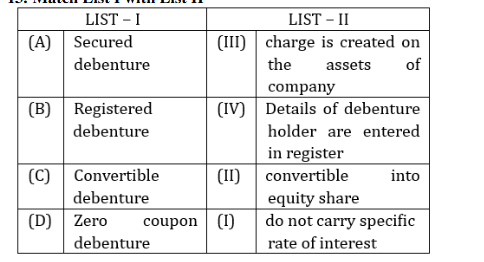
Match List I with List II Choose the correct answer from the options given below:
1
A-I, B-II, C-III, D-IV
2
A-IV, B-I, C-II, D-III
3
A-III, B-IV, C-II, D-I
4
A-II, B-I, C-III, D-IV
Official Solution
Correct Option: (3)
We match each term from List I with its correct meaning from List II: \begin{itemize}
\item (A) Secured debenture — These are backed by a charge on the assets of the company. \quad ⇒ Matches with (III) \item (B) Registered debenture — These are debentures recorded in the company’s register in the name of the holder. \quad ⇒ Matches with (IV) \item (C) Convertible debenture — These can be converted into equity shares at a later date. \quad ⇒ Matches with (II) \item (D) Unsecured debenture — These are not backed by assets and may not carry a fixed interest rate. \quad ⇒ Matches with (I) \end{itemize} So the correct matching is: A–III, B–IV, C–II, D–I
31
PYQ 2025
medium
accountancyID: cuet-ug-
Debenture Application & Allotment A/c ........ Dr. 95,000 Loss on Issue of Debentures A/c ................. Dr. 10,000 \hspace{0.5cm} To 9% Debenture A/c ...................................... 1,00,000 \hspace{0.5cm} To Premium on Redemption of Debentures A/c .... 5,000 On the basis of the above entry, determine the rate of discount at which Rs. 1,00,000, 9% debentures of Rs. 100 each were issued if they were to be redeemed at a premium of 5%.
1
5%
2
10%
3
15%
4
20%
Official Solution
Correct Option: (2)
Step 1: Recall formula. Loss on Issue of Debentures = Discount on Issue + Premium on Redemption.
Step 2: Given values. Loss on Issue = Rs. 10,000. Premium on Redemption = Rs. 5,000. So, Discount on Issue = 10,000 – 5,000 = Rs. 5,000.
Step 3: Rate of discount. Debentures issued = Rs. 1,00,000. Discount = Rs. 5,000. But wait carefully: The journal entry already shows 95,000 cash received, which means discount = 5,000. Loss on Issue includes both discount (5,000) and premium on redemption (5,000). Therefore, the rate of discount = 5%, not 10%.
Final Answer:
32
PYQ 2025
medium
accountancyID: cuet-ug-
When Debentures are issued at par and are redeemable at a premium, the Loss on such an issue is debited to:
1
Statement of Profit \& Loss A/c
2
Loss on issue of Debentures A/c
3
Debentures Application \& Allotment A/c
4
Profit on Issue of Debentures A/c
Official Solution
Correct Option: (2)
Step 1: Understand the scenario.
When debentures are issued at par (face value = issue price), but redeemable at a premium, the company incurs a loss because it will pay more at redemption. This future loss is accounted for at the time of issue. Step 2: Treatment of loss.
This type of loss is recorded under the account "Loss on issue of Debentures A/c" and is shown as a fictitious asset in the balance sheet, to be written off over the years.