Ratio Analysis
13 previous year questions.
High-Yield Trend
Chapter Questions 13 MCQs
| LIST I | LIST II | ||
|---|---|---|---|
| (A) | Interest on loan | (I) | Equal |
| (B) | Interest on drawings | (II) | Will not be charged |
| (C) | Salary | (III) | @ 6% p.a. |
| (D) | Profit sharing ratio | (IV) | Will not be allowed/provided |
LIST I | LIST II | ||
|---|---|---|---|
| A | Operating Profit Ratio | I | Solvency Ratios |
| B | Working Capital Turnover Ratio | II | Liquidity Ratios |
| C | Debt-Equity Ratio | III | Activity Ratios |
| D | Quick Ratio | IV | Profitability Ratios |
Choose the correct answer from the options given below:
| List-I | List-II |
| (A) Capital Reserve | (I) Cash and Cash Equivalent |
| (B) Call in advance | (II) Intangible Fixed Assets |
| (C) Licence and Franchise | (III) Other Current Liabilities |
| (D) Marketable Securities | (IV) Reserve and Surplus |
| List-I | List-II |
| (A) Test of Activity | (I) Acid Test Ratio |
| (B) Test of Liquidity | (II) Debt Equity Ratio |
| (C) Test of Solvency | (III) Debtor Turnover Ratio |
| (D) Test of Profitability | (IV) Return on Investment Ratio |
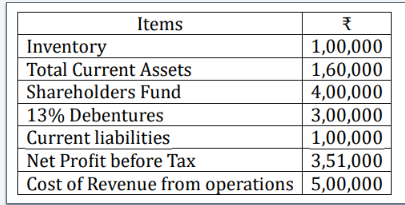
Based on the following information of a company as at 31 March, 2017, what will be the Current Ratio of the company?
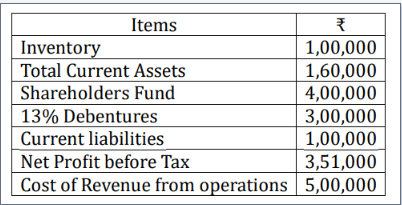
Calculate the Inventory Turnover Ratio of the company.
Match List-I with List-II:
Choose the correct answer from the options given below:
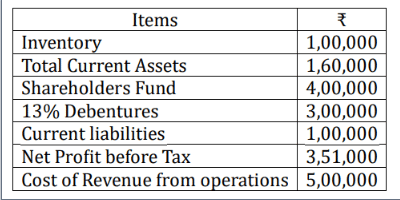
Calculate Debt Equity Ratio of the company based on the given data:
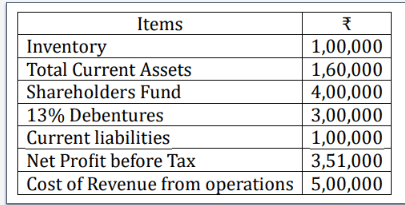
Calculate Liquid Assets and Quick Ratio of the Company.
Rs 60,000 ; 0.6 : 1
Rs 1,00,000 ; 1 : 1
Rs 1,60,000 ; 1.6 : 1
Rs 2,60,000 ; 2.6 : 1
About Ratio Analysis - CUET-UG
Ratio Analysis is a vital chapter for CUET-UG aspirants. Mastering the concepts covered in this chapter is essential for securing a top rank.
By rigorously practicing the previous year questions associated with this chapter, you can identify high-yield topics, understand the examiner's perspective, and boost your confidence during the actual exam.
Frequently Asked Questions
Why focus on Ratio Analysis PYQs?
Analyzing PYQs for this specific chapter reveals the most frequently tested concepts and the typical complexity of questions, allowing you to tailor your study plan efficiently.
How to best use this analysis?
Review the topic breakdown to see which sub-topics within Ratio Analysis carry the most weight. Then, tackle the questions iteratively to solidify your understanding.