To manipulate accounts to show a better picture of the financial position than the actual one
2
To show excessive depreciation
3
To avoid tax
4
To reduce tax
Official Solution
Correct Option: (1)
Solution:
The concept of 'Window Dressing' in accountancy refers to the manipulation of financial statements to present a more favorable view of a company's financial position than what is actually the case. This practice can involve various techniques such as altering the presentation of accounts, adjusting figures, or timing certain financial operations to make the financial statements appear more attractive to stakeholders such as investors, creditors, or financial analysts.
The primary aim of window dressing is not necessarily to evade taxes or depreciate assets more than necessary; rather, it focuses on improving the perceived financial health and value of a company as depicted in its financial reports. Therefore, the correct understanding of window dressing aligns with:
To manipulate accounts to show a better picture of the financial position than the actual one.
02
PYQ 2024
medium
accountancyID: cuet-ug-
Which of the following ratios are computed for evaluating solvency of the business?
Proprietary Ratio
Interest Coverage Ratio
Total Asset to Debt Ratio
Fixed Asset Turnover Ratio
1
(A), (B) and (D) only
2
(A), (B) and (C) only
3
(A), (B), (C) and (D)
4
(B), (C) and (D) only
Official Solution
Correct Option: (2)
To evaluate the solvency of a business, we focus on ratios that assess the company's ability to meet its long-term obligations. Here's a breakdown of each ratio:
Proprietary Ratio: This ratio is crucial for solvency analysis as it indicates the proportion of shareholders' equity to total assets, giving insight into how much of the company is funded by owners' equity compared to outside liabilities.
Interest Coverage Ratio: This ratio measures the company's ability to meet its interest obligations from its earnings before interest and taxes (EBIT). A higher ratio indicates greater ease in meeting interest commitments, crucial for assessing financial stability and solvency.
Total Asset to Debt Ratio: This ratio is directly related to solvency as it compares the company's total assets to its total debt, indicating the extent to which assets cover debts.
Fixed Asset Turnover Ratio: This ratio is not primarily used for solvency analysis; instead, it evaluates how efficiently a company utilizes its fixed assets to generate sales.
Thus, the ratios that are particularly instrumental in evaluating solvency are:
Proprietary Ratio (A)
Interest Coverage Ratio (B)
Total Asset to Debt Ratio (C)
Therefore, the correct answer is: (A), (B) and (C) only
03
PYQ 2024
medium
accountancyID: cuet-ug-
Dividend received is
1
Operating activity
2
Financing activity
3
Investing activity
4
Cash and cash equivalents
Official Solution
Correct Option: (3)
In accounting, financial activities are classified into three main categories: operating, investing, and financing activities. When assessing the cash flow statement, it's essential to correctly categorize transactions under these activities.
An investing activity involves transactions related to the acquisition and disposal of long-term assets and other investments not included in cash equivalents. This typically includes the sale of investments, purchase of fixed assets, and receipt of dividends.
Dividends received are considered part of investing activities because they represent a return on investment from financial assets. Therefore, when preparing a cash flow statement, dividends received are recorded under the investing activities section.
Given the options, the correct classification of dividend received is:
Operating activity
Financing activity
Investing activity
Cash and cash equivalents
The correct answer is Investing activity.
04
PYQ 2024
medium
accountancyID: cuet-ug-
Match List-I with List-II.
List-I
List-II
(A) Dissolution by notice
(I) Partnership at will
(B) Dissolution by agreement
(II) When a partner becomes insane
(C) Dissolution by court
(III) With the consent of all partners
(D) Compulsory Dissolution
(IV) When the business of the firm becomes illegal
1
(A)-(I), (B)-(II), (C) - (III), (D) - (IV)
2
(A)-(I), (B) - (III), (C) - (II), (D) - (IV)
3
(A)-(I), (B) - (II), (C)- (IV), (D) - (III)
4
(A)-(III), (B) - (IV), (C) - (I), (D)-(II)
Official Solution
Correct Option: (2)
To match the items in List-I with List-II accurately, we need to understand each type of dissolution and its correct description:
List-I:
(A) Dissolution by notice: This applies to a partnership at will, where any partner can dissolve the partnership by giving notice to the other partners. Thus, (A) matches with (I).
(B) Dissolution by agreement: This occurs with the consent of all partners agreeing to dissolve the partnership. Therefore, (B) matches with (III).
(C) Dissolution by court: A court may dissolve a partnership if a partner becomes insane or is permanently incapable of performing their duties. Thus, (C) matches with (II).
(D) Compulsory Dissolution: This happens when the business of the firm becomes illegal, forcing the partnership to dissolve. Hence, (D) matches with (IV).
List-II: Using the understanding from above, the correct matches are as follows:
(I) Partnership at will: Matches with (A) Dissolution by notice.
(II) When a partner becomes insane: Matches with (C) Dissolution by court.
(III) With the consent of all partners: Matches with (B) Dissolution by agreement.
(IV) When the business of the firm becomes illegal: Matches with (D) Compulsory Dissolution.
Therefore, the correct matching option is: (A)-(I), (B)-(III), (C)-(II), (D)-(IV).
05
PYQ 2024
medium
accountancyID: cuet-ug-
Which of the following situations lead to reconstitution of a partnership firm? (A) Death of a partner (B) Retirement of a partner (C) Admission of a partner (D) Change in Profit sharing ratio among existing partners
1
(A), (B) and (D) only
2
(A), (B) and (C) only
3
(A), (B), (C) and (D)
4
(B), (C) and (D) only
Official Solution
Correct Option: (3)
Reconstitution of a partnership firm occurs when there is a change in the partnership structure, which may involve changes in the partners, profit-sharing ratios, or other significant changes in the partnership agreement. Let’s analyze each situation to see if it leads to reconstitution:
Death of a partner (A): The death of a partner leads to the reconstitution of the partnership because the firm must adjust to the loss of that partner. The remaining partners may have to decide how to divide the deceased partner’s share, and new arrangements may be made. Therefore, (A) leads to reconstitution.
Retirement of a partner (B): When a partner retires, the partnership undergoes reconstitution. The retiring partner’s share of the partnership must be settled, and the remaining partners may revise their agreement, which could include changes in the profit-sharing ratio or other terms. Therefore, (B) leads to reconstitution.
Admission of a partner (C): The admission of a new partner into the firm always leads to the reconstitution of the partnership. The new partner brings in fresh capital and may alter the profit-sharing ratio among existing partners. Therefore, (C) leads to reconstitution.
Change in profit-sharing ratio among existing partners (D): A change in the profit-sharing ratio among the existing partners also results in reconstitution, as the new profit-sharing arrangement affects the distribution of the firm's profits. Therefore, (D) leads to reconstitution.
All of the situations (A), (B), (C), and (D) lead to the reconstitution of a partnership firm.
Thus, the correct answer is (C): (A), (B), (C) and (D).
06
PYQ 2024
medium
accountancyID: cuet-ug-
Which Accounting Standard governs the preparation of Cash Flow Statement?
1
AS-3 (Revised)
2
AS-26
3
AS-10
4
AS-16
Official Solution
Correct Option: (1)
The preparation of the Cash Flow Statement is governed by Accounting Standard (AS)-3 (Revised).
AS-3 (Revised) deals specifically with the preparation of Cash Flow Statements, outlining the methods of reporting cash inflows and outflows, as well as the classification of cash flows into operating, investing, and financing activities.
Other standards mentioned:
AS-26 relates to Intangible Assets.
AS-10 pertains to Property, Plant, and Equipment.
AS-16 deals with Borrowing Costs.
Thus, the correct answer is (A): AS-3 (Revised).
07
PYQ 2024
medium
accountancyID: cuet-ug-
Which one of the following are correct in connection with the Common Size Statement? (A) Expressed as a percentage on revenue from operation (B) Horizontal analysis (C) Vertical analysis (D) Expressed as a percentage on total assets
1
(A), (B), and (D) only
2
(A), (B), and (C) only
3
(A), (C), and (D) only
4
(B), (C), and (D) only
Official Solution
Correct Option: (3)
The correct options in connection with the Common Size Statement are (A), (C), and (D) only. Let's examine each option to understand why:
(A) Expressed as a percentage on revenue from operation: This is correct when analyzing income statements. Each line item is expressed as a percentage of total sales or revenue, helping in comparing financials across periods or companies of different sizes.
(B) Horizontal analysis: This refers to the analysis of financial statements over multiple periods to see trends, such as growth rates. It is not directly related to the Common Size Statement, which is a vertical analysis.
(C) Vertical analysis: This is indeed what Common Size Statements are; analyzing each line item as a percentage of a base item within the same financial period (e.g., total assets or total sales).
(D) Expressed as a percentage on total assets: This corresponds to the Common Size Balance Sheet, where each line item is expressed as a percentage of total assets, helping in understanding the structure of a company's finances.
Thus, the correct answer is the combination of options (A), (C), and (D).
08
PYQ 2024
easy
accountancyID: cuet-ug-
Read the following information carefully and answer the next five questions :
Particulars
₹
Revenue from Operations
8,75,000
Creditors
90,000
Bills Receivable
48,000
Bills Payable
52,000
Purchases
4,20,000
Trade Debtors
59,000
Official Solution
Correct Option: (1)
09
PYQ 2025
medium
accountancyID: cuet-ug-
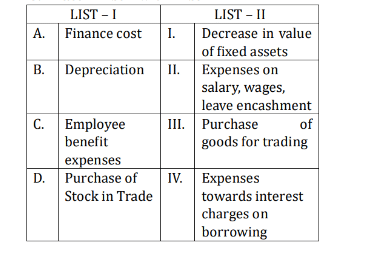
Match List I with List II Choose the correct answer from the options given below:
1
A-III, B-IV, C-I, D-II
2
A-I, B-III, C-IV, D-II
3
A-IV, B-I, C-III, D-II
4
A-IV, B-I, C-II, D-III
Official Solution
Correct Option: (4)
Step 1: Match each item in List I with the correct explanation from List II. % Option (A) \textit{Finance cost} refers to the cost incurred on borrowing, mainly interest charges — matches with (IV). % Option (B) \textit{Depreciation} is the systematic reduction in the value of fixed assets over time — matches with (I). % Option (C) \textit{Employee benefit expenses} includes salary, wages, and leave encashment — matches with (II). % Option (D) \textit{Purchase of Stock in Trade} refers to buying goods meant for resale — matches with (III). Step 2: Verify the correct matching pattern. Option (d) has: A–IV, B–I, C–II, D–III — which is correct.
10
PYQ 2025
medium
accountancyID: cuet-ug-
Gross Profit Ratio of a company is 25%. Cost of revenue from operations are th of revenue from operations. If revenue from operations is ₹60,00,000, the Gross Profit of the company will be:
1
₹25,00,000
2
₹45,00,000
3
₹15,00,000
4
₹11,25,000
Official Solution
Correct Option: (3)
Step 1: Use the Gross Profit Ratio formula: Given: Revenue = ₹60,00,000 and Gross Profit Ratio = 25%