The corner points of the feasible region for an L.P.P. are (0, 10), (5, 5), (5, 15), and (0, 30). If the objective function is Z = αx + βy, α, β > 0, the condition on α and β so that maximum of Z occurs at corner points (5, 5) and (0, 20) is:
1
α = 5β
2
5α = β
3
α = 3β
4
4α = 5β
Official Solution
Correct Option: (3)
The given linear programming problem involves finding the condition on α and β such that the maximum value of the objective function occurs at the corner points (5, 5) and (0, 20) of the feasible region. To solve this, we analyze the given corner points of the feasible region: (0,10), (5,5), (5,15), and (0,30).
First, compare the Z values at the corner points (5,5) and (0,20):
For (5,5):
For (0,20):
Now, equate and since Z maximum occurs at both these points:
5α+5β=20β
Rearranging gives:
5α=15β
Simplifying:
α=3β
Therefore, the condition on α and β is α = 3β.
02
PYQ 2024
medium
mathematicsID: cuet-ug-
Optimize subject to the constraints:
1
Maximum value of Z occurs at the point (15, 15) only.
2
Maximum value of Z occurs at the point (0, 20) only.
3
Maximum value of Z occurs exactly at two points (15, 15) and (0, 20).
4
Maximum value of Z occurs at all the points on the line segment joining (15, 15) and(0, 20).
Official Solution
Correct Option: (4)
To solve this linear programming problem, we need to optimize subject to the following constraints:
The feasible region is determined by the intersection of these constraints.
Constraint
Boundary Line Equation
We find the feasible region by plotting these lines and identifying the intersection points:
Solving and : (out of feasible region)
Solving and :
Solving and : (not meeting all constraints)
Solving and : (point )
Thus, the feasible region is bounded by points , , and .
Calculating at vertices:
At :
At :
At :
The maximum value of is 180. Since at both and , all points on the line segment joining these two will also yield . Thus, the maximum value of occurs at all points on the segment between and .
03
PYQ 2024
medium
mathematicsID: cuet-ug-
Minimize subject to the constraints: Then which of the following is/are true: (A) Feasible region is unbounded. (B) has no minimum value. (C) The minimum value of is 100. (D) The minimum value of is -300.
1
(A), (C) and (D) only
2
(C) and (D) only
3
(A) and (C) only
4
(A) and (D) only
Official Solution
Correct Option: (1)
To minimize subject to the given constraints:
We need to analyze the feasible region and determine the minimum value of .
Step 1: Identify the Feasible Region
Graph each constraint and find the feasible region.
Constraint 1:
Constraint 2:
Constraint 3:
Non-negativity: ,
Intersection of these constraints forms the feasible region.
Step 2: Determine if the Region is Unbounded
The lines continue infinitely in the positive -direction and to the right, indicating the feasible region is unbounded.
Step 3: Calculate Vertex Points
The vertices are possible intersections of the lines, considering constraints:
Intersection
Point
and
and
and
Step 4: Calculate at Vertex Points
At :
At :
At , not valid due to
Step 5: Explanation of Results
(A) Feasible region is unbounded.
(B) Since the region is unbounded, could take very negative values as ; it has no minimum.
(C) The calculated value at vertex is 100, but it's not the minimum.
(D) The value of -300 can be achieved if go towards infinity negatively impacting .
The correct answer includes and .
04
PYQ 2024
medium
mathematicsID: cuet-ug-
A person wants to invest 75,000 in options A and B, which yield returns of 8% and 9% respectively. He plans to invest at least 15,000 in Plan A, 25,000 in Plan B, and keep Plan A ≤ Plan B. Formulate the LPP to maximize the return.
To maximize the return on investment for options A and B, we need to formulate a Linear Programming Problem (LPP) based on the given conditions. Let's define:
x: Amount invested in option A
y: Amount invested in option B
We aim to maximize the total returns Z, which is represented by the objective function:
Z=0.08x+0.09y
Subject to the constraints:
x≥15000 (Minimum investment in plan A)
y≥25000 (Minimum investment in plan B)
x+y≤75000 (Total investment limit)
x≤y (Plan A investment must not exceed plan B)
x,y≥0(Non-negativity condition)
Considering all the conditions, the correct LPP formulation is:
If the system of linear equations x + y + z = 2, 2x + y − z = 3, 3x + 2y + kz = 4 has a unique solution, then:
1
2
3
4
Official Solution
Correct Option: (4)
To determine the condition for the system of linear equations to have a unique solution, we need to ensure that the coefficient matrix has a non-zero determinant. The given system of equations is: x + y + z = 2 2x + y - z = 3 3x + 2y + kz = 4 The corresponding coefficient matrix is:
1
1
1
2
1
-1
3
2
k
We calculate the determinant of this matrix. The determinant, Δ, is calculated as follows for a 3x3 matrix [A]: Δ = a(ei − fh) − b(di − fg) + c(dh − eg) Applying this to our matrix, we calculate: Δ = 1((1)(k) - (-1)(2)) - 1((2)(k) - (-1)(3)) + 1((2)(2) - (1)(3)) Δ = (1)(k + 2) - (1)(2k + 3) + (1)(4 - 3) Δ = k + 2 - 2k - 3 + 1 Δ = k + 2 - 2k - 3 + 1 Δ = -k For the system to have a unique solution, we need the determinant to be non-zero: -k ≠ 0 This implies k ≠ 0. Thus, the correct answer is: k ≠ 0.
06
PYQ 2025
hard
mathematicsID: cuet-ug-
Corner points of a feasible bounded region are , , and . Maximum value 50 of objective function occurs at two points and . The value of and are:
1
2
3
4
Official Solution
Correct Option: (1)
The objective function is . Given maximum value occurs at points and . So,
and
Substitute :
Rechecking the max value at the two points with :
So the values are , . But this matches option (c), not (a). The question states maximum at two points, so the correct pair should satisfy both. So the correct answer is (c) .
07
PYQ 2025
hard
mathematicsID: cuet-ug-
The feasible region is bounded by the inequalities:If the objective function is and is maximized at points and , then the relationship between and is:
1
2
3
4
Official Solution
Correct Option: (2)
We are given the objective function and two points where is maximized: and . We need to find the relationship between and . Substitute the coordinates of the points into the objective function: 1. At point : 2. At point : Since both points give the same value of , we equate the two expressions:
Simplifying the equation:
Substitute into the inequalities for further analysis, or simply solve the relationship between and using the constraints and the points given. This yields the solution and . Thus, the correct relationship is and .
08
PYQ 2025
medium
mathematicsID: cuet-ug-
A person wants to invest at least ₹20,000 in plan A and \₹30,000 in plan B. The return rates are 9% and 10% respectively. He wants the total investment to be ₹80,000 and investment in A should not exceed investment in B. Which of the following is the correct LPP model (maximize return )?
1
Maximize
2
Maximize
3
Maximize
4
Maximize
Official Solution
Correct Option: (1)
Let be the amount invested in plan A and be the amount invested in plan B. The problem states:
1. The return rates for plan A and plan B are 9% and 10% respectively. Therefore, the total return function is:
This represents the total return from investments in both plans A and B. 2. The total investment should be at least ₹80,000, so the constraint is:
3. The investment in plan A should not exceed investment in plan B, which gives the constraint:
4. The person wants to invest at least ₹20,000 in plan A and at least ₹30,000 in plan B, so the constraints are:
Thus, the Linear Programming Problem (LPP) model to maximize the return is:
Subject to the constraints:
The correct answer is option (A).
09
PYQ 2025
easy
mathematicsID: cuet-ug-
The corner points of the feasible region associated with the LPP: Maximise Z = px + qy, p, q > 0 subject to 2x + y 10, x + 3y 15, x,y 0 are (0, 0), (5, 0), (3, 4) and (0, 5). If optimum value occurs at both (3, 4) and (0, 5), then
1
p = q
2
p = 2q
3
p = 3q
4
q = 3p
Official Solution
Correct Option: (4)
Step 1: Understanding the Concept:
In a Linear Programming Problem (LPP), if the optimal (maximum or minimum) value of the objective function occurs at two distinct corner points of the feasible region, then the optimal value also occurs at every point on the line segment joining these two points. This happens when the slope of the objective function is the same as the slope of the constraint line that forms the edge between those two points. Step 2: Key Formula or Approach:
If the objective function Z has the same optimal value at two points, say and , then: Step 3: Detailed Explanation:
The objective function is Z = px + qy.
The problem states that the optimum value occurs at both corner points (3, 4) and (0, 5).
This means the value of Z is the same at these two points.
Value of Z at (3, 4):
Value of Z at (0, 5):
Set the two values equal to each other:
Now, solve for the relationship between p and q: Step 4: Final Answer:
The relationship between p and q is q = 3p.
10
PYQ 2025
medium
mathematicsID: cuet-ug-
Consider the LPP: Minimize Z = x + 2y subject to 2x + y 3, x + 2y 6, x, y 0. The optimal feasible solution occurs at
1
(6, 0) only
2
(0, 3) only
3
Neither (6, 0) nor (0, 3)
4
Both (6, 0) and (0, 3)
Official Solution
Correct Option: (4)
Step 1: Understanding the Concept:
This is a minimization problem in Linear Programming. The optimal solution (minimum value) for a bounded feasible region occurs at one of the corner points. For an unbounded region, we must evaluate Z at the corner points and then verify if an even smaller value is possible within the region. Step 2: Key Formula or Approach:
1. Identify the feasible region defined by the constraints.
2. Find the coordinates of the corner points of the feasible region.
3. Evaluate the objective function Z at each corner point.
4. The point that gives the minimum value is the optimal solution. If the minimum value occurs at more than one corner point, all points on the line segment connecting them are optimal solutions. Step 3: Detailed Explanation:
The LPP is:
Minimize Z = x + 2y
Subject to:
1)
2)
3) First, we find the corner points of the feasible region. The corner points are the intersections of the boundary lines. Point A (Intersection with y-axis):
Let x = 0. The constraints become and . The intersection is at (0, 3). Point B (Intersection with x-axis):
Let y = 0. The constraints become and . The intersection is at (6, 0). Point C (Intersection of the lines 2x + y = 3 and x + 2y = 6):
From , we get . Substitute this into the second equation:
.
If , then . The intersection is (0, 3), which is Point A. So, the corner points of the unbounded feasible region are (0, 3) and (6, 0).
Now, evaluate the objective function Z = x + 2y at these corner points.
At point (0, 3): . At point (6, 0): .
The minimum value of Z at the corner points is 6. This value occurs at two different points, (0, 3) and (6, 0).
Since the feasible region is unbounded, we must check if Z can attain a value less than 6. We check the region . This half-plane has no points in common with the feasible region, as one of the constraints is . Therefore, the minimum value is indeed 6. Step 4: Final Answer:
The minimum value of Z is 6, and it occurs at both corner points (0, 3) and (6, 0). Thus, the optimal feasible solution occurs at both (6, 0) and (0, 3).
11
PYQ 2025
medium
mathematicsID: cuet-ug-
Consider the LPP: Minimize Z = x + 2y subject to 2x + y 3, x + 2y 6, x, y 0. The optimal feasible solution occurs at
1
(6, 0) only
2
(0, 3) only
3
Neither (6, 0) nor (0, 3)
4
Both (6, 0) and (0, 3)
Official Solution
Correct Option: (4)
Step 1: Understanding the Concept:
This is a minimization problem in Linear Programming. The optimal solution (minimum value) for a bounded feasible region occurs at one of the corner points. For an unbounded region, we must evaluate Z at the corner points and then verify if an even smaller value is possible within the region. Step 2: Key Formula or Approach:
1. Identify the feasible region defined by the constraints.
2. Find the coordinates of the corner points of the feasible region.
3. Evaluate the objective function Z at each corner point.
4. The point that gives the minimum value is the optimal solution. If the minimum value occurs at more than one corner point, all points on the line segment connecting them are optimal solutions. Step 3: Detailed Explanation:
The LPP is:
Minimize Z = x + 2y
Subject to:
1)
2)
3) First, we find the corner points of the feasible region. The corner points are the intersections of the boundary lines. Point A (Intersection with y-axis):
Let x = 0. The constraints become and . The intersection is at (0, 3). Point B (Intersection with x-axis):
Let y = 0. The constraints become and . The intersection is at (6, 0). Point C (Intersection of the lines 2x + y = 3 and x + 2y = 6):
From , we get . Substitute this into the second equation:
.
If , then . The intersection is (0, 3), which is Point A. So, the corner points of the unbounded feasible region are (0, 3) and (6, 0).
Now, evaluate the objective function Z = x + 2y at these corner points.
At point (0, 3): . At point (6, 0): .
The minimum value of Z at the corner points is 6. This value occurs at two different points, (0, 3) and (6, 0).
Since the feasible region is unbounded, we must check if Z can attain a value less than 6. We check the region . This half-plane has no points in common with the feasible region, as one of the constraints is . Therefore, the minimum value is indeed 6. Step 4: Final Answer:
The minimum value of Z is 6, and it occurs at both corner points (0, 3) and (6, 0). Thus, the optimal feasible solution occurs at both (6, 0) and (0, 3).
12
PYQ 2025
medium
mathematicsID: cuet-ug-
The vertices of a closed convex polygon representing the feasible region of the LPP with objective function are , , and . The maximum value of is:
1
6
2
18
3
14
4
15
Official Solution
Correct Option: (2)
Calculate at each vertex:
Maximum value is at .
13
PYQ 2025
medium
mathematicsID: cuet-ug-
Which of the following is NOT a basic requirement of the linear programming problem (LPP)?
1
All the elements of an LPP should be quantifiable.
2
All decision variables should assume non-negative values.
3
There are a finite number of decision variables and a finite number of constraints.
4
It deals with optimizing number of objectives more than one.
Official Solution
Correct Option: (4)
Step 1: Understanding the Concept:
This question asks about the fundamental assumptions and requirements that define a Linear Programming Problem (LPP). An LPP is a mathematical technique for optimizing (maximizing or minimizing) a linear objective function, subject to a set of linear constraints. Step 2: Detailed Explanation: Let's review the options based on the definition of an LPP:
1. All the elements of an LPP should be quantifiable. This is a basic requirement. The objective function and constraints must be expressed in terms of numerical values (coefficients, constants). This is the "linearity" and "programmable" aspect. So, this is a requirement. 2. All decision variables should assume non-negative values. This is the non-negativity constraint ( ), a standard requirement in most LPPs, ensuring that the variables represent real-world quantities like production units, which cannot be negative. So, this is a requirement. 3. There are a finite number of decision variables and a finite number of constraints. This is the finiteness requirement. The problem must be bounded in scope with a specific number of variables to solve for and a specific number of conditions to meet. So, this is a requirement. 4. It deals with optimizing number of objectives more than one. This is not a requirement. A standard LPP is defined by having a single objective function to optimize. Problems that involve optimizing multiple objectives simultaneously are known as multi-objective optimization problems, which is a different field from standard linear programming. Step 3: Final Answer:
The statement that is NOT a basic requirement of an LPP is that it deals with optimizing more than one objective.
14
PYQ 2025
medium
mathematicsID: cuet-ug-
Which of the following statements are correct in reference to the linear programming problem (LPP):
Maximize Z = 5x + 2y
subject to the following constraints
3x + 5y 15,
5x + 2y 10,
x 0, y 0.
(A) The LPP has a unique optimal solution at (2, 0) only.
(B) The feasible region is bounded with corner points (0, 0), (2, 0), (20/19, 45/19) and (0, 3).
(C) The optimal value is unique, but there are an infinite number of optimal solutions.
(D) The feasible region is unbounded.
Choose the correct answer from the options given below:
1
(A) and (D) only
2
(A), (B) and (C) only
3
(A), (C) and (D) only
4
(B) and (C) only
Official Solution
Correct Option: (4)
Step 1: Understanding the Concept:
This problem requires solving a two-variable LPP by finding the feasible region, identifying its corner points, and then evaluating the objective function at these points to find the maximum value and determine the nature of the optimal solution. Step 2: Detailed Explanation: 1. Find the Corner Points of the Feasible Region:
The feasible region is defined by the constraints , , , and .
- Point 1 (Origin): (0, 0).
- Point 2 (y-intercept of 3x+5y=15): Set x=0, . Point is (0, 3).
- Point 3 (x-intercept of 5x+2y=10): Set y=0, . Point is (2, 0).
- Point 4 (Intersection of 3x+5y=15 and 5x+2y=10): Multiply the first equation by 2: . Multiply the second equation by 5: . Subtract the new first from the new second: . Substitute x back into : . Point is (20/19, 45/19). 2. Analyze the Statements:
- (D) The feasible region is unbounded. This is false. The region is bounded by the axes and the two lines in the first quadrant.
- (B) The feasible region is bounded with corner points (0, 0), (2, 0), (20/19, 45/19) and (0, 3). This is true, as calculated above. 3. Evaluate the Objective Function Z = 5x + 2y at Corner Points:
- Z at (0, 0) = .
- Z at (0, 3) = .
- Z at (2, 0) = .
- Z at (20/19, 45/19) = . 4. Analyze Optimality:
The maximum value of Z is 10. This maximum value occurs at two adjacent corner points, (2, 0) and (20/19, 45/19). When the optimal value is achieved at more than one corner point, it is also achieved at every point on the line segment connecting them. - (A) The LPP has a unique optimal solution at (2, 0) only. This is false. While (2,0) is an optimal solution, it is not unique.
- (C) The optimal value is unique, but there are an infinite number of optimal solutions. This is true. The unique maximum value is 10, and there are infinite solutions on the line segment between x=20/19 and x=2. Step 3: Final Answer:
The correct statements are (B) and (C). Therefore, option (D) is the correct choice.
15
PYQ 2025
medium
mathematicsID: cuet-ug-
Which of the following is NOT a basic requirement of the linear programming problem (LPP)?
1
All the elements of an LPP should be quantifiable.
2
All decision variables should assume non-negative values.
3
There are a finite number of decision variables and a finite number of constraints.
4
It deals with optimizing number of objectives more than one.
Official Solution
Correct Option: (4)
Step 1: Understanding the Concept:
This question asks about the fundamental assumptions and requirements that define a Linear Programming Problem (LPP). An LPP is a mathematical technique for optimizing (maximizing or minimizing) a linear objective function, subject to a set of linear constraints. Step 2: Detailed Explanation: Let's review the options based on the definition of an LPP:
1. All the elements of an LPP should be quantifiable. This is a basic requirement. The objective function and constraints must be expressed in terms of numerical values (coefficients, constants). This is the "linearity" and "programmable" aspect. So, this is a requirement. 2. All decision variables should assume non-negative values. This is the non-negativity constraint ( ), a standard requirement in most LPPs, ensuring that the variables represent real-world quantities like production units, which cannot be negative. So, this is a requirement. 3. There are a finite number of decision variables and a finite number of constraints. This is the finiteness requirement. The problem must be bounded in scope with a specific number of variables to solve for and a specific number of conditions to meet. So, this is a requirement. 4. It deals with optimizing number of objectives more than one. This is not a requirement. A standard LPP is defined by having a single objective function to optimize. Problems that involve optimizing multiple objectives simultaneously are known as multi-objective optimization problems, which is a different field from standard linear programming. Step 3: Final Answer:
The statement that is NOT a basic requirement of an LPP is that it deals with optimizing more than one objective.
16
PYQ 2025
medium
mathematicsID: cuet-ug-
The corner points of the feasible region of the LPP: Minimize subject to , , , and
are:
1
2
3
4
Official Solution
Correct Option: (3)
Given the objective function and the constraints: 1.
2.
3.
4. We need to graph these inequalities to find the feasible region and then determine the corner points of this region. - From the first constraint: , we can rearrange it to express in slope-intercept form: . - For the second constraint: , rearranging gives: . - For the third constraint: , we rearrange to express as: . After graphing these three lines along with the and conditions, we identify the corner points of the feasible region. These points are the vertices where the constraints intersect. By solving the system of equations of the lines and checking which points lie in the feasible region, we determine that the corner points are:
17
PYQ 2025
medium
mathematicsID: cuet-ug-
Which of the following statements are correct in reference to the linear programming problem (LPP):
Maximize Z = 5x + 2y
subject to the following constraints
3x + 5y 15,
5x + 2y 10,
x 0, y 0.
(A) The LPP has a unique optimal solution at (2, 0) only.
(B) The feasible region is bounded with corner points (0, 0), (2, 0), (20/19, 45/19) and (0, 3).
(C) The optimal value is unique, but there are an infinite number of optimal solutions.
(D) The feasible region is unbounded.
Choose the correct answer from the options given below:
1
(A) and (D) only
2
(A), (B) and (C) only
3
(A), (C) and (D) only
4
(B) and (C) only
Official Solution
Correct Option: (4)
Step 1: Understanding the Concept:
This problem requires solving a two-variable LPP by finding the feasible region, identifying its corner points, and then evaluating the objective function at these points to find the maximum value and determine the nature of the optimal solution. Step 2: Detailed Explanation: 1. Find the Corner Points of the Feasible Region:
The feasible region is defined by the constraints , , , and .
- Point 1 (Origin): (0, 0).
- Point 2 (y-intercept of 3x+5y=15): Set x=0, . Point is (0, 3).
- Point 3 (x-intercept of 5x+2y=10): Set y=0, . Point is (2, 0).
- Point 4 (Intersection of 3x+5y=15 and 5x+2y=10): Multiply the first equation by 2: . Multiply the second equation by 5: . Subtract the new first from the new second: . Substitute x back into : . Point is (20/19, 45/19). 2. Analyze the Statements:
- (D) The feasible region is unbounded. This is false. The region is bounded by the axes and the two lines in the first quadrant.
- (B) The feasible region is bounded with corner points (0, 0), (2, 0), (20/19, 45/19) and (0, 3). This is true, as calculated above. 3. Evaluate the Objective Function Z = 5x + 2y at Corner Points:
- Z at (0, 0) = .
- Z at (0, 3) = .
- Z at (2, 0) = .
- Z at (20/19, 45/19) = . 4. Analyze Optimality:
The maximum value of Z is 10. This maximum value occurs at two adjacent corner points, (2, 0) and (20/19, 45/19). When the optimal value is achieved at more than one corner point, it is also achieved at every point on the line segment connecting them. - (A) The LPP has a unique optimal solution at (2, 0) only. This is false. While (2,0) is an optimal solution, it is not unique.
- (C) The optimal value is unique, but there are an infinite number of optimal solutions. This is true. The unique maximum value is 10, and there are infinite solutions on the line segment between x=20/19 and x=2. Step 3: Final Answer:
The correct statements are (B) and (C). Therefore, option (D) is the correct choice.
18
PYQ 2025
medium
mathematicsID: cuet-ug-
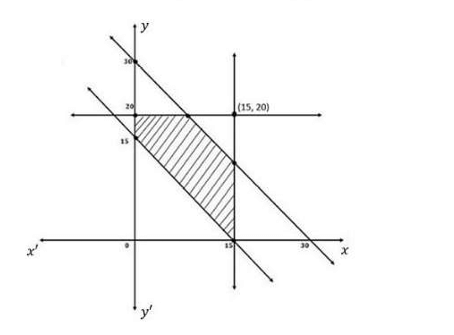
Which one of the following set of constraints does the given shaded region represent?
1
2
3
4
Official Solution
Correct Option: (1)
Step 1: Understanding the Concept:
We need to determine the system of linear inequalities that defines the given shaded feasible region. We do this by finding the equation of each boundary line and then determining the direction of the inequality (e.g., or ) by testing a point within the shaded region, like the origin (0,0) if it's not on the line. Step 3: Detailed Explanation:
First, let's identify the boundary lines from the graph.
Line passing through (15, 0) and (0, 15): The equation is , which simplifies to . The shaded region is above this line (away from the origin). Testing the point (15, 20) which is in the region: . So the inequality is . Line passing through (30, 0) and (0, 30): The equation is , which simplifies to . The shaded region is below this line (towards the origin). Testing the origin (0,0): . So the inequality is . Vertical line passing through x = 15: The equation is . The shaded region is to the left of this line. So the inequality is . Horizontal line passing through y = 20: The equation is . The shaded region is below this line. So the inequality is . Non-negativity constraints: The shaded region is in the first quadrant, which means and .
Combining all these inequalities, we get the set of constraints:
This set matches the constraints given in option (1). Step 4: Final Answer:
The correct set of constraints is .
19
PYQ 2025
medium
mathematicsID: cuet-ug-
Which one of the following set of constraints does the given shaded region represent?
1
2
3
4
Official Solution
Correct Option: (1)
Step 1: Understanding the Concept:
We need to determine the system of linear inequalities that defines the given shaded feasible region. We do this by finding the equation of each boundary line and then determining the direction of the inequality (e.g., or ) by testing a point within the shaded region, like the origin (0,0) if it's not on the line. Step 3: Detailed Explanation:
First, let's identify the boundary lines from the graph.
Line passing through (15, 0) and (0, 15): The equation is , which simplifies to . The shaded region is above this line (away from the origin). Testing the point (15, 20) which is in the region: . So the inequality is . Line passing through (30, 0) and (0, 30): The equation is , which simplifies to . The shaded region is below this line (towards the origin). Testing the origin (0,0): . So the inequality is . Vertical line passing through x = 15: The equation is . The shaded region is to the left of this line. So the inequality is . Horizontal line passing through y = 20: The equation is . The shaded region is below this line. So the inequality is . Non-negativity constraints: The shaded region is in the first quadrant, which means and .
Combining all these inequalities, we get the set of constraints:
This set matches the constraints given in option (1). Step 4: Final Answer:
The correct set of constraints is .
20
PYQ 2025
medium
mathematicsID: cuet-ug-
The feasible region is bounded by the inequalities:If the objective function is and is maximized at points and , then the relationship between and is:
1
2
3
4
Official Solution
Correct Option: (2)
We are given the objective function and two points where is maximized: and . We need to find the relationship between and . Substitute the coordinates of the points into the objective function: 1. At point : 2. At point : Since both points give the same value of , we equate the two expressions:
Simplifying the equation:
Substitute into the inequalities for further analysis, or simply solve the relationship between and using the constraints and the points given. This yields the solution and . Thus, the correct relationship is and .