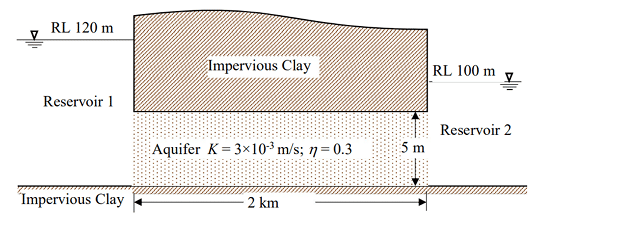
Two reservoirs differ by 20 m in water levels and are connected through a confined aquifer (thickness = 5 m, length = 2 km, hydraulic conductivity m/s, porosity ). If Reservoir 1 is contaminated, the time (in days, rounded off to one decimal place) taken by the pollutant to reach Reservoir 2 by advection is __________.
A pipeline delivers 20 L/s of oil (kinematic viscosity = , specific gravity = 0.9) under laminar flow. Minimum diameter of pipe is ________________ (in m, rounded off to two decimal places).
Official Solution
Correct Option:
(1)
Step 1: Flow rate. .
Step 2: Condition for laminar flow. Laminar if Reynolds number . where is velocity, diameter, and kinematic viscosity. Step 3: Velocity.
In the context of fluid flow, which of the following statement(s) is/are correct?
1
Streamline is a line, tangent to which at any point gives the direction of the velocity vector
2
Streakline is the actual path traversed by a given fluid particle in an unsteady flow
3
Streakline and streamline are same for a steady flow
4
Pathline and streamline are same for a steady flow
Official Solution
Correct Option:
(1)
Step 1: Understand the terms. Streamline: A curve that is tangent to the velocity vector at every point, representing the instantaneous direction of fluid flow. Streakline: The locus of all particles that have passed through a given point in the flow field. Pathline: The trajectory traced by an individual fluid particle over time. Steady flow: A flow where the fluid properties (velocity, pressure, etc.) do not change with time at any point in the flow field.
Step 2: Analyze each option. (1) Streamline is a line, tangent to which at any point gives the direction of the velocity vector: Correct. This is the definition of a streamline. (2) Streakline is the actual path traversed by a given fluid particle in an unsteady flow: Incorrect. A streakline is the locus of particles that have passed through a specific point, not the actual path of a single particle. (3) Streakline and streamline are same for a steady flow: Correct. In steady flow, streaklines and streamlines coincide as the flow properties do not change with time. (4) Pathline and streamline are same for a steady flow: Correct. In steady flow, pathlines and streamlines coincide as the flow properties do not change with time.
In a rectangular open channel, the flow is critical, and the flow depth is 2 m. Select the correct statement(s)
1
Specific energy for the flow is 3.0 m
2
Specific energy for the flow is 2.0 m
3
Froude number is 1.0
4
Froude number is 1.5
Official Solution
Correct Option:
(1)
Step 1: Understand critical flow conditions.
In an open channel, critical flow occurs when the Froude number ( ) is . The specific energy ( ) at critical flow is given by:
where: : Critical depth ( in this case). : Discharge (not required for determining specific energy in this problem). : Acceleration due to gravity. : Cross-sectional area. For critical flow in a rectangular channel, the specific energy simplifies to:
Step 2: Calculate specific energy.
Given :
Step 3: Determine the Froude number.
The Froude number for critical flow is always:
Step 4: Analyze the options. (1) Specific energy for the flow is : Correct, as calculated. (2) Specific energy for the flow is : Incorrect, as the specific energy is greater than the critical depth. (3) Froude number is : Correct, as this is the defining condition for critical flow. (4) Froude number is : Incorrect, as this would represent supercritical flow.
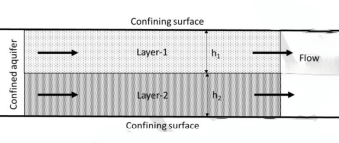
Consider two horizontal layers of an aquifer as shown in figure. Each layer is isotropic and homogeneous. Flow is parallel to the stratification. Thickness and horizontal hydraulic conductivity of layer-1 are i and , respectively. Thickness and horizontal hydraulic conductivity of layer-2 are and , respectively, where is not equal to . The equivalent horizontal conductivity for the aquifer system is given by _____
1
2
3
4
Official Solution
Correct Option:
(1)
Step 1: Equivalent horizontal hydraulic conductivity. When flow is parallel to the stratification, the equivalent horizontal hydraulic conductivity for the aquifer system is given by: where and are the hydraulic conductivity and thickness of the -th layer, respectively.
Step 2: Substitute for two layers. For two layers, the equation becomes:
Step 3: Interpretation of the terms. : Contribution of layer-1 to the equivalent hydraulic conductivity. : Contribution of layer-2 to the equivalent hydraulic conductivity. : Total thickness of the aquifer system.
Step 4: Verify the given options. The correct formula for equivalent horizontal conductivity matches:
Water is flowing FULL through a rectangular tunnel of size 3 m (width) × 2 m (height). The average velocity of flow is 1 m/s. The frictional head loss is observed to be 1 m per km. Consider acceleration due to gravity (g) as 10 . The correct statement(s) is/are
1
Hydraulic radius is 0.6 m
2
Darcy-Weisbach friction factor is 0.048
3
Hydraulic radius is 2 m
4
Darcy-Weisbach friction factor is 0.024
Official Solution
Correct Option:
(1)
Step 1: Compute the hydraulic radius. The hydraulic radius ( ) is given by:
For a rectangular cross-section of width and height :
Substitute these into the formula for :
Step 2: Compute the Darcy–Weisbach friction factor. The Darcy–Weisbach equation for head loss ( ) is:
Rearrange to solve for (friction factor):
Substitute these values:
Step 3: Verify the options. 1. Hydraulic radius is : This is correct, as calculated in Step 1. 2. Darcy–Weisbach friction factor is : This is correct, as calculated in Step 2. 3. Hydraulic radius is : This is incorrect, as . 4. Darcy–Weisbach friction factor is : This is incorrect, as .
About Fluid Flow - GATE-ES
Fluid Flow is a vital chapter for GATE-ES aspirants. Mastering the concepts covered in this chapter is essential for securing a top rank.
By rigorously practicing the previous year questions associated with this chapter, you can identify high-yield topics, understand the examiner's perspective, and boost your confidence during the actual exam.
Frequently Asked Questions
Why focus on Fluid Flow PYQs?
Analyzing PYQs for this specific chapter reveals the most frequently tested concepts and the typical complexity of questions, allowing you to tailor your study plan efficiently.
How to best use this analysis?
Review the topic breakdown to see which sub-topics within Fluid Flow carry the most weight. Then, tackle the questions iteratively to solidify your understanding.