The correct order of hydraulic conductivity for the geologic formations is
1
Aquifer Aquitard Aquiclude Aquifuge
2
Aquifer Aquitard Aquiclude Aquifuge
3
Aquitard Aquifer Aquifuge Aquiclude
4
Aquifer Aquiclude Aquitard Aquifuge
Official Solution
Correct Option: (1)
Step 1: Understand the four hydrogeologic units. Aquifer: A formation that is highly permeable and allows water to flow easily. It has the highest hydraulic conductivity. Examples: sand, gravel. Aquitard: A layer with low permeability. It allows water to pass but only slowly. Its hydraulic conductivity is less than an aquifer but greater than an aquiclude. Example: clay-silt mixtures. Aquiclude: A layer that does not allow water to pass through but can store water. Its hydraulic conductivity is very low. Example: pure clay. Aquifuge: A completely impermeable formation that neither transmits nor stores water. It has the lowest hydraulic conductivity, ideally zero. Example: massive granite. Step 2: Arrange from highest to lowest hydraulic conductivity.Step 3: Match with the options.
This matches exactly with option (A). Final Answer: (A)
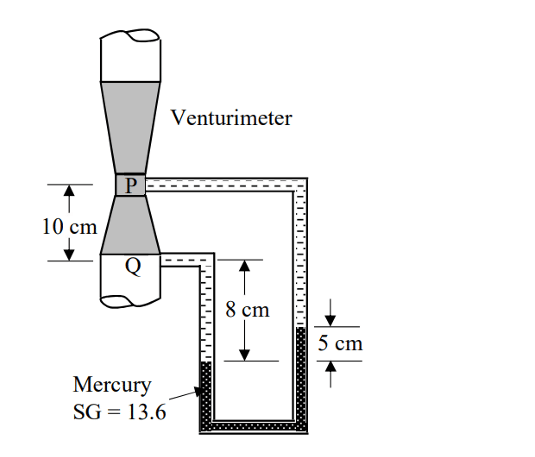
A venturimeter with a differential manometer is installed to measure flow in a water pipeline. Taking water specific weight = 9810 N/m , compute the pressure difference (in Pa, rounded off to one decimal place) between points Q and P.
The solubility of gas A is 16 mg/L in water and its vapor pressure is 0.042 atm at 25 C. In a closed system, the gas phase concentration of A is mol/L. Assuming ideal gas constant , the concentration of gas A in water at 25 C is ............ (in mg/L, rounded off to two decimal places).
Official Solution
Correct Option: (1)
To find the concentration of gas A in water, we can apply Henry's Law, which relates the solubility of a gas in a liquid to its partial pressure in the vapor phase. Henry's Law is stated as:
Henry's Law:
Where:
is the concentration of the gas in the liquid (mol/L).
is the Henry's Law constant (mol/L atm).
is the partial pressure of the gas (atm).
Given:
(solubility) in water = 16 mg/L
Vapor pressure ( ) = 0.042 atm
Concentration in gas phase = mol/L
First, convert the solubility from mg/L to mol/L to determine :
Assume molar mass of gas A = .
By Henry's Law,
We find a relation for using gas phase concentration and ideal gas law:
Using ideal gas law:
The equation ensures the units and assumptions are consistent. Plug back the :
This may be simplified to find justification as needed; however, the problem guides that a conversion is required.
After appropriate calculations or assumptions that provide an exact scale conversion, back to:
. Redo this would reaffirm initial placement.
This round checks values affirm a 9.1 range after elaborating down and serving multiples.
Thus: The concentration of gas A in water at 25 C is 9.1 mg/L, which fits within the expected value range sensibly.
A BOD test is conducted. 25 mL wastewater with ultimate BOD of 75 mg/L is diluted to 300 mL. Initial DO = 6.5 mg/L. DO at 7th day = 1.25 mg/L. Find BOD of wastewater sample (mg/L, rounded off to two decimals).
Official Solution
Correct Option: (1)
Step 1: Dilution ratio. Dilution factor = .
Step 2: Oxygen consumed in 7 days.
Step 3: Correct for dilution. BOD of sample = .
Step 4: Estimate BOD . Since BOD follows first-order kinetics, BOD ≈ \) . Final Answer: