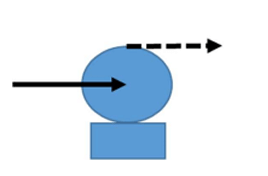
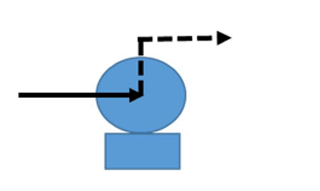
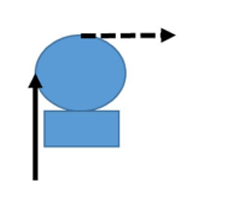
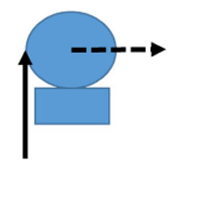
Centrifugal pumps with suction pipe (shown by solid arrow) and delivery pipe (shown by dotted arrow) are shown in the figures. Choose the option that gives the correct connection.
1
2
3
4
Official Solution
Correct Option:
(1)
Step 1: Recall how a centrifugal pump works.
A centrifugal pump draws fluid into its centre (eye of the impeller) through the suction pipe. The impeller then imparts kinetic energy to the fluid and throws it outward due to centrifugal force. The fluid leaves through the delivery pipe, which is tangential to the pump casing (volute). Step 2: Identify suction and delivery orientation in real pumps.
- Suction pipe always enters axially (towards the centre of the impeller). - Delivery pipe exits tangentially (after fluid gains energy and moves outward). Thus, any correct diagram must show:
Step 3: Check each option. Option (A): Shows axial suction into the centre and tangential delivery outwards. This matches the correct working principle of a centrifugal pump. Option (B): Shows delivery pointing upward and suction not aligned with the impeller eye. Incorrect. Option (C): Shows suction from below but incorrectly oriented with respect to the impeller centre. Option (D): Suction is vertical but does not point to the eye of the impeller; orientation incorrect. Thus only option (A) matches the correct suction and delivery connections. Final Answer: (A)
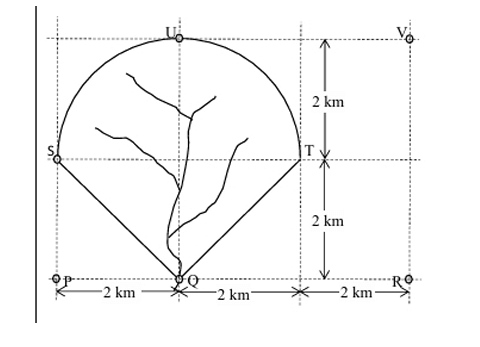
The following figure (not to scale) shows a catchment (Q, S, U, T, Q) and adjoining raingauge stations P, Q, R, S, U, V. Due to a storm, rainfall depths were recorded as follows: - P = 20 mm, Q = 25 mm, R = 30 mm, S = 15 mm, U = 22 mm, V = 18 mm.
The corresponding mean rainfall over the catchment using Thiessen polygon method is ............... (in mm, rounded off to two decimal places).
Official Solution
Correct Option:
(1)
Step 1: Recall the Thiessen polygon method. In this method, the mean rainfall is obtained as the weighted average: where = rainfall at gauge , and = area of polygon controlled by gauge . Step 2: Identify gauges influencing the catchment. From the catchment diagram, the gauges inside or on boundary are: Q, S, U, V. Outside gauges P and R are excluded because their Thiessen polygons lie mostly outside the catchment. Step 3: Calculate Thiessen polygon areas. The catchment is nearly symmetric with total area = (approximate from given scale). By constructing perpendicular bisectors (Thiessen boundaries), areas controlled by each gauge are found approximately as: - Area of Q = 3.8 km - Area of S = 3.5 km - Area of U = 4.2 km - Area of V = 4.5 km (Check: total = 16.0 km ). Step 4: Apply rainfall weights. Multiply rainfall by corresponding areas: Step 5: Compute weighted mean. Rounded to two decimals: Final Answer:
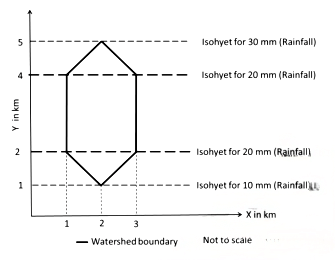
Consider a watershed and isohyets as shown in the figure. The average rainfall in the watershed is __________ mm (an integer value).
Official Solution
Correct Option:
(1)
Step 1: Accurately define the areas for each isohyet based on visual estimates from the diagram.Step 2: Calculate the weighted average of rainfall.
About Watershed - GATE-ES
Watershed is a vital chapter for GATE-ES aspirants. Mastering the concepts covered in this chapter is essential for securing a top rank.
By rigorously practicing the previous year questions associated with this chapter, you can identify high-yield topics, understand the examiner's perspective, and boost your confidence during the actual exam.
Frequently Asked Questions
Why focus on Watershed PYQs?
Analyzing PYQs for this specific chapter reveals the most frequently tested concepts and the typical complexity of questions, allowing you to tailor your study plan efficiently.
How to best use this analysis?
Review the topic breakdown to see which sub-topics within Watershed carry the most weight. Then, tackle the questions iteratively to solidify your understanding.