Municipal Solid Waste Management
8 previous year questions.
High-Yield Trend
Chapter Questions 8 MCQs
Ultimate analysis of an MSW sample (mass fractions, % by weight): C = 48, H = 6, O = 35, N = 6, Ash = 5. For burning 1 kg of this MSW (air contains only O and N ), the maximum CO emitted is ________________ (in kg, rounded off to three decimals).
An industry with an effective stack height of 80 m emits 1200 g/h of CO. The windrose indicates wind speed m/s. At a downwind distance of 2 km (plume centerline), the dispersion coefficients depend on wind direction as per the table below.
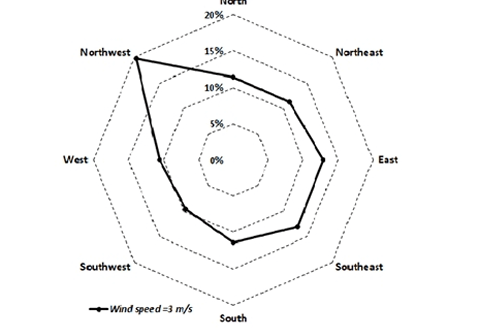
Air Pollution Concentration Calculation
During the maximum duration of the year (i.e., the most frequent wind direction from the windrose), the ground-level PM2.5 concentration is to be computed at the plume centerline at 2 km. Find the concentration (in μg/m3, rounded off to two decimal places).
Dispersion Coefficients (in m)
| Wind Direction | Dispersion Coefficients (in m) |
|---|---|
| Northeast | Crosswind: 50, Vertical: 20 |
| North | Crosswind: 45, Vertical: 30 |
| Northwest | Crosswind: 40, Vertical: 35 |
| East | Crosswind: 45, Vertical: 30 |
| Southeast | Crosswind: 55, Vertical: 35 |
| South | Crosswind: 60, Vertical: 40 |
| Southwest | Crosswind: 65, Vertical: 45 |
| West | Crosswind: 70, Vertical: 50 |
Table 1: Dispersion coefficients based on wind direction
About Municipal Solid Waste Management - GATE-ES
Municipal Solid Waste Management is a vital chapter for GATE-ES aspirants. Mastering the concepts covered in this chapter is essential for securing a top rank.
By rigorously practicing the previous year questions associated with this chapter, you can identify high-yield topics, understand the examiner's perspective, and boost your confidence during the actual exam.
Frequently Asked Questions
Why focus on Municipal Solid Waste Management PYQs?
Analyzing PYQs for this specific chapter reveals the most frequently tested concepts and the typical complexity of questions, allowing you to tailor your study plan efficiently.
How to best use this analysis?
Review the topic breakdown to see which sub-topics within Municipal Solid Waste Management carry the most weight. Then, tackle the questions iteratively to solidify your understanding.