The minimum and maximum Digital Number (DN) values of an image are 30 and 55, respectively. If the input DN value of a pixel is 35, the output DN value after linear contrast stretch of an 8-bit data is __________________ (in integer).
Official Solution
Correct Option:
(1)
For linear contrast stretching, we use the following formula:
Where:
- (the input DN value),
- (the minimum DN value),
- (the maximum DN value),
- (the maximum possible value for 8-bit data),
- (the minimum possible value for 8-bit data). Substituting the values into the formula: Final Answer:
02
PYQ 2022
medium
image-processing-and-analysisID: gate-ge-
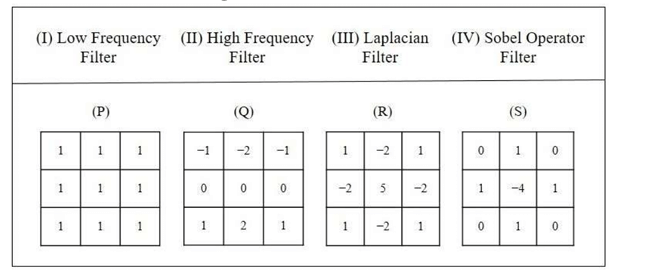
Match the CORRECT option(s) for the types of filters given in (I), (II), (III), and (IV) with their kernels given in (P), (Q), (R), and (S).
1
I - P and II - Q
2
III - R and IV - S
3
I - P and IV - Q
4
II - R and III - S
Official Solution
Correct Option:
(3)
To answer this question, we need to understand what each filter does and how it relates to the given kernels (P, Q, R, S). Filters are used in image processing for operations like edge detection, smoothing, and enhancing details. Here, we are given four types of filters and their respective kernels. Let's analyze each one: - (I) Low Frequency Filter (P): This filter is designed to smooth an image by removing high-frequency noise, which represents rapid intensity changes in the image. The kernel for a low frequency filter typically contains values that help to average or blur the image. The kernel is a smooth, symmetric kernel with positive values that would result in averaging the neighboring pixels. - (II) High Frequency Filter (Q): High-frequency filters emphasize rapid changes in pixel values, such as edges. These filters are often used for edge detection. The kernel is a difference kernel, with positive and negative values, which emphasizes the differences between adjacent pixels, highlighting edges. - (III) Laplacian Filter (R): The Laplacian filter is used for edge detection and image enhancement by detecting areas of rapid intensity change. The kernel contains both positive and negative values, which helps to highlight rapid changes in intensity, characteristic of the Laplacian filter. - (IV) Sobel Operator Filter (S): The Sobel operator is used for edge detection and enhances the gradient of an image. It helps in detecting edges by calculating the gradient of image intensity. The kernel is the standard Sobel operator kernel, which is used for edge detection in both horizontal and vertical directions. Matching the Filters to the Kernels: - (I) Low Frequency Filter (P): The kernel is a smooth kernel, which is ideal for low-frequency filtering, and corresponds to the low-frequency filter. - (II) High Frequency Filter (Q): The kernel is a difference-based kernel, which corresponds to the high-frequency filter.
- (III) Laplacian Filter (R): The kernel is a Laplacian kernel, which is used to highlight rapid changes, thus matching the Laplacian filter.
- (IV) Sobel Operator Filter (S): The kernel is the Sobel operator, which is specifically designed for edge detection, matching the Sobel operator filter. Thus, the correct matches are: - (I) - P (Low Frequency Filter)
- (IV) - Q (Sobel Operator Filter) Hence, the correct answer is (C) I - P and IV - Q.
03
PYQ 2022
medium
image-processing-and-analysisID: gate-ge-
When the histogram of an image is non-Gaussian in nature, the type of linear contrast enhancement preferred to be used is
1
Piece-wise Linear Contrast Stretching
2
Min-max Linear Contrast Stretching
3
Percentage Linear Contrast Stretching
4
Standard Deviation Contrast Stretching
Official Solution
Correct Option:
(1)
When the histogram of an image is non-Gaussian, piece-wise linear contrast stretching is preferred. This technique divides the image histogram into several intervals and applies different stretching to each interval. This allows for better contrast enhancement in non-uniform histograms. Step 1: Understanding Contrast Stretching
- Option (A) is correct because piece-wise linear contrast stretching is specifically useful when the histogram is non-Gaussian, allowing for better control over various ranges of pixel values.
- Option (B) refers to min-max linear contrast stretching, which is used for images with uniform histograms, not typically for non-Gaussian images.
- Option (C) refers to percentage linear contrast stretching, which is not commonly used in non-Gaussian histogram enhancement.
- Option (D) refers to standard deviation contrast stretching, which is also not ideal for non-Gaussian histograms. Step 2: Conclusion
The preferred method for non-Gaussian histograms is (A) Piece-wise Linear Contrast Stretching.
About Image Enhancement - GATE-GE
Image Enhancement is a vital chapter for GATE-GE aspirants. Mastering the concepts covered in this chapter is essential for securing a top rank.
By rigorously practicing the previous year questions associated with this chapter, you can identify high-yield topics, understand the examiner's perspective, and boost your confidence during the actual exam.
Frequently Asked Questions
Why focus on Image Enhancement PYQs?
Analyzing PYQs for this specific chapter reveals the most frequently tested concepts and the typical complexity of questions, allowing you to tailor your study plan efficiently.
How to best use this analysis?
Review the topic breakdown to see which sub-topics within Image Enhancement carry the most weight. Then, tackle the questions iteratively to solidify your understanding.