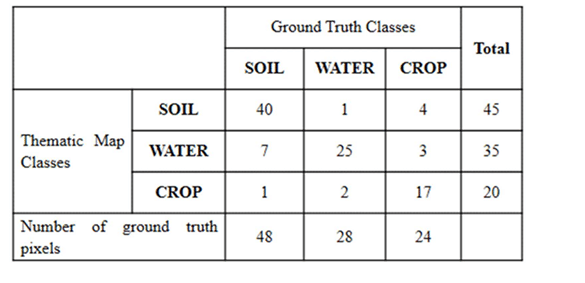
The overall image classification accuracy (in percentage) calculated from the following error matrix is __________________ (in integer).
Official Solution
Correct Option: (1)
To calculate the overall image classification accuracy, we use the following formula:
From the error matrix: The diagonal elements are 40 (SOIL), 25 (WATER), and 17 (CROP). The sum of these diagonal elements is:
The total number of elements in the matrix is:
Thus, the overall accuracy is:
Hence, the overall classification accuracy is 82.
02
PYQ 2022
medium
image-processing-and-analysisID: gate-ge-
Choose the INCORRECT statement about image segmentation in digital image processing.
1
Segmentation divides an image into different regions.
2
Image segmentation does not help in image classification.
3
Segmentation helps to identify objects or boundaries.
4
Segmentation is a process of partitioning an image into multiple sets of similar pixels.
Official Solution
Correct Option: (2)
Image segmentation is an important step in image processing that helps in dividing an image into different regions based on similarity in pixel values. It is a crucial step in identifying objects and boundaries within an image, which makes it highly useful for image classification. Step 1: Understanding Image Segmentation
- Option (A) is correct because segmentation indeed divides an image into different regions based on pixel similarity.
- Option (B) is incorrect because image segmentation actually aids in image classification by separating objects and regions of interest.
- Option (C) is correct as segmentation helps in identifying objects or boundaries by isolating distinct areas of the image.
- Option (D) is correct because segmentation involves partitioning an image into multiple sets of similar pixels based on some criteria (e.g., color, intensity). Step 2: Conclusion
The incorrect statement is (B), as segmentation is essential for image classification.
03
PYQ 2022
medium
image-processing-and-analysisID: gate-ge-
Select the CORRECT sequence for supervised classification of satellite image. (i) Classification
(ii) Training
(iii) Accuracy assessment
(iv) Radiometric/geometric correction
1
(i), (ii), (iii), (iv)
2
(iv), (ii), (i), (iii)
3
(iv), (iii), (ii), (i)
4
(i), (iv), (ii), (iii)
Official Solution
Correct Option: (2)
The process of supervised classification of satellite images generally follows these steps: 1. Radiometric/Geometric correction (iv): This is the first step, where the image is corrected for any distortions due to sensor errors, atmospheric conditions, and geometric misalignments. This ensures that the image is accurate and aligned with the Earth's surface. 2. Training (ii): In this step, the user selects training areas for each class of interest. These training areas are used to train the classification algorithm to recognize patterns in the image. 3. Classification (i): Once the training data is ready, the classification process begins. The image is classified into various categories based on the training data, producing the final classified image. 4. Accuracy assessment (iii): After classification, it is essential to assess the accuracy of the classification. This is done by comparing the classification results with ground truth data to determine how well the classification matches real-world conditions. Thus, the correct sequence is (iv), (ii), (i), (iii), as outlined in option (B).
04
PYQ 2022
medium
image-processing-and-analysisID: gate-ge-
The correlation coefficient between two bands of remote sensing data that would yield good classification is
1
close to one
2
close to zero
3
close to ten
4
between one to ten
Official Solution
Correct Option: (2)
The correlation coefficient measures the strength and direction of the linear relationship between two bands of remote sensing data. A value close to one indicates a strong positive linear relationship between the bands, which typically results in better classification. In remote sensing, a higher correlation between the bands generally means they are similar in terms of the spectral characteristics they measure, which can help in classification tasks. Step 1: Analyzing the options. - Option (A) is correct because a correlation coefficient close to one indicates a high positive correlation, which is beneficial for classification.
- Option (B) is incorrect because a correlation coefficient close to zero means no correlation, which is not useful for classification.
- Option (C) is incorrect because the correlation coefficient cannot be close to ten; it is bounded between -1 and 1.
- Option (D) is incorrect because the correlation coefficient is between -1 and 1, not between 1 and 10. Thus, the correct answer is (A).