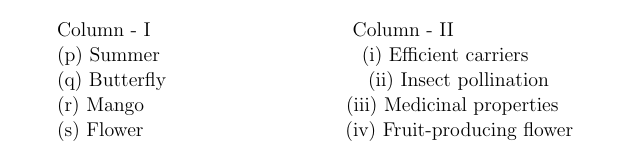
Match the items from Column - 1 with Column - II and select the correct option.
1
(p-iii), (q-iv), (r-i), (s-ii)
2
(p-iv), (q-iii), (r-i), (s-iii)
3
(p-iii), (q-iii), (r-iv), (s-i)
4
(p-iii), (q-i), (r-ii), (s-iv)
Official Solution
Correct Option:
(1)
Step 1: Understanding the Question. We are asked to match the items in Column I with their appropriate pairs in Column II. Let's look at the connections between the items.
Step 2: Analyzing the Options. (A) (p-iii), (q-iv), (r-i), (s-ii): Correct — Summer relates to medicinal properties, butterflies are involved in insect pollination, mango is an efficient carrier of seeds, and flowers are fruit-producing flowers. (B) (p-iv), (q-iii), (r-i), (s-iii): This is incorrect, as the pairings do not make sense. (C) (p-iii), (q-iii), (r-iv), (s-i): This doesn't fit because the pairings do not align with their correct meanings. (D) (p-iii), (q-i), (r-ii), (s-iv): Again, this doesn't match as expected.
Step 3: Conclusion. The correct answer is (A) (p-iii), (q-iv), (r-i), (s-ii), as it correctly pairs the items based on their meanings.
02
PYQ 2025
medium
biologyID: gujcet-2
Which of the following plant families' pollen cannot remain viable for months?
1
Pine
2
Willow
3
Solanaceae
4
None
Official Solution
Correct Option:
(3)
Step 1: Understanding the Question. This question asks which plant family produces pollen that cannot remain viable for months.
Step 2: Analyzing the Options. (A) Pine: Pine pollen can remain viable for extended periods. (B) Willow: Willow pollen also tends to remain viable for a longer duration. (C) Solanaceae: Correct — Solanaceae family pollen does not remain viable for as long as other types. (D) None: This is incorrect since Solanaceae is the correct answer.
Step 3: Conclusion. The correct answer is (C) Solanaceae, as this plant family’s pollen does not remain viable for months.
About Reproduction In Plants - GUJCET
Reproduction In Plants is a vital chapter for GUJCET aspirants. Mastering the concepts covered in this chapter is essential for securing a top rank.
By rigorously practicing the previous year questions associated with this chapter, you can identify high-yield topics, understand the examiner's perspective, and boost your confidence during the actual exam.
Frequently Asked Questions
Why focus on Reproduction In Plants PYQs?
Analyzing PYQs for this specific chapter reveals the most frequently tested concepts and the typical complexity of questions, allowing you to tailor your study plan efficiently.
How to best use this analysis?
Review the topic breakdown to see which sub-topics within Reproduction In Plants carry the most weight. Then, tackle the questions iteratively to solidify your understanding.