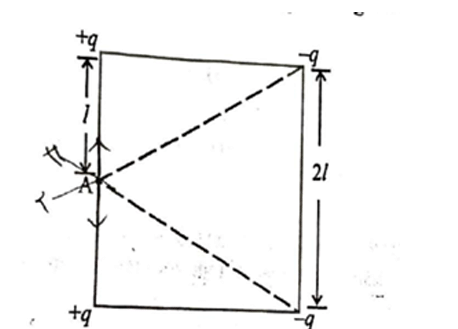
In the diagram of two point charges and , the potential at point A is given by the formula. Calculate the potential at point A if the distance between the charges is .
1
2
3
4
Official Solution
Correct Option:
(1)
Step 1: Understanding the potential formula.
The electric potential at a point due to a point charge is given by:
where is Coulomb's constant, is the charge, and is the distance from the charge. The total potential at point A will be the sum of the potentials due to both charges. Step 2: Applying the formula for multiple charges.
Using the distances from point A to each of the charges and substituting the appropriate values, the total potential at point A is calculated as: Step 3: Conclusion.
The correct potential at point A is , so the correct answer is (A).
02
PYQ 2025
medium
physicsID: gujcet-2
For a resistor , the potential across it is given by of charge and a voltage across it. The electrical potential due to this charge will depend on:
1
2
3
4
Official Solution
Correct Option:
(3)
Step 1: Electric potential formula.
The potential across a resistor is related to the charge and the resistance by the formula:
where is the capacitance of the system. Step 2: Using the charge.
Since the total charge is , the potential across the resistor will be directly proportional to . Step 3: Conclusion.
Thus, the potential will depend on the value of , so the correct answer is (C).
03
PYQ 2025
medium
physicsID: gujcet-2
If the electric field between the plates of a capacitor with charge is , then what will the electric field be when the capacitor is connected to a battery with a voltage across the plates?
1
2
3
4
Official Solution
Correct Option:
(3)
Step 1: Understanding the electric field.
The electric field between the plates of a capacitor is given by the formula:
where:
- is the voltage across the plates,
- is the distance between the plates. Step 2: Applying the change in voltage.
If the capacitor is connected to a battery with a voltage across the plates, and the charge on the capacitor is , the electric field will double. Step 3: Conclusion.
The electric field will become , so the correct answer is (C).
04
PYQ 2025
medium
physicsID: gujcet-2
In a spherical shell, the potential at a point from the center of the shell is equal to the potential due to a point charge placed at the center of the shell. The potential at this point is:
1
2
3
4
Official Solution
Correct Option:
(2)
Step 1: Understanding the potential formula.
The electric potential at a point due to a point charge is given by:
where is Coulomb's constant, is the charge, and is the distance from the charge. Step 2: Applying the potential for a spherical shell.
For a spherical shell, the potential at a point is determined by the charge at the center and the distance from the center. Given that the potential due to the shell is equivalent to the potential due to a point charge at the center, the result will be . Step 3: Conclusion.
Thus, the correct answer is (B) .
05
PYQ 2025
medium
physicsID: gujcet-2
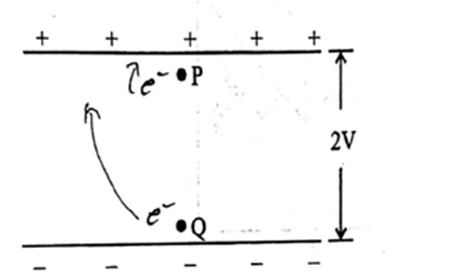
Two point charges are placed on either side of the system, and the electric field is applied with a voltage of 2V. If the electric potential is the same, what will be the interaction between the two charges and ?
1
The electric potential on both charges will be the same.
2
The potential at point P will be higher than at point Q.
3
The potential at point Q will be higher than at point P.
4
The interaction between the charges will be mutually repulsive.
Official Solution
Correct Option:
(1)
Step 1: Understanding electric potential.
The electric potential at a point in space is the same for both charges when the system is symmetrical and the charges are placed in an evenly distributed electric field. Step 2: Conclusion.
Since the electric field is applied equally to both charges, the electric potential at both points will be the same, hence the correct answer is (A).
06
PYQ 2026
medium
physicsID: gujcet-2
An electric dipole of dipole moment is placed parallel to the uniform electric field of intensity . On rotating it through angle of 90° from this situation, the amount of work done is ______.
1
2
3
4
Zero
Official Solution
Correct Option:
(3)
Step 1: Understanding the Concept:
The potential energy of a dipole in an electric field is . The work done in rotating the dipole is the change in its potential energy: . Step 2: Detailed Explanation:
Initial angle ( ) = 0° (parallel to the field).
Final angle ( ) = 90°.
$ PE$.
07
PYQ 2026
medium
physicsID: gujcet-2
The total charge on a uniformly charged spherical shell having radius R is Q. Then electric potential at a distance from the centre of the shell ______.
1
2
3
4
Official Solution
Correct Option:
(1)
Step 1: Understanding the Concept:
For a charged spherical shell, the electric field inside is zero. This means the electric potential remains constant at all points inside and is equal to the potential on the surface. Step 2: Detailed Explanation:
The potential on the surface ( ) is .
Since the potential is constant inside the shell ( ), the potential at is exactly the same as the potential on the surface.
$ $ Step 3: Final Answer:
The correct option is (a).
08
PYQ 2026
medium
physicsID: gujcet-2
A parallel plate capacitor with air between the plates has a capacitance of 1.0 pF. If the distance between the plates is made doubled and space between them is filled with dielectric substance, the capacitance becomes 2.0 pF. Then the value of dielectric constant of dielectric substance is ______.
1
1.5
2
3.0
3
2.0
4
4.0
Official Solution
Correct Option:
(4)
Step 1: Understanding the Concept:
The capacitance of a parallel plate capacitor is , where is the dielectric constant and is the distance. Step 2: Detailed Explanation:
Initial state (Air, ): .
Final state (Dielectric , Distance ): .
Substitute into the second equation:
$ $ Step 3: Final Answer:
The dielectric constant is 4.0.
09
PYQ 2026
medium
physicsID: gujcet-2
Two infinitely long thin straight parallel wires are kept a perpendicular distance having uniform linear charge densities and respectively. The magnitude of electric field at a mid point between two wires will be ______.
1
2
3
4
Official Solution
Correct Option:
(1)
Step 1: Understanding the Concept:
The electric field due to an infinitely long wire at a distance is . We must use superposition to find the net field at the midpoint. Step 2: Detailed Explanation:
The midpoint is at a distance from each wire.
1. Field due to : (directed away from the positive wire).
2. Field due to : (directed toward the negative wire).
At the midpoint, both fields point in the same direction (from positive to negative).
$ $ Step 3: Final Answer:
The correct option is (a).
10
PYQ 2026
medium
physicsID: gujcet-2
If charge is placed on one of the vertex of a cube, then total electric flux passing through the cube is ______.
1
2
3
4
Official Solution
Correct Option:
(2)
Step 1: Understanding the Concept:
According to Gauss's Law, the total electric flux through a closed surface is times the net charge enclosed. If a charge is not fully enclosed, we must imagine a symmetrical structure to enclose it. Step 2: Detailed Explanation:
A charge placed at the corner (vertex) of a cube is shared by 8 identical cubes meeting at that point. To fully enclose the charge symmetrically, we need a larger "super-cube" made of 8 smaller cubes. The total flux through this large cube is . Since the flux is distributed equally among the 8 cubes, the flux through one single cube is:
$ $ Step 3: Final Answer:
The correct option is (b).
11
PYQ 2026
medium
physicsID: gujcet-2
A proton and a -particle are placed in uniform electric field. Accelerations produced in them are and respectively. Then will be ______.
1
1 : 2
2
4 : 1
3
2 : 1
4
1 : 4
Official Solution
Correct Option:
(3)
Step 1: Understanding the Concept:
Force in an electric field is . According to Newton's Second Law, . Therefore, acceleration . Step 2: Detailed Explanation:
For a Proton ( ): Charge , Mass .
For an Alpha particle ( ): Charge , Mass .
$ \frac{a_p}{a_\alpha} = \frac{eE/m}{eE/2m} = \frac{2}{1}$. Step 3: Final Answer:
The correct option is (c).
About Electrostatics - GUJCET
Electrostatics is a vital chapter for GUJCET aspirants. Mastering the concepts covered in this chapter is essential for securing a top rank.
By rigorously practicing the previous year questions associated with this chapter, you can identify high-yield topics, understand the examiner's perspective, and boost your confidence during the actual exam.
Frequently Asked Questions
Why focus on Electrostatics PYQs?
Analyzing PYQs for this specific chapter reveals the most frequently tested concepts and the typical complexity of questions, allowing you to tailor your study plan efficiently.
How to best use this analysis?
Review the topic breakdown to see which sub-topics within Electrostatics carry the most weight. Then, tackle the questions iteratively to solidify your understanding.