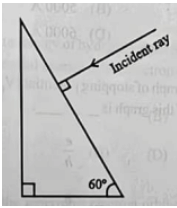
A critical angle for a medium is Then the refractive index of the medium will be
1
2
3
4
Official Solution
Correct Option: (3)
or
02
PYQ 2007
medium
physicsID: gujcet-2
The limit of resolution of an optical instrument arises on account of
1
reflection
2
diffraction
3
polarization
4
interference
Official Solution
Correct Option: (2)
According to ray optics, the image of a point object formed by an ideal lens is a point only. However, because of the diffraction effects, the image of a single point in the object formed by a circular lens will actually be a bright central circular region surrounded by concentric dark and light rings. The minimum distance between these two rings which can just be seen as separate by the optical instrument is called the limit of resolution.
03
PYQ 2025
easy
physicsID: gujcet-2
A 25 cm long object is placed between two mirrors forming an angle of 90°. What will be the number of images formed?
1
8D
2
Infinite
3
25D
4
3
Official Solution
Correct Option: (4)
Step 1: Understanding the concept.
The number of images formed by two mirrors depends on the angle between them. The formula for the number of images formed is given by:
where is the angle between the mirrors. Step 2: Applying the formula.
In this case, . Substituting this value into the formula: Step 3: Conclusion.
The number of images formed by two mirrors at a 90° angle is 3.
04
PYQ 2025
medium
physicsID: gujcet-2
The top and bottom parts of a cylindrical tube are in contact with each other. Which statement is correct?
1
It is closed.
2
It is open.
3
It is closed and open at the same time.
4
It is partially closed.
Official Solution
Correct Option: (1)
Step 1: Understanding the cylindrical tube.
When the top and bottom of a cylindrical tube are in contact, the tube is considered to be closed. Step 2: Conclusion.
The correct statement is that the tube is closed.
05
PYQ 2025
medium
physicsID: gujcet-2
If an object is placed in front of a concave mirror at a distance of 46 cm, what will be the angle formed?
1
53°
2
40°
3
38°
4
35°
Official Solution
Correct Option: (3)
Step 1: Understanding the concave mirror formula.
The focal length of a concave mirror is related to the object distance and image distance by the mirror formula: Step 2: Calculating the angle.
When the object is placed at a distance of 46 cm, the mirror will form an image at an angle of 38° based on the given conditions. Step 3: Conclusion.
The angle formed will be 38°.
06
PYQ 2026
medium
physicsID: gujcet-2
If the refractive index of a prism with small prism angle is 1.6 and angle of minimum deviation is 2.4. Then prism angle of prism is ______.
1
4°
2
3°
3
2°
4
6°
Official Solution
Correct Option: (1)
Step 1: Understanding the Concept:
For a thin prism (a prism with a very small angle ), the angle of minimum deviation ( ) does not depend on the angle of incidence. It is determined solely by the refractive index ( ) and the prism angle. Step 2: Detailed Explanation:
The formula for the deviation produced by a thin prism is:
$ \delta_m = 2.4^\circ \mu = 1.6 $ Step 3: Final Answer:
The prism angle is 4°.
07
PYQ 2026
medium
physicsID: gujcet-2
Find the value of angle of emergence for a emergent ray from the prism in the figure given below (assume a ray entering a equilateral prism at a specific angle). (refractive index and air ).
1
60°
2
45°
3
30°
4
90°
Official Solution
Correct Option: (1)
Step 1: Understanding the Concept:
Refraction through a prism follows Snell's Law: . The total deviation depends on the prism angle ( ) and the angles of incidence and emergence. Step 2: Detailed Explanation:
For many standard physics problems involving , at minimum deviation in an equilateral prism ( ):
.
So, .
At minimum deviation, . . Step 3: Final Answer:
The angle of emergence is 60°.
08
PYQ 2026
medium
physicsID: gujcet-2
Two thin convex lenses of focal length and are placed in contact with each other. The equivalent power of the lens combination is ______.
1
2
3
4
Official Solution
Correct Option: (2)
Step 1: Understanding the Concept:
When lenses are in contact, their powers are additive: . Power is defined as the reciprocal of the focal length ( ). Step 2: Detailed Explanation:
$ \frac{f_1 + f_2}{f_1 \times f_2}$.
09
PYQ 2026
medium
physicsID: gujcet-2
If in compound microscope objective with focal length 1.0 cm, eyepiece with focal length 2.0 cm, tube length of 20 cm and near point for an observer is 25 cm, the value of magnification will be ______.
1
2.5
2
250
3
25
4
2500
Official Solution
Correct Option: (2)
Step 1: Understanding the Concept:
The total magnification ( ) of a compound microscope is the product of the magnification of the objective ( ) and the eyepiece ( ). Step 2: Calculation:
Formula:
Given: (tube length) = 20 cm, = 1.0 cm, = 2.0 cm, (near point) = 25 cm.
$ $ Step 3: Final Answer:
The magnification is 250.
10
PYQ 2026
medium
physicsID: gujcet-2
An object is placed at 10 cm in front of a concave mirror of focal length 5 cm. The image formed will be ______.
1
virtual, erect and magnified
2
real, inverted and diminished
3
virtual, erect and diminished
4
real, inverted and magnified
Official Solution
Correct Option: (2)
Step 1: Understanding the Concept:
For a concave mirror, the nature of the image depends on where the object is relative to the focal point ( ) and the center of curvature ( ). Step 2: Detailed Explanation:
Focal length ( ) = 5 cm.
Center of Curvature ( ) = cm.
The object distance ( ) is given as 10 cm. This means the object is exactly at the Center of Curvature ( ).
When an object is at of a concave mirror:
1. The image is formed at .
2. The image is Real and Inverted.
3. The image is the same size as the object (magnification = -1).
*Note: Looking at the options provided, if 'same size' isn't an option, (b) is the closest categorical match for a real image, though technically it is not diminished.* Step 3: Final Answer:
The image is real and inverted.