Chemical Reactions
7 previous year questions.
High-Yield Trend
Chapter Questions 7 MCQs
Rita added dilute hydrochloric acid to four metals. She recorded her observations in the table given below. While noting her observations she made some errors. 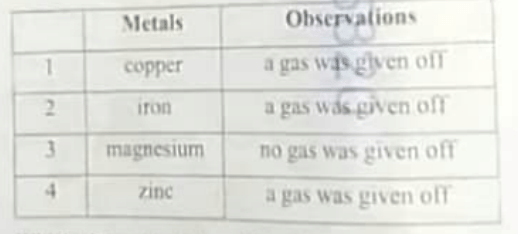
(a) The most electronegative element of Period 2
(b) The largest atom of Period 3
(a) The oxide that dissolves in caustic potash (KOH) is [ZnO / CuO]
(b) The reaction that takes place at the anode during the electrolysis of molten lead bromide is [2Br(^-) () Br(_2) + 2e(^-) / 2Br(^-) + 2e(^-) () 2Br(^-)]
(c) The volume occupied by 8 grams of oxygen gas at STP is ______ litres. [15 / 8.96] [Atomic weight of O = 16]
(d) ______ does not give hydrogen gas when it reacts with cold and very dilute nitric acid. [Cu / Mn]
(e) ______ is a polar covalent compound [HCl / CCl(_4)]
Match Column A with Column B: 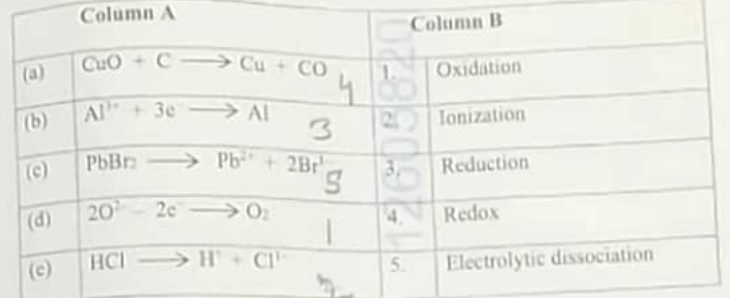
(a) A compound which reacts with water to give acetylene gas.
(b) The gas evolved when sodium propanoate is heated with soda lime.
(c) A reddish-brown precipitate formed when ferric chloride solution reacts with an alkali.
(d) A pair of electrons present in an atom which is not shared with any other atom during bond formation.
(e) The relative molecular mass of a substance expressed in grams.
About Chemical Reactions - ICSE-CLASS-X-BOARD
Chemical Reactions is a vital chapter for ICSE-CLASS-X-BOARD aspirants. Mastering the concepts covered in this chapter is essential for securing a top rank.
By rigorously practicing the previous year questions associated with this chapter, you can identify high-yield topics, understand the examiner's perspective, and boost your confidence during the actual exam.
Frequently Asked Questions
Why focus on Chemical Reactions PYQs?
Analyzing PYQs for this specific chapter reveals the most frequently tested concepts and the typical complexity of questions, allowing you to tailor your study plan efficiently.
How to best use this analysis?
Review the topic breakdown to see which sub-topics within Chemical Reactions carry the most weight. Then, tackle the questions iteratively to solidify your understanding.