Organic Chemistry
12 previous year questions.
High-Yield Trend
Chapter Questions 12 MCQs
A hydrocarbon X undergoes the reaction under suitable conditions as shown below. 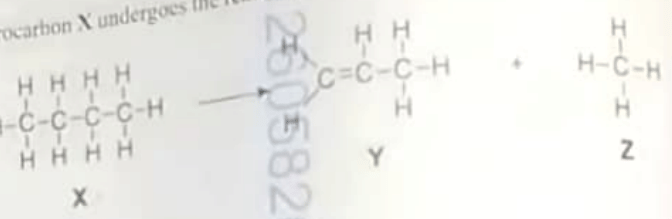
K, L and M are beakers containing three different solutions: [Beaker K: Aqueous acetic acid, Beaker L: Sodium chloride solution, Beaker M: Distilled water]. Name the beaker which:
(a) contains only ions.
(b) contains only molecules.
(c) has pH less than 7. 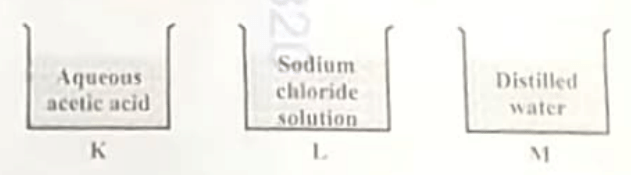
Give one relevant observation for the following:
(a) Sodium hydroxide is added dropwise to Calcium nitrate solution.
(b) Dilute Hydrochloric acid is added to Iron (II) sulphide.
(c) An amphoteric metal is added to hot concentrated alkali.
(a) Hydrochloric acid cannot form an acid salt.
(b) Electronegativity increases across a period.
(a) Name the gas collected.
(b) Which acid is formed when the gas collected by the chemist is dissolved directly in water?
(c) Why should we not dissolve this gas directly in water?
(a) The type of reaction that occurred is __________ (addition / substitution)
(b) Name a suitable catalyst which is used in the reaction
(c) Write a balanced chemical equation for the above reaction
• P readily loses its one valence electron to form a stable ion.
• Q shares its electrons in bonding but does not form ions easily.
• R has high electronegativity.
(a) (C_2H_4Br_2 + 2KOH (textalcoholic) )
(b) (8NH_3(textexcess) + 3Cl_2 )
(c) (C_12H_22O_11 xrightarrowtextconc. H_2SO_4)
1. Butanal
2. Pent-2-yne
3. The isomer of n-butane
(a) Give the IUPAC name for the following organic compounds: 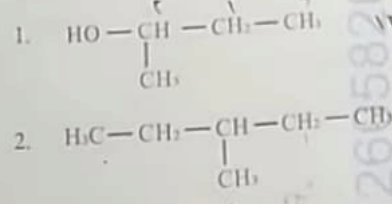
About Organic Chemistry - ICSE-CLASS-X-BOARD
Organic Chemistry is a vital chapter for ICSE-CLASS-X-BOARD aspirants. Mastering the concepts covered in this chapter is essential for securing a top rank.
By rigorously practicing the previous year questions associated with this chapter, you can identify high-yield topics, understand the examiner's perspective, and boost your confidence during the actual exam.
Frequently Asked Questions
Why focus on Organic Chemistry PYQs?
Analyzing PYQs for this specific chapter reveals the most frequently tested concepts and the typical complexity of questions, allowing you to tailor your study plan efficiently.
How to best use this analysis?
Review the topic breakdown to see which sub-topics within Organic Chemistry carry the most weight. Then, tackle the questions iteratively to solidify your understanding.