Which of the following occupies 2 bytes of storage?
1
25
2
AM
3
35.2
4
\textbackslash\textbackslash
Official Solution
Correct Option:
(2)
Step 1: Understanding byte storage. In basic computer representation, each character generally occupies 1 byte of storage in simple character encoding. So, to find which option occupies 2 bytes, we count the number of characters. Step 2: Analyze each option.
25: This contains two digits, but in such school-level questions it is usually treated as a numeric value rather than a two-character text entry.
AM: This contains two characters, A and M. Hence, it occupies 2 bytes.
35.2: This has more than two characters.
\textbackslash\textbackslash: This representation does not match the expected two-byte text answer in the given context.
Step 3: Identify the best answer. Among the given options, AM clearly consists of two characters. Since each character occupies 1 byte, the total storage required is:
Step 4: Conclusion. Therefore, the option that occupies 2 bytes of storage is AM. Final Answer:AM.
02
PYQ 2026
easy
computer-applicationsID: icse-cla
Which of the following is \underline{NOT an access specifier?}
1
private
2
protected
3
package
4
public
Official Solution
Correct Option:
(3)
Step 1: Understand what an access specifier is. An access specifier controls the visibility or accessibility of classes, methods, variables, and constructors in object-oriented programming. It decides from where a member can be accessed. Step 2: Recall the common access specifiers in Java. In Java, the commonly used access specifiers are:
public -- accessible from everywhere.
private -- accessible only within the same class.
protected -- accessible within the same package and also in subclasses.
default -- when no access specifier is written, it is called default or package-private access.
Step 3: Compare the given options.
(A) private: This is a valid access specifier.
(B) protected: This is also a valid access specifier.
(C) package: This is not an actual keyword used as an access specifier. The correct term is default access or package-private access, but package itself is not an access specifier keyword.
(D) public: This is a valid access specifier.
Step 4: Conclusion. Therefore, the option which is \underline{NOT} an access specifier is package. Final Answer:package.
03
PYQ 2026
medium
computer-applicationsID: icse-cla
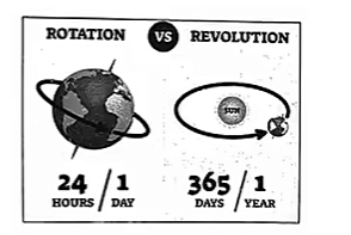
The earth spins on its axis completing one rotation in a day. The earth moves around the sun in 365 days to complete one revolution. What is concept depicted in the given picture?
1
Array
2
Condition
3
Nested loop
4
While loop
Official Solution
Correct Option:
(3)
Step 1: Understand the two repeating motions shown in the picture. The picture shows two repeating processes happening together:
The earth rotates on its own axis once every day.
The earth revolves around the sun once every year.
This means one repeated motion is happening inside another larger repeated motion. Step 2: Relate this to programming logic. In programming, when one loop works inside another loop, it is called a nested loop. Here, daily rotation can be compared to the inner loop, while yearly revolution can be compared to the outer loop. So, many rotations happen during one revolution, just like many inner loop executions happen during one outer loop cycle. Step 3: Compare with the given options.
(A) Array: Incorrect. An array is a collection of elements, not a repeated process.
(B) Condition: Incorrect. A condition checks true or false, but the picture shows repetition.
(C) Nested loop: Correct. One repetitive activity is taking place within another repetitive activity.
(D) While loop: Incorrect. A while loop is a single loop, not a loop inside another loop.
Step 4: Conclusion. Therefore, the concept shown in the picture is nested loop, because one cycle of motion takes place repeatedly inside another larger cycle. Final Answer:Nested loop.
04
PYQ 2026
medium
computer-applicationsID: icse-cla
The full form of JVM is:
1
Java Visible Machine
2
Java Virtual Mode
3
Java Virtual Machine
4
Java Visible Mode
Official Solution
Correct Option:
(3)
Step 1: Understanding the term JVM. JVM is a very common term in computer science, especially in Java programming. It refers to the environment that allows Java programs to run on different systems. Step 2: Expanding the abbreviation. The letters in JVM stand for:
J = Java
V = Virtual
M = Machine So, JVM means Java Virtual Machine. Step 3: Checking the options.
(A) Java Visible Machine: Incorrect. ``Visible'' is not the correct word.
(B) Java Virtual Mode: Incorrect. JVM does not stand for Virtual Mode.
(C) Java Virtual Machine: Correct. This is the standard full form of JVM.
(D) Java Visible Mode: Incorrect. This is not related to Java execution.
Step 4: Conclusion. Therefore, the correct full form of JVM is Java Virtual Machine. Final Answer:Java Virtual Machine.
05
PYQ 2026
medium
computer-applicationsID: icse-cla
In a statement which variable is an accumulator?
1
d
2
c
3
e
4
x
Official Solution
Correct Option:
(2)
Step 1: Understand the meaning of accumulator. An accumulator is a variable that stores a running total. It usually appears on both sides of an assignment statement because its old value is used and then updated with a new value. Step 2: Examine the given statement. The statement is:
Here, the old value of c is taken first. Then some new quantity is added to it. After that, the result is stored again in c. Step 3: Identify the accumulator variable. Since c is the variable that keeps collecting the updated value repeatedly, it acts as the accumulator. The other variables , , and are only used in the calculation and are not storing the running total. Step 4: Conclusion. Therefore, the accumulator variable in the given statement is c. Final Answer:c.
About Programming In Java - ICSE-CLASS-X-BOARD
Programming In Java is a vital chapter for ICSE-CLASS-X-BOARD aspirants. Mastering the concepts covered in this chapter is essential for securing a top rank.
By rigorously practicing the previous year questions associated with this chapter, you can identify high-yield topics, understand the examiner's perspective, and boost your confidence during the actual exam.
Frequently Asked Questions
Why focus on Programming In Java PYQs?
Analyzing PYQs for this specific chapter reveals the most frequently tested concepts and the typical complexity of questions, allowing you to tailor your study plan efficiently.
How to best use this analysis?
Review the topic breakdown to see which sub-topics within Programming In Java carry the most weight. Then, tackle the questions iteratively to solidify your understanding.