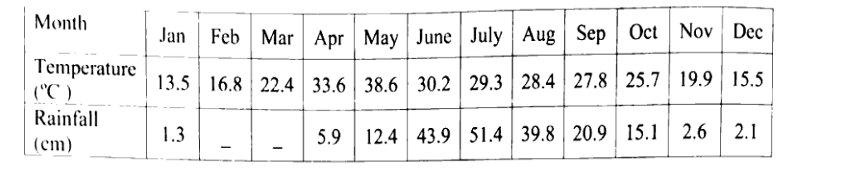
Calculate the total rainfall of the station during the rainy season and give your answer in cm.
Official Solution
Correct Option:
(1)
Step 1: Identify the rainy season.
The rainy season in India generally occurs from June to September. Therefore, we consider the rainfall data from June to September for calculating the total rainfall. Step 2: Total rainfall calculation.
Rainfall during the rainy season is the sum of rainfall from June to September: Thus, the total rainfall during the rainy season is 155.9 cm.
02
PYQ 2026
medium
geographyID: icse-cla
Why is there a decrease in temperature in the month of June after the high temperature of May?
Official Solution
Correct Option:
(1)
Step 1: Influence of rainfall.
The high temperature in May is followed by a decrease in June because the onset of the monsoon brings heavy rainfall. The cooling effect of the rain lowers the temperature, despite the high temperature in May. Step 2: Cloud cover.
Additionally, cloud cover during the monsoon months (especially June) blocks direct sunlight, which also contributes to the drop in temperature.
03
PYQ 2026
medium
geographyID: icse-cla
Shyam attended winter trekking camps in both Nainital and in Ooty. He observed that the mountains in Nainital were ice-covered, whereas, in Ooty, they were ice-free.As a student of Geography, explain the reason for the difference in climate of Nainital and Ooty?
Official Solution
Correct Option:
(1)
Step 1: Difference in altitude.
Nainital is located at a higher altitude (around 2,084 meters above sea level) compared to Ooty, which is situated at a lower altitude (around 2,240 meters above sea level). However, Nainital experiences colder temperatures during the winter due to its position closer to the Himalayas, where the influence of altitude and latitude leads to cooler conditions. Step 2: Influence of geographical location.
The climate in Nainital is also influenced by its proximity to the Himalayas, which receive more snowfall due to their higher elevation and climatic conditions. Ooty, being located in the Nilgiri Hills, experiences a subtropical highland climate with less intense cold, which is why it does not have snow during winter.
04
PYQ 2026
medium
geographyID: icse-cla
If Shyam goes to Kochi in the same season, what difference of climate will he experience?
Official Solution
Correct Option:
(1)
Step 1: Climate of Kochi.
Kochi, located in Kerala on the southwestern coast of India, has a tropical climate. During winter, Kochi experiences mild and pleasant temperatures due to its coastal location. It does not experience snowfall and has higher humidity levels. Step 2: Comparison with Nainital and Ooty.
Compared to Nainital and Ooty, Kochi will be significantly warmer and more humid. While Nainital and Ooty experience cooler temperatures, especially in the winter months, Kochi enjoys a tropical climate with mild winters but no snow or frost.
05
PYQ 2026
medium
geographyID: icse-cla
Is station X located near the sea or away from the sea? Give a reason for your answer.
Official Solution
Correct Option:
(1)
Step 1: Characteristics of station X's climate.
Station X experiences high temperatures in May, followed by a drop in temperature during the rainy season. The significant rainfall from June to September and the moderate temperatures indicate that the station is likely near a large body of water, such as the sea, which helps moderate temperatures and brings monsoon rains. Step 2: Conclusion.
Given these characteristics, it is reasonable to conclude that station X is located near the sea.
06
PYQ 2026
medium
geographyID: icse-cla
Name a state in India which is the first to receive the summer monsoon and is also the last to see its retreat.
Official Solution
Correct Option:
(1)
Step 1: Identify the state.
The state of Kerala in India is the first to receive the summer monsoon and is also the last to see its retreat. Step 2: Explain the monsoon's arrival.
The summer monsoon generally arrives in India in June. Kerala, being located on the western coast, is the first state to receive the monsoon rains. Step 3: Explain the monsoon's retreat.
Kerala also experiences the last retreat of the monsoon, which generally happens around September, after covering the rest of India.
07
PYQ 2026
medium
geographyID: icse-cla
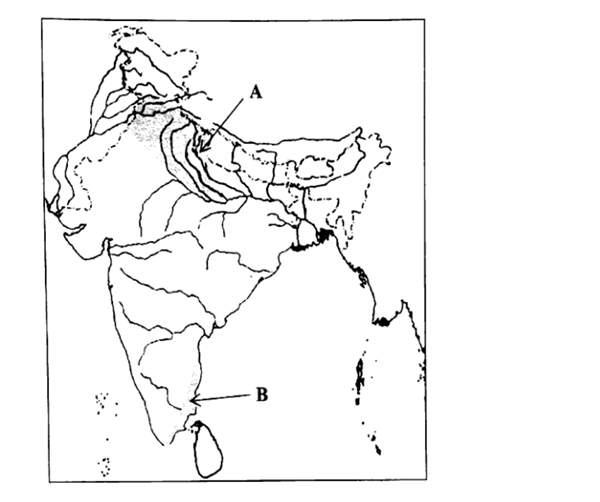
How is the rain brought by the winds named by you in (a) above, beneficial for the area shaded A and the area shaded B?
Official Solution
Correct Option:
(1)
Step 1: Benefits for area A.
The winter rainfall brought by the Western Disturbance is crucial for the rabi crops in the northwestern states of India, including wheat, barley, and mustard. The rainfall helps in the proper growth of these crops. Step 2: Benefits for area B.
The rain brought by the Northeast Monsoon is important for the agricultural activities in the eastern coastal regions, especially for the cultivation of crops like rice, groundnut, and cotton. It also helps in replenishing groundwater levels in the region.
08
PYQ 2026
medium
geographyID: icse-cla
Study the map showing the area that receives rains during winter and answer the questions that follow:(a) Name the wind which brings rainfall to: 1. the shaded area labelled A.
2. the shaded area labelled B.
Official Solution
Correct Option:
(1)
(ii)(a) Winds bringing rainfall
Step 1: Wind bringing rainfall to Area A The wind which brings rainfall to the shaded area A is . These winds originate from the and cause winter rainfall in the northwestern parts of India.
Step 2: Wind bringing rainfall to Area B The wind which brings rainfall to the shaded area B is . These winds blow from the northeast direction and bring rainfall to the eastern coastal regions, especially Tamil Nadu and parts of Andhra Pradesh.
(ii)(b) Benefits of rainfall
Step 1: Benefits for Area A The winter rainfall caused by is very important for such as wheat, barley, and mustard. It supports proper growth and increases agricultural productivity in northwestern India.
Step 2: Benefits for Area B The rainfall brought by the is essential for agriculture in the eastern coastal regions. It helps in the cultivation of crops like rice, groundnut, and cotton. It also recharges groundwater levels in the region.
09
PYQ 2026
medium
geographyID: icse-cla
Mention the weather conditions experienced during the retreating monsoon season.
Official Solution
Correct Option:
(1)
Step 1: Define retreating monsoon.
The retreating monsoon season occurs during the months of September to November, when the monsoon winds start to withdraw from India. Step 2: Weather conditions.
During this season, the weather conditions are characterized by:
- Decreasing rainfall across most parts of the country.
- Clear skies and lower humidity levels.
- Cooler temperatures in northern and central India, with some parts of the south continuing to experience rainfall. Step 3: Changes in air pressure.
The air pressure begins to rise over the landmass as the monsoon winds retreat, causing drier conditions in many areas.
10
PYQ 2026
medium
geographyID: icse-cla
Mawsynram, the rainiest place in the world, gets the rain from:
1
South-west monsoon wind - Arabian Sea branch
2
South-west monsoon wind - Bay of Bengal branch
3
Western Disturbance
4
North-east monsoon wind
Official Solution
Correct Option:
(2)
Step 1: Understanding the rain patterns.
Mawsynram, located in India, receives the most rainfall in the world, primarily from the South-west monsoon winds that originate in the Bay of Bengal.
Step 2: Analysis of other options.
- (A) Incorrect: The Arabian Sea branch does not directly influence Mawsynram.
- (C) Incorrect: Western Disturbances bring winter rain, but Mawsynram's rainfall is more related to the monsoon.
- (D) Incorrect: The North-east monsoon wind does not significantly contribute to Mawsynram's rainfall.
Step 3: Conclusion.
Therefore, the correct answer is (B), as the Bay of Bengal branch of the South-west monsoon winds is responsible for Mawsynram's high rainfall. Final Answer: South-west monsoon wind - Bay of Bengal branch.
About Climate - ICSE-CLASS-X-BOARD
Climate is a vital chapter for ICSE-CLASS-X-BOARD aspirants. Mastering the concepts covered in this chapter is essential for securing a top rank.
By rigorously practicing the previous year questions associated with this chapter, you can identify high-yield topics, understand the examiner's perspective, and boost your confidence during the actual exam.
Frequently Asked Questions
Why focus on Climate PYQs?
Analyzing PYQs for this specific chapter reveals the most frequently tested concepts and the typical complexity of questions, allowing you to tailor your study plan efficiently.
How to best use this analysis?
Review the topic breakdown to see which sub-topics within Climate carry the most weight. Then, tackle the questions iteratively to solidify your understanding.