Why is the component mentioned by you in (a) important for agriculture?
Official Solution
Correct Option:
(1)
Step 1: Role of humus in soil.
Humus is important for agriculture because it improves soil structure, making it looser and better for plant roots to penetrate. It also enhances water retention and drainage in the soil, which is vital for plant growth. Step 2: Nutrient supply.
Humus provides essential nutrients to the plants, such as nitrogen, phosphorus, and potassium, which are necessary for healthy plant growth. It also increases the soil's ability to hold these nutrients, reducing the need for chemical fertilizers.
02
PYQ 2026
medium
geographyID: icse-cla
It is difficult to grow rice in red soil without the help of irrigation.
Official Solution
Correct Option:
(1)
Red soil is typically low in water retention capacity, making it prone to drying out quickly. As rice requires a lot of water for its growth, the lack of moisture retention in red soil makes it difficult to grow rice without irrigation. The soil must be constantly moist for optimal rice growth.
03
PYQ 2026
medium
geographyID: icse-cla
What is soil conservation?
Official Solution
Correct Option:
(1)
Soil conservation refers to the set of practices that are designed to protect the soil from degradation, erosion, and loss of fertility. This is achieved by preventing the loss of soil through natural elements such as wind and water and by maintaining soil health for future agricultural productivity. Step 1: Prevention of soil erosion.
Soil erosion is the removal of the topsoil layer due to wind, water, or human activity. Soil conservation practices prevent this erosion by stabilizing the soil. For example, planting trees or cover crops helps in reducing wind and water erosion. Step 2: Maintenance of soil fertility.
Soil conservation also involves the preservation of soil fertility, which is essential for successful agriculture. Techniques such as crop rotation, the use of organic fertilizers, and minimizing the use of chemical fertilizers help maintain the nutrient levels in the soil. Step 3: Sustainable land use.
Soil conservation practices emphasize sustainable land use, ensuring that the land remains productive over the long term. This can include proper water management, controlled grazing, and preventing over-cultivation or deforestation.
04
PYQ 2026
medium
geographyID: icse-cla
Name two methods of soil conservation practised in India.
Official Solution
Correct Option:
(1)
Soil conservation methods are used across India to reduce soil erosion, improve soil fertility, and enhance agricultural productivity. Two widely practised methods of soil conservation in India are: Step 1: Terracing.
Terracing is a method used in hilly areas where the land is divided into a series of flat steps. This helps to reduce the speed of water runoff, preventing soil erosion. The flat surface allows for better water retention and provides more space for crops to grow. Terracing is common in the hilly regions of Himachal Pradesh, Uttarakhand, and parts of the Western Ghats. Step 2: Contour Ploughing.
Contour ploughing involves ploughing the land along the contours of the slopes, rather than up and down the hill. This helps to reduce water runoff and allows the soil to retain moisture better. It also reduces the erosion of topsoil and is commonly practised in regions with gentle slopes. This method is used in states like Madhya Pradesh, Maharashtra, and Andhra Pradesh.
05
PYQ 2026
medium
geographyID: icse-cla
Name two areas in north India where soil conservation is required.
Official Solution
Correct Option:
(1)
Soil conservation is crucial in areas that are prone to soil erosion, often due to heavy rainfall, hilly terrain, or deforestation. In north India, two areas where soil conservation is particularly needed are: Step 1: Himachal Pradesh.
Himachal Pradesh is a mountainous state that faces severe soil erosion due to its steep terrain and heavy rainfall during the monsoon season. Soil conservation techniques such as terracing and afforestation are needed to reduce erosion and preserve soil fertility. The region's agriculture is dependent on the fertile soil, making soil conservation efforts vital for sustaining crop production and reducing landslides. Step 2: Uttarakhand.
Uttarakhand, known for its hilly terrain and rich biodiversity, is another region in north India where soil conservation is required. The deforestation and overgrazing in the state have caused significant soil erosion. Moreover, heavy rains during the monsoon further contribute to the soil loss. To prevent this, methods such as contour ploughing, terracing, and afforestation are crucial to stabilize the soil and improve its water retention capacity.
06
PYQ 2026
medium
geographyID: icse-cla
In arid regions, trees are planted in rows perpendicular to wind direction.
Official Solution
Correct Option:
(1)
In arid regions, trees are planted perpendicular to the wind direction to reduce the wind speed and minimize soil erosion. This arrangement helps in reducing the loss of moisture from the soil by shielding the land from strong winds, which are common in such areas.
07
PYQ 2026
medium
geographyID: icse-cla
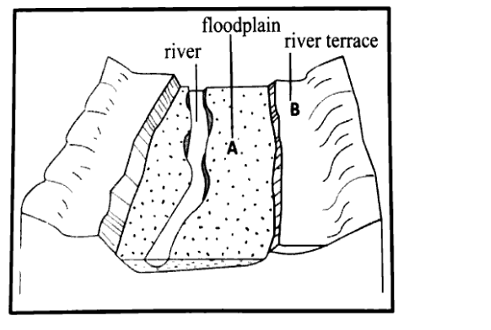
Observe the picture of ex-situ soil given below and answer the questions that follow:
Official Solution
Correct Option:
(1)
Step 1: Identify the soil types marked as A and B.
In the given diagram, the soil marked as A is \textit{Floodplain soil}, and the soil marked as B is \textit{River terrace soil}. Step 2: Describe Floodplain soil (A).
Floodplain soil is deposited by river floods, characterized by fine, alluvial material. It is rich in nutrients and is often used for agriculture due to its fertility. Step 3: Describe River terrace soil (B).
River terrace soil is found on raised riverbanks and terraces formed by the periodic movement of rivers. It has well-drained, coarse-textured soil that is less fertile than floodplain soil due to its limited nutrient availability. Step 4: Which soil is more fertile and why?
The soil marked as A (Floodplain soil) is more fertile than the soil marked as B (River terrace soil). This is because floodplain soil is frequently replenished with fresh, nutrient-rich deposits during floods, making it more suitable for agricultural use.
08
PYQ 2026
medium
geographyID: icse-cla
Name the soil component derived from the decay of dead plants and animals.
Official Solution
Correct Option:
(1)
The soil component derived from the decay of dead plants and animals is called humus. It is an organic material that contributes to soil fertility by providing essential nutrients.
09
PYQ 2026
medium
geographyID: icse-cla
Choose the characteristic that is true about Laterite soil:
1
It is a clayey soil.
2
It is moisture retentive.
3
It is rich in calcium.
4
It undergoes desiccation.
Official Solution
Correct Option:
(4)
Step 1: Understanding Laterite soil.
Laterite soil is rich in iron and aluminum and undergoes desiccation (drying out) under high temperature and low rainfall conditions.
Step 2: Analysis of other options.
- (A) Incorrect: Laterite soil is not clayey but rather coarse in texture.
- (B) Incorrect: Laterite soil is not moisture-retentive; it is usually dry due to its nature.
- (C) Incorrect: Laterite soil is not particularly rich in calcium, but it contains iron and aluminum.
Step 3: Conclusion.
The correct answer is (D), as Laterite soil undergoes desiccation in dry conditions, leading to its hardened structure. Final Answer: It undergoes desiccation.
About Soils - ICSE-CLASS-X-BOARD
Soils is a vital chapter for ICSE-CLASS-X-BOARD aspirants. Mastering the concepts covered in this chapter is essential for securing a top rank.
By rigorously practicing the previous year questions associated with this chapter, you can identify high-yield topics, understand the examiner's perspective, and boost your confidence during the actual exam.
Frequently Asked Questions
Why focus on Soils PYQs?
Analyzing PYQs for this specific chapter reveals the most frequently tested concepts and the typical complexity of questions, allowing you to tailor your study plan efficiently.
How to best use this analysis?
Review the topic breakdown to see which sub-topics within Soils carry the most weight. Then, tackle the questions iteratively to solidify your understanding.